
dates unknown·Feast None recorded
St. Blida
Anglo-Saxon princess, mother of St. Walstan
Overview
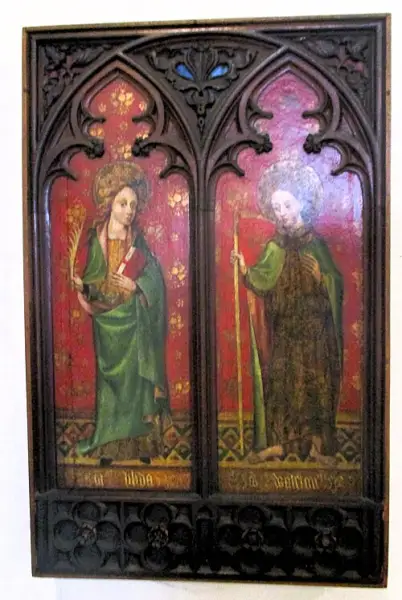
Blida — recorded under the name Blithe in certain documents — was a princess of the Anglo-Saxons, best remembered as the mother of Saint Walstan, the patron saint of farm labourers whose medieval cult drew pilgrims across the county of Norfolk. She belonged to the highest rank of English royalty: she was a kinswoman of King Æthelred the Unready and of his son Edmund Ironside, and her husband is named as Benedict, himself of royal descent. The couple lived at Bawburgh, the Norfolk vill where their son Walstan was born, and it was from Blida's household that the boy set out, at the age of twelve and with his parents' consent, upon the life of prayer and labour that made him famous. Blida's own sanctity was honoured after her death: she was buried at Martham in Norfolk, where a chapel was dedicated in her name and where bequests were made to her shrine for more than four hundred years. The south aisle chapel of the parish church there remains a prayer corner in her honour. Medieval artists portrayed her crowned, holding book and palm, on rood screens and in church windows, and the village of Martham still counts her among its own.
The Complete Life
A Princess of the English Royal House
Blida was born into the troubled grandeur of the late Anglo-Saxon monarchy. The sources record her as a kinswoman of Æthelred the Unready, the king whose long reign was shadowed by Danish invasion, and of his son Edmund Ironside, the warrior who fought Cnut to a standstill before his early death. To be of that kin was to stand near the centre of a kingdom under assault, and it gave Blida a rank that medieval writers never forgot: on the rood screen at Norwich she was painted with her crown, and in the genealogies of her son's cult she is always the princess, the woman of royal blood whose son renounced his inheritance. Her husband is named as Benedict, himself described as a king or of kingly line in the traditions that grew around the family. The couple made their home at the vill of Bawburgh, west of Norwich, a modest seat for people of such lineage, and there their son Walstan was born. The household was evidently a devout one, ordered toward prayer and almsgiving, for the boy who left it at twelve to devote himself to God did so with the full permission of both parents — a detail that says much about the spirit in which Blida raised him.
§ Life
The Mother Who Let Her Son Go
Blida's chief work in the story of Norfolk sanctity was the gift of her son. When Walstan was twelve years old he renounced the life of privilege into which he had been born and determined, with the consent of his parents, to give himself to a life of prayer — though not, as the sources are careful to say, within the walls of a monastery. He went out instead to labour as a farm worker among the villagers of Taverham, and the legends that gathered round him always returned to the strangeness of that choice: a king's son, as one account insists he was, forsaking a court for the scythe and the cart. Behind that renunciation stood his mother. The medieval Life records the contract of permission granted by the parents, and in doing so it makes Blida a figure for every Christian parent asked to release a child into God's hands. She had borne royal blood and passed it to her son; she then watched him lay it down, and she blessed what she could not keep. The anonymity of her later years — the records trace Walstan's labours and miracles in detail but say little more of her — only sharpens the picture of a woman whose sanctity was lived in the unfashionable vocation of a mother whose son became a saint.
§ Life
Martham, the Chapel, and the Painted Crown
Blida's own cult centred on the village of Martham, in the farming country of east Norfolk, where she died and was buried. A chapel was dedicated in her honour there, and the record of bequests shows that the faithful of the region remembered her at their deaths for more than four hundred years — an unusually long continuity of offering for a saint who never received a formal feast day and whose life left no written legend of its own. The parish church of Martham keeps the memory to this day: its south aisle chapel is maintained as a place of prayer in her honour, and she may lie buried there still, her grave belonging to the eleventh century. Medieval artists gave her a place beside her more famous son. On a rood-screen panel painted in the Middle Ages, once at the Pockthorpe church of St James the Less in Norwich, Blida appears crowned, holding a book and the palm of sanctity; a chancel window at North Tuddenham showed her likewise. She is listed among the saints of Anglo-Saxon England as Blida of Martham, the mother of Walstan of Bawburgh, and it is a fitting pairing: the princess who stayed, and the labourer who went out, both honoured by the same Norfolk countryside that has never quite forgotten either of them.
§ Life
The Record
- Patron of
- Martham, Norfolk
- Symbols
- crown·book·palm
- Canonization
- Pre-Congregation; her cult was celebrated in Norfolk during the Middle Ages
Prayer
Bibliography
Show 5 sources
- Twinch, Carol (2015). Saint Walstan: The Third Search. Media Associates. ISBN 978-0-9521499-4-1.
- Blair, John (2002). "A Handlist of Anglo-Saxon Saints". In Thacker, Alan; Sharpe, Richard (eds.). Local Saints and Local Churches in the Early Medieval West. Oxford: Oxford University Press. ISBN 9-780-19820-394-0.
- Farmer, David Hugh (2011). The Oxford Dictionary of Saints. Oxford: Oxford University Press. ISBN 9-780-19959-660-7.
- Stanton, Richard (1887). A Menology of England and Wales. London: Burns & Oates. OCLC 982778548.
- "Blida". Oxford Reference. Oxford University Press.
Profile text adapted from the Wikipedia article, licensed CC BY-SA 4.0.
Pray with this saint every day
Save St. Blida to your favorites, read the full profile, and get feast-day reminders in the Saints app.
Get the Saints AppFree on the App Store for iPhone and iPad