
died 7th century·Feast June 2
St. Bodfan
Welsh Monk of Bardsey and Founder of Llanaber
Overview
Bodfan, also spelled Bodfaen, was a Welsh holy man of the seventh century, honored by both the Catholic Church and the Anglican Communion and kept on 2 June. He was a son of Helig ap Glanawg, a figure of the old Welsh genealogies. The tradition attached to him tells of a catastrophe: the sea is said to have swept over and drowned the family lands, and the shock of that loss turned him toward the religious life. He went on to embrace monastic living on Bardsey Island, the renowned haven of Welsh monks off the Llŷn coast, and afterwards raised the first church at Llanaber on the Meirionnydd shore. Three of his brothers — Brothen, Celynin and Rhichwyn — are likewise counted among the saints, and churches bearing their names stand across Gwynedd and Conwy. Bodfan remains the patron of several churches in north-west Wales, above all St Mary and St Bodfan at Llanaber and St Bodfan at Abergwyngregyn. Near Llanaber two great carved stones of the fifth and sixth centuries, known locally as St Bodfan's Stones, keep his memory.
The Complete Life
A Son of Helig ap Glanawg
Bodfan — the name also appears as Bodfaen — belonged to the seventh-century Welsh church and to a family already woven into its story. He was a son of Helig ap Glanawg, and the tradition preserved about him begins not with a miracle but with a drowning. The sea, it is said, rose and swallowed the lands his family held. Whatever historical event may lie behind the tale — the Welsh chronicles tell of a flooded tract in the north — the story shaped his vocation: confronted with the loss of an earthly inheritance, he chose a heavenly one and became a religious. That pattern, ruin turned to renunciation, gave later generations a plain reading of his life. He stands at the meeting of old Welsh princely lineage and the monastic movement that was then spreading through the western seaboard of Britain. No birth year survives, only the century of his death, and it is from his kin rather than from a rule or a see that his place in the genealogy of the saints is fixed. Three of his brothers — Brothen, Celynin and Rhichwyn — are venerated as saints as well, and the churches raised under their names around Gwynedd and Conwy mark a family whose holiness was remembered collectively by the people of north Wales.
§ Biography
Monk of Bardsey, Builder at Llanaber
Bodfan's religious life led him first to Bardsey Island, the monastic refuge off the Welsh coast where many of the early Welsh saints are said to have ended their days as members of its community. He became a monk there, joining a brotherhood whose austerity and remoteness made it a symbol of the ascetic ideal in early medieval Wales. From Bardsey his path returned to the mainland: he went on to establish the first church at Llanaber, on the coast of what is now Gwynedd. That foundation is his principal monument, and it grew into the parish whose dedication still carries his name — St Mary and St Bodfan Church at Llanaber, a building of early Welsh stonework that looks out over Cardigan Bay. No companions, no miracles and no writings are attached to this stage of his life; what remains is the plain sequence of a monastic vocation lived out in two places, an island and a shore. A second church, St Bodfan at Abergwyngregyn in Caernarfonshire, also bears his dedication, extending his cult from the Meirionnydd coast into the heartland of Gwynedd. Together these foundations frame a mission that was local, enduring and still visible in the landscape and life of the Church in Wales.
§ Biography
Patron of the Churches of Gwynedd
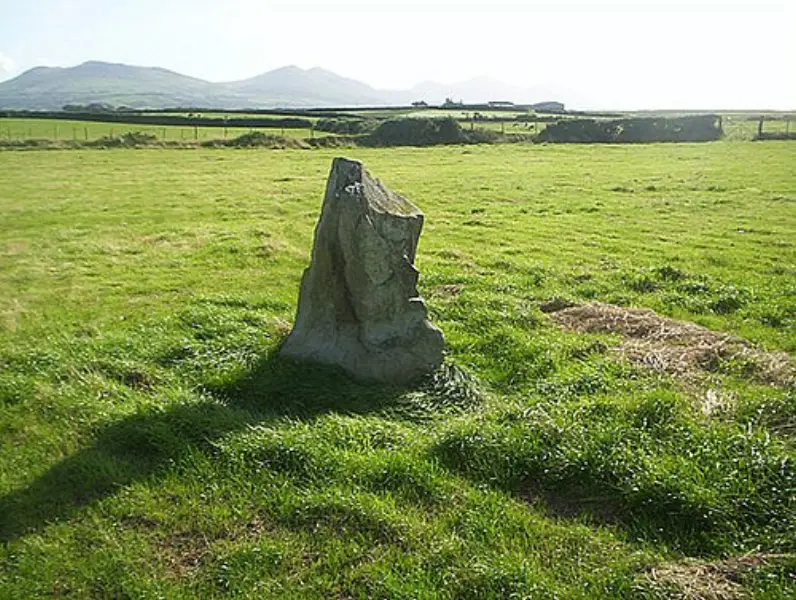
Bodfan's afterlife in the devotion of north-west Wales rests on the churches that keep his patronage. He is named patron of many churches in Gwynedd, among them St Mary and St Bodfan Church in Llanaber and St Bodfan Church in Abergwyngregyn, and his feast is observed on 2 June. His memory is also carried by stones rather than buildings alone: close to Llanaber, about a kilometre from the church, stand two very large rocks bearing Latin inscriptions carved in the fifth and sixth centuries. Locally they are known as St Bodfan's Stones, and their ancient lettering has attached itself to the saint's name even though the carvings predate him by a century or more. The Llanaber Stones remain a landmark of the district and a reminder of how deeply Christian memory is layered into the Welsh countryside. Alongside his own cult stand those of his brothers Brothen, Celynin and Rhichwyn, whose dedications reach around Gwynedd and Conwy, so that the family's holiness is written across a whole region rather than a single site. Venerated in the Catholic Church and the Anglican Communion alike, Bodfan belongs to that broad company of early Welsh saints whose witness survives not in treatises but in dedications, place-names and an annual feast still kept at the beginning of summer.
§ Legacy
The Record
- Major works
- First church at Llanaber
- Patron of
- Patron of Llanaber·Patron of Abergwyngregyn
- Symbols
- Monastic habit of Bardsey
- Canonization
- Pre-congregation Welsh saint venerated in the Catholic Church and the Anglican Communion
Prayer
Bibliography
Show 4 sources
- St Bodfan, Catholic Online, retrieved 8 June 2013
- Megalithic.co.uk, retrieved 8 June 2013
- Abergwyngregyn.co.uk, retrieved 8 June 2013
- Benefice of Llanaber with Barmouth and Caerdeon with Bontddu, retrieved 8 June 2013
Profile text adapted from the Wikipedia article, licensed CC BY-SA 4.0.
Pray with this saint every day
Save St. Bodfan to your favorites, read the full profile, and get feast-day reminders in the Saints app.
Get the Saints AppFree on the App Store for iPhone and iPad