
c. 480 – 524·Feast October 23
St. Boethius
Philosopher, Senator and Martyr of the Ostrogothic Court
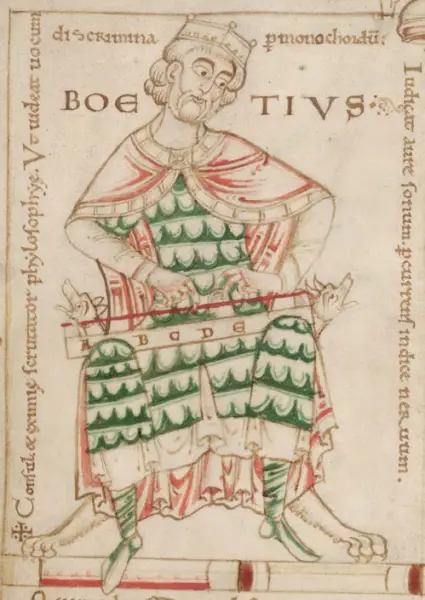
Overview
Anicius Manlius Severinus Boethius, born in Rome around 480 into the patrician Anicii gens shortly after the last Western emperor was deposed, was a senator, consul and magister officiorum under Theodoric the Great, and the most learned Latin Christian of his century. Orphaned young, he was raised by the patrician Symmachus, who introduced him to philosophy and literature; he mastered Greek at a time when few in the West could read it. His life project was to carry Greek learning into Latin: he translated Aristotle's logical works and Porphyry's Isagoge, adapted Nicomachus on arithmetic, wrote an unfinished textbook on music, and composed five theological treatises defending the Nicene faith against Arianism, Nestorianism and Eutychianism. His logic remained the only substantial Aristotle available in the West from the sixth century until the twelfth, earning him the title of the last Roman philosopher and first scholastic theologian. Serving Theodoric, he denounced corruption at court; after defending the ex-consul Albinus from a charge of treasonable correspondence with Constantinople, he was himself accused, imprisoned at Pavia and executed in 524. In prison he wrote On the Consolation of Philosophy, a dialogue with Lady Philosophy on fortune and providence that became among the most copied books of the Middle Ages. Venerated as a martyr, he rests in San Pietro in Ciel d'Oro at Pavia, beside Augustine.
The Complete Life
Last Son of the Roman Aristocracy
Boethius was born in Rome around 480, some years after Romulus Augustulus had been forced from the throne and the line of Western emperors closed. His family, the Anicii, was among the wealthiest and most powerful gentes of the late empire, counting emperors and many consuls among its members; yet its fortunes had sharply declined before his birth. His grandfather, a senator of the same name who had served as praetorian prefect of Italy, perished in 454 in the palace plot against Flavius Aetius. His father Manlius Boethius, consul in 487, died while the boy was still a child. Orphaned into a house of diminished influence, he was adopted and raised by Quintus Aurelius Memmius Symmachus, a patrician and later consul who introduced him to philosophy and literature. The adoption proved decisive: the Symmachi gave him tutors, a command of both Latin and Greek — a skill increasingly rare in the West — and eventually a wife, Rusticiana, his foster-father's daughter, by whom he had two sons named Symmachus and Boethius. Whether he acquired his Greek in the East has long been debated. Edward Gibbon's old claim of eighteen years of study in Athens rests, most now agree, on a misreading of Cassiodorus's letters; Pierre Courcelle argued for Alexandria and the Neoplatonist Ammonius Hermiae, while John Moorhead cautions that the evidence is weaker than it looks and that such learning could be had without travel. The question remains open; the fluency itself does not.
§ Early life
The Plan of a Lifetime: Translate the Greeks
Boethius gave his scholarly career a program of extraordinary ambition: to render the whole of Plato and Aristotle into Latin for Western readers, and so to hand classical philosophy to a world that was losing the language of its birth. He never finished. What he completed changed Europe anyway. His versions of Aristotle's logical corpus — the Categories, De interpretatione, Prior Analytics, Topics and Sophistical Refutations — together with two commentaries on Porphyry's Isagoge, formed the only substantial Aristotle that Latin Christendom possessed between the sixth century and the twelfth-century recovery of his works, and it is largely through him that the Philosopher's work survived to be rediscovered. Around 500 he adapted Nicomachus's arithmetic as De arithmetica; around 510 he produced his unfinished De institutione musica, built on Nicomachus and Ptolemy, which taught the Middle Ages Greek music theory and its famous threefold division of music: of the cosmos, of the human person, and of instruments. His manuals of the quadrivium shaped medieval schooling for centuries, and R. W. Southern named him the schoolmaster of Europe. In logic he composed original treatises on categorical and hypothetical syllogisms, on division, and on topical argument — In Ciceronis Topica and De topicis differentiis — in which he distinguished maximal propositions from their differentiae and fashioned a doctrine of argument that governed dialectic down to Ockham and Buridan. He also left five theological treatises, the Opuscula sacra, defending Chalcedonian orthodoxy against Arian, Nestorian and Eutychian error.
§ Major works
Statesman Under Theodoric
Taking his model from Plato's Republic, in which philosophers are called to govern, Boethius left his books for the service of Theodoric the Great. The two had met around 500, during the Ostrogothic king's half-year stay in Rome, and Theodoric evidently took to the young scholar at once. His rise was rapid: a senator by twenty-five, consul by 510, and in 522 head of the government as magister officiorum, master of all palace and administrative affairs. His earliest recorded services were practical and various — investigating charges that the paymaster of the royal bodyguard had debased his men's coin, building a waterclock for Theodoric to send to Gundobad of the Burgundians, and recruiting a lyre-player to perform before Clovis of the Franks. The summit of his fortunes came in 522, when both his sons were named consuls together, representing the whole Roman Empire, an honor made more striking because the Byzantine emperor Justin I yielded his own nomination in goodwill. Boethius wrote that he sat between the two young consuls as though at a triumph, his generosity meeting the crowds' wildest hopes. Yet the same office exposed him. He set himself against the corruption of the court: he thwarted the schemes of Triguilla, steward of the royal household, confronted the Gothic minister Cunigast, who devoured the substance of the poor, and used the king's authority to stop a grain shipment from Campania that would have deepened a famine. His integrity made him enemies on every side of the palace, even while he kept the king's confidence.
§ Rise to power
Verona, Pavia and the Prison Book
The end came swiftly. In 520 Boethius had been laboring to mend relations between the Roman See and Constantinople, a diplomatic task that may have first cost him standing with an Arian king suspicious of Nicene rapprochement. In 523, at a Royal Council at Verona, the referendarius Cyprianus accused the ex-consul Albinus of treasonable correspondence with Justin I. Boethius rose in Albinus's defense, declaring that if Albinus had written to Constantinople, then he and the whole senate had done so with him — words that turned the accusation on himself. Cyprianus produced three witnesses — men Boethius describes as disgraced debtors and exiled fraudsters, though Cassiodorus remembered some of them as scrupulous and loyal — and Boethius and Basilius were taken. Held first in a church baptistery, then banished to the distant estate called Ager Calventianus, he was condemned and killed in 524. The sources disagree on the manner of his death — beheading, clubbing or the rope; the likeliest account has him tortured with a cord tightened about his head and bludgeoned before his skull was broken. No proof of any crime ever emerged, and Procopius and many later historians judged the condemnation unjust. In captivity he wrote the book that outlived the empire that killed him: On the Consolation of Philosophy, a prose-and-verse dialogue with Lady Philosophy on fate, free will, and a providence that fortune's turning wheel cannot disturb. Not long after, Theodoric put Symmachus to death as well and confiscated the family's wealth, leaving Rusticiana in poverty.
§ Downfall and death
A Martyr's Crown, Slowly Granted
The generations that followed Boethius in death regarded him as a Christian martyr, executed by an Arian king in the course of defending the senate and, in the tradition's reading, the orthodox faith. He is included in the Roman Martyrology, honored there as a saint and martyr of the Christian faith, though some modern students of the martyrologies, Basil Watkins among them, have called the martyrdom doubtful on the strictest reading of the evidence. His cult has been kept chiefly in two places: at Pavia, where his remains lie in San Pietro in Ciel d'Oro — the golden-roofed church of Saint Peter that also holds Augustine of Hippo — and at the church of Santa Maria in Portico in Rome; in parts of Italy he is honored under the name Saint Severinus, after Severinus of Noricum, whom he was named to commemorate. The decisive formal step came in 1883, when the Sacred Congregation of Rites approved the cult Pavia had long paid him locally, confirming the custom of observing his feast on 23 October, a date some give as the day of his death. In the current Martyrologium Romanum his commemoration remains restricted to that diocese. Pope Benedict XVI later pointed to Boethius as a teacher for contemporary Christians, tying his thought to an understanding of providence. His honor, then, is real but local: a saint of Pavia, acknowledged by Rome for that church's altar rather than for the universal calendar.
§ Veneration
The Schoolmaster of Medieval Europe
Edward Kennard Rand's famous formula — the last of the Roman philosophers, and also the first of the scholastic theologians — fixes Boethius at the hinge between antiquity and the Middle Ages. Though his mathematical texts served the early universities, it is the Consolation that secured his fame: composed in prose and verse, it teaches acceptance of hardship in philosophical detachment from misfortune, and its Socratic movement, in which Lady Philosophy questions and corrects the prisoner's despair, gave medieval readers a model of consolation they never tired of copying. King Alfred translated it into Old English; Chaucer and Queen Elizabeth into English; manuscripts survive in great numbers and editions poured from the European presses from the fourteenth century onward. Its central image, the wheel of fortune, became one of the most familiar emblems of the age, painted and carved across Europe and echoed in the Romance of the Rose and in Chaucer. His De topicis differentiis furnished the matter for one of the first logic books in a western vernacular, rendered into Old French by John of Antioch in 1282, and his topical theory shaped the logic of Ockham and Buridan, of Albert of Saxony and the Pseudo-Scotus. Dante set his spirit among the blessed, pointed out by Thomas Aquinas; C. S. Lewis invoked him in the Screwtape Letters; a lunar crater bears his name. Johannes Fried's verdict stands: the West owes this one man nothing less than its progress toward a culture of reason.
§ Legacy
Timeline
- 480
Born in Rome to the Anicii family shortly after the abdication of Romulus Augustulus
§ Early life
- 487
His father Manlius Boethius, consul in this year, dies while the boy is young; Symmachus adopts and educates him
§ Early life
- 500
Meets Theodoric the Great during the king's six-month stay in Rome; enters his service and completes De arithmetica
§ Rise to power
- 510
Reaches the consulship, having become a senator by age 25; his textbook De musica is written around this time
§ Rise to power
- 513
Composes Contra Eutychen et Nestorium, the earliest of his five theological treatises
§ Opuscula sacra
- 520
Works to restore relations between the Roman See and Constantinople; writes De Trinitate about this time
§ Downfall and death
- 522
Both his sons are named consuls with imperial endorsement and he is elevated to magister officiorum
§ Rise to power
- 523
Defends Albinus at Verona, is accused of treason, and is imprisoned at Pavia; De topicis differentiis dates from these years
§ Downfall and death
- 23 Oct 524
Tortured and executed at the Ager Calventianus; De consolatione Philosophiae is written awaiting death
§ Downfall and death
- 526
His foster-father and father-in-law Symmachus is also put to death by Theodoric
§ Notes
- 1883
The Sacred Congregation of Rites confirms the cult of Boethius as a saint in the Diocese of Pavia
§ Veneration
In Their Own Words
The charge of Cyprianus is false, but if Albinus did that, so also have I and the whole senate with one accord done it; it is false, my Lord King
Music is so naturally united with us that we cannot be free from it even if we so desired
The young philosopher Boethius, a man whose varied accomplishments adorned the middle period of the reign of Theodoric, and whose tragic death was to bring sadness over its close
If you expect a physician to help you, you must lay bare your wound.
In every adversity of fortune, to have been happy is the most unhappy kind of misfortune.
Nothing is miserable but what is thought so, and contrariwise, every estate is happy if he that bears it be content.
Who can give law to lovers? Love is a greater law to itself.
What place can be left for random action, when God constraineth all things to order?
The Record
- Major works
- On the Consolation of Philosophy (De consolatione philosophiae)·De arithmetica (On Arithmetic)·De institutione musica (Fundamentals of Music)·De topicis differentiis and In Ciceronis Topica·Translations of Aristotle's Organon and Porphyry's Isagoge·Opuscula sacra: De Trinitate, De fide catholica, Contra Eutychen et Nestorium and other theological treatises
- Patron of
- Patron of the Diocese of Pavia
- Symbols
- The wheel of fortune·Lady Philosophy personified as a crowned woman·Prison bars, writing in captivity
- Canonization
- Pre-congregation martyr; his local cult in the Diocese of Pavia was sanctioned by the Sacred Congregation of Rites in 1883, confirming the custom of honoring him on 23 October
Prayer
Bibliography
Show 10 sources
- Barrett, Helen (1940). Boethius: Some Aspects of His Times and Work. Cambridge University Press. ISBN 978-1107415768
- Marenbon, John (2003), Boethius, Great Medieval Thinkers, Oxford: Oxford University Press, ISBN 978-0195134070
- Hodgkin, Thomas (1894). Theodoric the Goth. G. P. Putnam's Sons
- Fried, Johannes (2015). The Middle Ages (3rd ed.). Cambridge, MA: Harvard University Press. ISBN 978-0-674-055629-9
- Kaylor, Noel; Philips, Philip (2012). A Companion to Boethius in the Middle Ages (1st ed.). Brill Publishers. ISBN 978-90-04-183544
- Stump, Eleonore (1978). Boethius's De topicis differentiis. Cornell University Press. ISBN 978-0801489334
- Matthews, John (1981). "Anicius Manlius Severinus Boethius". Boethius: His Life, Thought and Influence. Wiley-Blackwell. pp. 15–44. ISBN 978-0631111412
- Watkins, Basil (2016). The Book of Saints. St. Augustine's Abbey of Ramsgate, England (8th ed.). London: Bloomsbury. ISBN 978-0567664150
- Marenbon, John (2016), "Anicius Manlius Severinus Boethius", Stanford Encyclopedia of Philosophy, retrieved 23 October 2017
- Pope Benedict XVI (12 March 2008), Boethius and Cassiodorus, archived from the original on 28 December 2008, retrieved 4 November 2009
Profile text adapted from the Wikipedia article, licensed CC BY-SA 4.0.
Pray with this saint every day
Save St. Boethius to your favorites, read the full profile, and get feast-day reminders in the Saints app.
Get the Saints AppFree on the App Store for iPhone and iPad