
2 May 1647 – 1 August 1654·Feast July 24
St. Bogolep of Chorny Yar
Child Schema-Monk and Venerable Wonderworker of the Volga
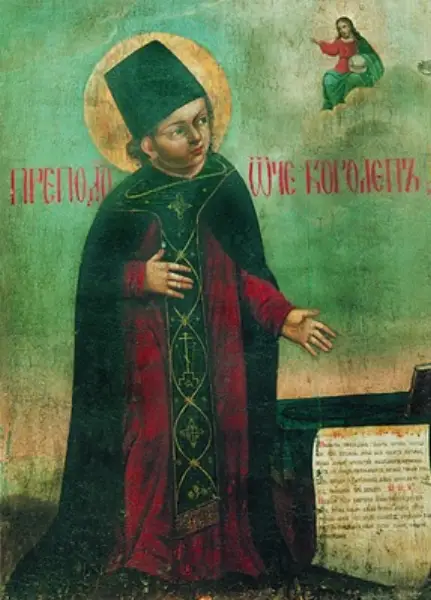
Overview
Bogolep of Chorny Yar, born Boris Yakovlevich Ushakov in Moscow on 2 May 1647, was a Russian Orthodox child schema-monk who died at the age of seven and is venerated as a locally canonized saint with the title of Venerable. He came from the old and influential Ushakov family, making him a distant kinsman of two later saints, the hieromonk Theodore of Sanaksar and the admiral Fyodor Ushakov; his father was the boyar Yakov Lukich Ushakov, appointed voyevoda of Chorny Yar in 1651. The Life records extraordinary childhood piety: as an infant Boris kept the Wednesday and Friday fasts and wept at the sound of the church bell until he was carried to the services. His health, however, was frail. At seven an ulcer appeared on his leg, which healed only for ulcerous sores to break out on his face. Struck by the vestments of a wandering monk he had seen, the child asked his parents to have his hair cut in the monastic manner, promising he would then recover; they consented, and he was tonsured into the great schema under the name Bogolep, the Russian form of the Greek Theoprepius. He was well the next day, but a day later fever struck and he died that same day, on 1 August 1654. Buried beside the church of the Resurrection of the Lord at Chorny Yar, he is honored on 24 July and the second Sunday after Pentecost, and is invoked as patron of Astrakhan Oblast and of sick children.
The Complete Life
A Boyar's Son in Moscow
Boris Yakovlevich Ushakov was born in Moscow on 2 May 1647 into the old and influential Russian house of the Ushakovs, a lineage that would later give the church two more saints: the hieromonk Theodore of Sanaksar and the admiral Fyodor Ushakov, both distant relatives of the child. His father, Yakov Lukich Ushakov, served as a boyar at the Muscovite court; his mother was Yekaterina Vasilyeva Ushakova. At baptism he received the name Boris in honor of Prince Boris Vladimirovich. The earliest pages of his Life describe a piety out of all proportion to his years. While still a baby he was said to observe the fasting days appointed for Wednesdays and Fridays, refusing food in the manner of an adult ascetic, and the sound of the church bell would move him to tears — a signal, the hagiographer explains, that he wished to be carried to the services. Such stories belong to a recognizable tradition of child sanctity in Russian hagiography, in which divine favor announces itself through a child's precocious discipline, and they should be read as the Life's own idiom rather than as chronicle. What stands behind them is nonetheless a family firmly placed within the Muscovite elite and a boy whose frail constitution and religious sensitivity marked him out early. In 1651 the family's fortunes carried him south, when his father received appointment as voyevoda — military and administrative governor — of Chorny Yar, the frontier fortress town on the Volga in what is now Astrakhan Oblast.
§ Life
The Tonsure of a Seven-Year-Old
Boris's childhood was shadowed by illness. His health was very poor, and around the age of seven an ulcer broke out on his leg; it soon healed, but only for a fresh affliction the Life calls "chechui" — ulcerous sores spreading across his face. In the midst of this sickness came the encounter that decided everything: the boy saw a wandering monk and was captivated by his vestments, the outward sign of the monastic profession. Boris begged his parents for the monastic cutting of his hair, promising that once it was done he would be well again. The request was extraordinary — a child of seven asking for the monastic tonsure — yet his parents agreed, and the boy was tonsured into the schema, the strictest and most solemn grade of Orthodox monastic profession, receiving the name Bogolep, the Russian rendering of the Greek Theoprepius, meaning "fitting for God." That a mortally ill child should seek the angelic habit, and that his family should grant it, belongs to the devotional world of seventeenth-century Russia, where the schema was both a vow and a consecration for the journey to death. According to the Life, the tonsure was followed at once by healing: on the day after taking the veil, Bogolep was well. The recovery proved brief. A day later fever set in, and the child schema-monk died that same day. The Life reads the sequence as a sign — the boy had asked for the habit not for a longer life in this world but for a blessed passage out of it, and his request, in the hagiographer's telling, was granted in full.
§ Life
Death and Burial at Chorny Yar
Bogolep died on 1 August 1654 at Chorny Yar, aged seven, only days after receiving the schema. His passing closed a short life that the Life presents entirely in the light of that final act: the sick child, the wandering monk's vestments, the tonsure, the one day of health, the fever. He was buried beside the church built in honor of the Resurrection of the Lord at Chorny Yar, and devotion at the graveside grew to the point that a chapel was later raised over the tomb, so that the boy's grave became a fixed station of local prayer. The dating of his death is not perfectly secure: different versions of the Life give the year as 1654 or as 1659, and the earlier of the two is generally judged the better fit with the hagiographic history. The uncertainty is itself a reminder of how local and informal his cult remained for two and a half centuries, sustained by the memory of Chorny Yar's families rather than by formal recognition. His kinship with the Ushakov house gave the story a wider currency in Muscovite society, and the image of the tonsured boy — fixed in a nineteenth-century icon type — made him one of the most tender figures in the Russian calendar of child saints, a schema-monk younger than the novices who tended his grave.
§ Life
Locally Canonized in 1918
Bogolep's formal glorification came in 1918, when the Russian Orthodox Church canonized him as a locally venerated saint — a category of recognition limited to a particular diocese or region rather than extended to the whole church — with the title of Venerable (Prepodobny), the traditional epithet of monastic saints. The Old Believers likewise honor him: the Russian Orthodox Old-Rite Church keeps his memory, a rare instance of a saint shared across the seventeenth-century schism in Russian Orthodoxy. His liturgical commemoration falls twice in the calendar: on 24 July, and together with the assembly of the saints of his region on the second Sunday after Pentecost. Local devotion has remained steady through the upheavals of the twentieth century. A Russian account of his cult observes that even after long years of persecution of the Church, the inhabitants of Chorny Yar and the surrounding countryside never lost their faith in the schema-monk Bogolep's intercession, and that help is most often reported for children, including in various illnesses — mothers and grandmothers of Astrakhan particularly asking his prayers when children show signs of skin disease. He thus stands in Russian piety as a patron of Astrakhan Oblast and above all of sick children, an intercessor close to the smallest and weakest of the faithful, whose entire recorded life was encompassed in seven years and one act of monastic consecration.
§ Life
Timeline
- 2 May 1647
Born Boris Yakovlevich Ushakov in Moscow on 2 May, baptized in honor of Prince Boris Vladimirovich
§ Life
- 1651
His father, the boyar Yakov Lukich Ushakov, is appointed voyevoda of Chorny Yar and the family moves to the Volga
§ Life
- 1654
At seven he suffers an ulcer on his leg, then ulcerous sores on his face
§ Life
- 1654
Tonsured into the great schema with the name Bogolep after asking his parents for the monastic haircut; he recovers for a day
§ Life
- 1 Aug 1654
Dies of fever on 1 August at Chorny Yar, aged seven, and is buried by the church of the Lord's Resurrection, where a chapel later rises over his grave
§ Life
- 1918
Canonized by the Russian Orthodox Church as a locally venerated saint, with feasts on 24 July and the second Sunday after Pentecost
§ Introduction
The Record
- Patron of
- Patron of Astrakhan Oblast, especially Chorny Yar·Patron of sick children
- Symbols
- Child in monastic schema·Russian icon type showing the boy schema-monk
- Canonization
- Canonized in 1918 by the Russian Orthodox Church as a locally venerated saint; also honored by the Russian Orthodox Old-Rite Church
Prayer
Bibliography
Show 7 sources
- Лебединский Я. В. Отрок схимонах Боголеп Черноярский // Астраханские епархиальные ведомости. 1877. № 3, 4, 5, 6, 7, 8 (Lebedinsky, The child schema-monk Bogolep of Chorny Yar, Astrakhan Diocesan Gazette, 1877)
- Праведный отрок схимник Боголеп // Русский паломник. 1893. № 10. С. 145–147 (The righteous child schema-monk Bogolep, Russian Pilgrim, 1893)
- Леонид (Кавелин), архим. Предание в г. Чёрном Яре о схимнике Боголепе // Астраханские епархиальные ведомости. 1899. № 8. С. 391–395 (Archimandrite Leonid Kavelin, The tradition at Chorny Yar concerning the schema-monk Bogolep, 1899)
- Иосиф (Марьян), иером. Жизнеописание схимонаха Боголепа Черноярского // Святые земли Астраханской. Астрахань; Элиста, 2001. С. 77–118 (Hieromonk Joseph, Life of the schema-monk Bogolep of Chorny Yar, 2001)
- "Боголеп Черноярский". Православная энциклопедия (Orthodox Encyclopedia). Vol. V. 2002. pp. 455–456
- Житие преподобного отрока схимонаха Боголепа Черноярского // Святые и подвижники благочестия земли астраханской. Астрахань, 2010. С. 86–116 (Life of the venerable child schema-monk Bogolep of Chorny Yar, 2010)
- Ивашнева Л. Л. Агиографические народные легенды Нижней Волги: отрок схимонах Боголеп // Русская литература. 2014. № 3. С. 84–105 (Ivashneva, Hagiographic folk legends of the Lower Volga, Russian Literature, 2014)
Profile text adapted from the Wikipedia article, licensed CC BY-SA 4.0.
Pray with this saint every day
Save St. Bogolep of Chorny Yar to your favorites, read the full profile, and get feast-day reminders in the Saints app.
Get the Saints AppFree on the App Store for iPhone and iPad