
died 7 July 664·Feast July 7
St. Boisil
Prior of Melrose and Teacher of St. Cuthbert
Overview
Boisil, who died on 7 July 664, was a monk and abbot of Melrose Abbey, a daughter-house of Lindisfarne founded in the Anglo-Saxon kingdom of Northumbria but lying in what is now Scotland, where he belonged to the first generation of the community, probably joining when the house was planted in the late 640s. Trained, like his abbot Eata, in monastic discipline under Aidan of Lindisfarne, he served as prior of Melrose and became the teacher and close friend of the young Cuthbert, who came to Melrose in 651 drawn by Boisil's reputation for holiness rather than by the greater fame of Lindisfarne. Standing at the abbey gate when the newcomer arrived, Boisil is said by Bede to have perceived at once the heights of sanctity the boy would reach, greeting him with the words "Behold the servant of the Lord." From Boisil, Cuthbert learned the scriptures; the two preached together through the villages around Melrose, and the sick were brought to the prior from far away to seek his herbal remedies and the healing iron-salt springs nearby. Renowned for supernatural intuitions, he foretold the great pestilence of 664 three years in advance, together with his own death from it, Eata's survival, and Cuthbert's future as a bishop. He succeeded Eata as abbot in 659 and died of the plague as he had prophesied. St Boswells in Roxburghshire preserves his name, and his relics were taken to Durham in the eleventh century.
The Complete Life
First Monk of a New Foundation
Boisil was born in Northumbria, in the north-east of the Anglo-Saxon kingdom whose church was being shaped from Iona through Aidan's mission at Lindisfarne; no date for his birth survives. His working life belongs to Melrose, a monastery planted as an offshoot of Lindisfarne on a bend of the River Tweed — a house in Northumbrian territory then, though the site lies inside modern Scotland. When the foundation began, some time in the late 640s, Boisil almost certainly moved there with the first brethren, which would make him one of the founding generation of a community that would become one of the most storied in northern Britain. His formation, like that of his abbot Eata, appears to have come directly from Aidan, the Irish monk-bishop who governed Lindisfarne and its daughters with the austere gentleness that marked the Celtic tradition in England. Almost everything recorded about Boisil reaches us through Bede, whose information came through Sigfrid, a Jarrow monk whom Boisil himself had once formed at Melrose — a chain of testimony only one step removed from the man himself. That a teacher of teachers should be remembered chiefly through his pupils is the shape of his whole story: Eata above him, Cuthbert beneath him, Sigfrid carrying the memory on, and Boisil at the center of the transmission, the link between Aidan's generation and the age of Cuthbert.
§ Life
Prior Under Abbot Eata
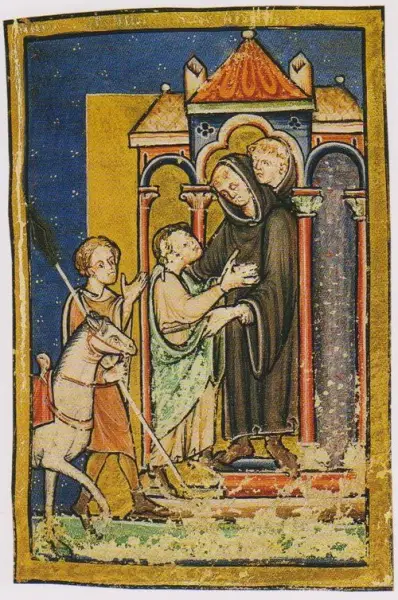
Within the community at Melrose, Boisil served as prior, the second officer of the house under Abbot Eata, and in that office he carried the daily weight of monastic teaching and discipline. The title the tradition gives him is abbot, for he succeeded Eata in the government of Melrose in 659, but his lasting work was done as prior, in the scriptorium and the school rather than the abbot's cell. His evident sanctity was already the talk of the neighborhood when a young shepherd named Cuthbert, weighing a vocation, chose Melrose over the more famous Lindisfarne in 651 precisely because of what he had heard of Boisil. The meeting at the gate has become one of the familiar scenes of northern hagiography: the prior happened to be standing at the abbey entrance when the newcomer arrived, and while Cuthbert went into the church to pray, Boisil — sensing, as Bede tells us, how far in holiness the boy would one day rise — said to the monks beside him only, "Behold the servant of the Lord." Abbot Eata then gave leave for Cuthbert to join the community, and the prior became his teacher. From Boisil, Cuthbert learned the scriptures, and the classroom matured into friendship between master and pupil. The pattern is worth noticing: Boisil's vocation was not spectacular but mediating — the man through whose hands Aidan's tradition passed into the saint who would carry it to Lindisfarne, Farne and fame.
§ Life
Preacher, Healer, Guide of the Villages
Boisil's ministry reached well beyond the cloister. Together with Cuthbert he traveled among the villages neighboring Melrose, preaching to the local people — the itinerant evangelism of the Northumbrian church, in which monks walked out from the monastery to teach the faith in the scattered settlements of the Tweed valley. The two went as companions, the elder and the younger, and the mission they shared bound them for the rest of Boisil's life. His reputation as a healer was equally wide: the sick and ailing were brought to him from far and near, seeking cures through his herbal remedies and through the healing properties attributed to two local springs whose waters contained iron salts. Here the hagiographic convention of the holy man as healer meets a practical northern monasticism that knew both plants and minerals; the Life preserves the memory of a monk whom the countryside trusted with its bodies as well as its souls. Contemporaries were impressed above all by his supernatural intuitions — the sense that Boisil saw further into events than ordinary sight allows. Bede records the most striking case: he predicted the great pestilence of 664 three years in advance, declaring that he would himself die in it while Eata, the abbot, would survive it. The prophecy shaped the last chapter of his life and, when the plague came exactly as he had said, confirmed for his contemporaries the conviction of his sanctity that had first drawn Cuthbert to his gate.
§ Life
The Pestilence of 664
Boisil's last years fell under the shadow of the plague he had himself foretold. In the great pestilence of 664 — the same epidemic that carried off many of the Northumbrian church's leaders — Cuthbert was among those stricken down, and Boisil declared that he would certainly recover, a judgment that proved true. Some time afterward the prior himself, exactly as he had predicted three years before, fell victim to the terrible epidemic. Even dying, his intuition did not fail: even at the last he foretold a bishopric for Cuthbert, and great things achieved for the Church through him — a prophecy fulfilled in Cuthbert's reluctant consecration to the see of Hexham and then Lindisfarne. Boisil died on 7 July 664 at Melrose, having governed the house as abbot since his succession in 659. His death did not close his influence. Twice he appeared in vision to a monk who had known him, bearing a message concerning the future Bishop Ecgberht of Ripon, instructing him to concentrate on existing monasteries rather than on missionary activity on the continent — counsel that bore on one of the standing questions of the early English church, whether its energies should go outward to pagan Europe or inward to the consolidation of its own houses. The appearance belongs to the same world of intuition that had marked his life: a monk whose perceptions were believed to reach past the grave.
§ Life
Venerated in Three Communions
Boisil belongs to the great company of pre-congregation saints of the Anglo-Saxon church, never formally canonized by any process yet honored continuously since his death. His veneration spans the later divisions of western Christianity: he is commemorated in the Eastern Orthodox Church, in the Roman Catholic Church and in the Anglican Communion, a breadth few shared saints enjoy. The calendar evidence is varied and instructive. In the early martyrologies his day was assigned to 23 February, the date the Orthodox churches still keep, while the Bollandists treat of him on 9 September; the generally accepted feast, however, is 7 July, the anniversary of his death in the pestilence, with a commemoration of the translation of his relics on 8 June. Those relics, together with Bede's, were taken to Durham in the eleventh century by the priest Alfred Westow, joining the great northern collection centered on Cuthbert's shrine. His major shrine at Melrose Abbey itself was destroyed, with the abbey, in the later medieval wars; only the ruined abbey church marks the site today. What could not be destroyed was the memory: the scholar's judgment that he may have written certain theological works rests on somewhat dubious authority and nothing survives, so that Boisil's true monument is not a book but the place-name St Boswells in Roxburghshire and the line of saints he formed.
§ Life
The Teacher Behind Cuthbert
History remembers Boisil chiefly as the man who made Cuthbert. The northern church's greatest saint arrived at Melrose in 651 because of the prior's reputation, was taught the scriptures at his side, preached beside him through the villages, received from him the assurance of recovery during the plague, and heard from his deathbed the prophecy of a bishopric — and Bede, our informant for nearly all of this, had it from Sigfrid of Jarrow, whom Boisil had also trained. Through Bede's Life of Cuthbert and Ecclesiastical History, scenes of Boisil entered the imagination of medieval Europe: the welcome at the abbey gate, illuminated in a twelfth-century miniature of the Yates Thomson manuscript of the prose Life, where the prior greets the young shepherd who will outshine him. That inversion is the point of his legacy. Boisil held the offices — prior, then abbot — and possessed the local fame as healer and prophet, yet his permanent significance lies in recognition and formation: he saw what Cuthbert would become before anyone else did, said so in a single phrase, and gave the boy the scriptural learning on which a bishop's career would be built. He is a patron figure for every teacher whose students surpass them, and a reminder that the communities of Aidan's Northumbria transmitted their faith person to person, master to pupil, gate to cloister. The ruined abbey at Melrose, the village of St Boswells and the Orthodox feast of 24 February keep his name alive in three churches and two countries.
§ Life
Timeline
- 648
Joins the newly founded monastery of Melrose, an offshoot of Lindisfarne, in its first generation
§ Life
- 651
Standing at the abbey gate, he recognizes the holiness of the arriving young Cuthbert and welcomes him into the community under Abbot Eata
§ Life
- 659
Succeeds Eata as abbot of Melrose
§ Life
- 661
Three years beforehand, foretells the great pestilence to come, his own death from it, and Abbot Eata's survival
§ Life
- 7 Jul 664
During the great pestilence he assures the stricken Cuthbert of recovery; falling ill himself, he predicts Cuthbert's future episcopate and dies on 7 July
§ Life
- 664
After his death he appears twice in vision to a monk he had known, instructing the future Bishop Ecgberht of Ripon to focus on existing monasteries rather than continental missions
§ Life
- 1050
His relics, together with Bede's, are taken to Durham in the eleventh century by the priest Alfred Westow
§ Life
In Their Own Words
Behold the servant of the Lord
The Record
- Major works
- Theological works attributed on dubious authority, not preserved
- Patron of
- Commemorated in the place-name St Boswells, Roxburghshire
- Symbols
- Abbot's habit and staff·Shown welcoming Cuthbert at the gate of Melrose
- Canonization
- Pre-congregation saint venerated in the Eastern Orthodox Church, the Roman Catholic Church and the Anglican Communion
Prayer
Bibliography
Show 7 sources
- Thurston, Herbert (1907). "St. Boisil". In Herbermann, Charles (ed.). Catholic Encyclopedia. Vol. 2. New York: Robert Appleton Company
- Bede, Historia ecclesiastica gentis Anglorum, IV, xxvii, and Vita Cuthberti
- Butler, Alban. The Lives of the Saints, Vol. II, 1866
- "Saint Boisil". LTN. Retrieved 25 February 2011
- "Ὁ Ὅσιος Μποϊζὶλ ἐκ Σκωτίας" [The saint of Scotland Boizil]. GRAND SYNAXARISTIS. Retrieved 25 February 2011
- "Northern Saints". This is Durham, Durham County Council
- "St. Boisil - Confessor". Parish of Oystermouth, Swansea
Profile text adapted from the Wikipedia article, licensed CC BY-SA 4.0.
Pray with this saint every day
Save St. Boisil to your favorites, read the full profile, and get feast-day reminders in the Saints app.
Get the Saints AppFree on the App Store for iPhone and iPad