
c. 1156 – c. 1207·Feast May 29
St. Bona of Pisa
Virgin Pilgrim and Guide of the Ways to Compostela
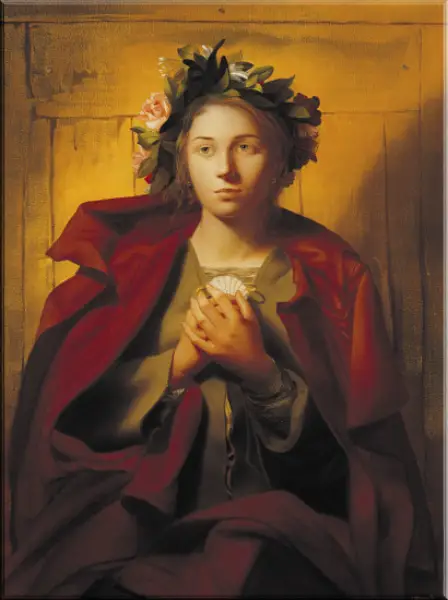
Overview
Bona of Pisa, born around 1156 in the parish of San Martino in Guazzolongo, was a medieval Italian virgin and pilgrim who became one of the legendary guides of the road to Santiago de Compostela. Her mother, Berta, was Corsican and her father, Bernardo, a Pisan merchant who abandoned the family when she was three, leaving them in hardship. At ten years old she had given herself to the tertiary life in the Augustinian family of nuns. At fourteen she set out on her first journey, traveling to the Holy Land to see her father, who was serving as a Crusader near Jerusalem; on the voyage home Muslim pirates captured her party on the Mediterranean, wounded her and held her prisoner until Pisan countrymen ransomed her. Soon after, she joined a large company of pilgrims on the long and dangerous road to Santiago de Compostela, helping with difficulties, encouraging the discouraged, giving medical aid and calling everyone to prayer and penance; the Knights of Saint James then appointed her one of the official guides of the route, which she traversed successfully nine times. She also journeyed to Rome and to the shrine of Monte Sant'Angelo sul Gargano. Though ill, she attempted a tenth Compostela journey but turned back to Pisa and died around 1207 in her room near the Church of San Martino, where her remains are preserved. Canonized by John XXIII in 1962, she is the patron of travelers — couriers, guides, pilgrims and flight attendants — and of Pisa.
The Complete Life
A Child of San Martino
Bona was born in Pisa around 1156, in the parish of San Martino in Guazzolongo, into a family of mixed origins: her mother Berta came from Corsica, while her father Bernardo was a Pisan merchant. The city of her birth was then at the height of its Mediterranean power, its merchants and fleets trading and fighting from the Holy Land to Sardinia, and that maritime world would shape her whole life. Her childhood knew early hardship. Her father went away when she was three and was never seen again, leaving the family in hardship — a loss that seems to have marked her deeply, since her first journey as a girl of fourteen was undertaken precisely to find him in the East. Two visionary incidents survive from her earliest years. At seven, in the church of the Holy Sepulchre, the figure on the crucifix was seen to hold out a hand to her; later, in another church, she beheld Jesus, the Virgin Mary and three saints, among them James the Greater, surrounded by a light that frightened her so badly that she ran away — whereupon James went after her and brought her back to the figure of Jesus. From that episode dates the pronounced devotion to the apostle James that governed the rest of her life, and that would send her again and again along the road to his shrine at Compostela. The legends belong to the genre of hagiographic childhood, but the direction they indicate — toward the cross and toward James — is exactly the direction her documented life took.
§ Biography
Augustinian Tertiary at Ten
By the age of ten, Bona had dedicated herself as a tertiary — a member of the third order living a consecrated life in the world — within the Augustinian family of nuns. The step is remarkable less for its rarity than for its earliness: a fatherless child of the Guazzolongo parish committing herself to prayer, penance and service before most children of her age had learned a trade. The Augustinian tertiary vocation fitted the shape her life would take, for it did not remove her to a cloister but consecrated her freedom of movement, and her road would run through the Mediterranean and across northern Spain rather than around a convent court. At fourteen she set out on the first of many journeys, traveling east to find her father, who had gone on Crusade and was stationed near Jerusalem. The voyage brought her within sight of the holy places, but the return nearly killed her: on the homeward voyage her party of fellow travelers fell into the hands of Muslim pirates on the Mediterranean; she was wounded in the seizure and then held prisoner. Pisan countrymen eventually ransomed her, and she completed her trip home. The experience — captivity, wounds and deliverance endured at sixteen — did not deter her from the road. Instead it seems to have confirmed a vocation already formed: within a short time she set out again, this time not east but west, toward the tomb of the apostle whose image had comforted her in childhood.
§ Biography
Nine Journeys to Compostela
Bona's second pilgrimage set out for Santiago de Compostela in Galicia, where James the Greater is honored, in the company of a large number of pilgrims undertaking the long and dangerous journey across the Alps, France and the Pyrenees. On the road she found her particular charism: she helped with the difficulties of the route, encouraged those who grew discouraged, provided medical aid to the sick and injured, and invited everyone to prayer and penance. She was, in effect, the servant and nurse of the pilgrim band, and her usefulness was such that the Knights of Saint James — the military order charged with protecting the pilgrimage roads — afterward made her one of the official guides along the route, a formal recognition of her experience and her gift for leading others. In that office she successfully completed the journey nine times, a record that made her one of the most seasoned travelers of twelfth-century Europe and the natural protectress, centuries later, of everyone whose work is travel. Her journeys were not confined to the Spanish road: she also went as a pilgrim to Rome and to the shrine of Monte Sant'Angelo sul Gargano on the Adriatic, the ancient cave-sanctuary of the archangel Michael. The pattern of her mission is consistent throughout — she traveled not as a solitary mystic but as a companion on the road, sharing its dangers and its prayers, and the medieval pilgrimage, with its risks of pirates, brigands, rivers and mountain passes, was exactly the terrain for a woman whose courage had been tested at sea.
§ Biography
The Tenth Journey
Bona's life ended on the road she loved, or nearly on it. Ill as she then was, she attempted a tenth trip to Compostela — a decision that shows both her devotion to James and her refusal to spare herself once a pilgrimage was in view. Her strength, however, did not hold: she turned back and returned home to Pisa, and died there shortly afterward, around 1207, at roughly fifty years of age. The place of her death is recorded with a peculiar tenderness: not a convent infirmary but the room she kept near the Church of San Martino — the parish church of her birth and baptism, to which she had returned between journeys and beside which she had made her home. Her body has been preserved there to the present day, and the remains of Santa Bona still rest in the Church of San Martino in Pisa, an object of local veneration for eight centuries. The Roman Martyrology compresses her whole life into a single line, naming Pisa and a virgin who went repeatedly as a pilgrim to the Holy Land, then to Rome and lastly to Compostela. The three destinations named — Jerusalem, Rome, Santiago — were the three great pilgrimages of the Middle Ages, and Bona had made them all, dying within sight of the church where, as a girl of seven, she had first been drawn to the figure on the crucifix.
§ Biography
Canonized in 1962
For more than seven centuries Bona's cult remained local, limited to the diocese of Pisa, where her preserved body at San Martino and the memory of her nine journeys sustained a steady if narrow devotion. Formal recognition came in 1962, when Pope John XXIII canonized her a saint of the Catholic Church. The same pope gave her patronage a strikingly contemporary extension, proclaiming her in 1962 the heavenly patron of Italian tour guides, of guides generally and of airline cabin crew, translating the medieval office she had held on the roads to Compostela into the vocabulary of the jet age. The choice was a natural one, for her life had been spent precisely in the guidance and care of travelers, and the modern professions of those who escort people across the world found in her their closest medieval counterpart. Her broader patronage embraces travellers in general, and specifically couriers, guides and pilgrims, together with her native city of Pisa. Her feast falls on 29 May, and in art she appears as a nun bearing a cross or a pilgrim's staff — the emblem of the road to Santiago that she walked nine times and attempted a tenth. The canonization of 1962 thus did two things at once: it confirmed a local Pisan cult with centuries of continuity behind it, and it proposed to the universal church a saint for the age of mass travel.
§ Veneration
Patron of Those Who Travel
Bona of Pisa's lasting significance lies in a single, sharply defined image: a woman who spent her life on pilgrimage and for travelers. In an age when the journey to Compostela could take months and expose pilgrims to pirates, bandits, sickness and exhaustion, she went east to Jerusalem and west to Santiago, and she did not go empty — she nursed, encouraged, organized and prayed for the companies she traveled with, until the Knights of Saint James formalized her role as an official guide of the route. Nine completed crossings of one of Europe's great pilgrimage roads made her, by any measure, one of the most traveled women of the twelfth century. Her afterlife has followed the logic of that achievement. Kept locally at Pisa for centuries — her cult confined to the diocese, her body at San Martino — she was raised to the universal calendar in 1962 and immediately matched to the modern world's travelers: guides and couriers, and with a note of gentle anachronism that is also entirely fitting, flight attendants, the professional descendants of those who escort others on long and sometimes dangerous journeys. Together with Godric of Finchale, the hermit-pilgrim who is her closest counterpart, she represents the medieval piety of the road, in which the journey itself was an ascetic exercise and service to one's fellow pilgrims its highest form. For Pisa she remains a civic patron, and for the church at large a reminder that sanctity can be measured in miles walked for God and in the weary helped along the way.
§ Veneration
Timeline
- 1156
Born in Pisa in the parish of San Martino in Guazzolongo, to the Pisan merchant Bernardo and the Corsican Berta
§ Biography
- 1159
Her father leaves and never returns, leaving the family in difficult straits
§ Biography
- 1163
At seven years old she sees the crucified figure at the Holy Sepulchre church reach out a hand to her
§ Legends
- 1166
At ten she dedicates herself as an Augustinian tertiary
§ Biography
- 1170
At fourteen she makes her first journey, to the Holy Land to see her Crusader father near Jerusalem
§ Biography
- 1170
Captured by Muslim pirates on the Mediterranean while returning home, wounded and imprisoned, later ransomed by countrymen
§ Biography
- 1207
Though ill, attempts a tenth journey to Compostela, returns to Pisa and dies in her room near the Church of San Martino
§ Biography
- 1962
Canonized by Pope John XXIII, who names her patron of tour guides, couriers and flight attendants
§ Veneration
In Their Own Words
In Pisa, Saint Bona, virgin, who made frequent pilgrimages with devotion to the Holy Land, to Rome and to Compostela
The Record
- Patron of
- Patron of travellers, specifically couriers, guides, pilgrims and flight attendants·Patron of the city of Pisa
- Symbols
- Depicted as a nun·Carrying a cross or a pilgrim's staff
- Canonization
- Canonized in 1962 by Pope John XXIII, who also named her patron of tour guides, guides and flight attendants
Prayer
Bibliography
Show 5 sources
- "St. Bona of Pisa", Archdiocese of Baltimore
- Odden, Per Einar. "Den hellige Bona av Pisa (~1156-1207)", Den katolske kirke, 23 December 2006
- Salani, Massimo (23 October 2001). "Santa Bona da Pisa Vergine". Santi e Beati
- "The Patron Saint of Pilgrims", Inside the Vatican Magazine (Pilgrimages)
- Attwater, Donald and Catherine Rachel John. The Penguin Dictionary of Saints. 3rd edition. New York: Penguin Books, 1993. ISBN 0-14-051312-4
Profile text adapted from the Wikipedia article, licensed CC BY-SA 4.0.
Pray with this saint every day
Save St. Bona of Pisa to your favorites, read the full profile, and get feast-day reminders in the Saints app.
Get the Saints AppFree on the App Store for iPhone and iPad