
1221 – 15 July 1274·Feast July 15
St. Bonaventure
Seraphic Doctor and Minister General of the Friars Minor
Overview
Bonaventure, born Giovanni di Fidanza in 1221 at Civita di Bagnoregio near Viterbo in the Papal States, was an Italian Franciscan friar, theologian, cardinal and saint. He owed his life, by his own report, to the prayers of Francis of Assisi, who rescued him from an untimely death in youth — the debt that later moved him to write the official Life of St. Francis. Entering the Friars Minor in 1243, he studied at Paris under John of Rochelle and possibly Alexander of Hales, held the Franciscan chair from 1253, and took his master's degree in 1257 alongside Thomas Aquinas, after defending the mendicant orders against their critics. The same year he was elected Minister General, the seventh, and steered the Franciscans along a moderate, intellectual course that made them the church's most prominent order before the Jesuits. His works center on the great Commentary on the Sentences, together with The Mind's Road to God, the Breviloquium and The Tree of Life, treatises of mystical theology integrating faith and reason under Christ, the one true master. He was instrumental in the election of Pope Gregory X, was made Cardinal Bishop of Albano in 1273, and played a significant part at the Second Council of Lyon, where his work helped carry the Greek and Latin churches into union; there he died suddenly on 15 July 1274, in circumstances his early biographers thought suspicious. Canonized in 1482 and declared the Seraphic Doctor in 1588, he is ranked with Aquinas among the greatest of the church's teachers.
The Complete Life
A Child Saved by Francis
Giovanni di Fidanza was born in 1221 at Civita di Bagnoregio, a hill town not far from Viterbo in the Papal States, the son of Giovanni di Fidanza and Maria di Ritella; almost nothing else is recorded of his childhood. One story of those years he told himself: that in his youth he was delivered from an untimely death through the prayers of Francis of Assisi, who had died only a few years before and was already revered throughout Umbria and Lazio. The claim matters for more than piety — Bonaventure names it as the primary motivation for his writing the vita of the Poverello, the Legenda maior that became the order's authorized portrait of its founder. The personal bond with Francis, real or felt, thus shaped both his devotion and his career as the order's historian. Five years after Francis's canonization, when the boy of Bagnoregio came of age, the Franciscan movement had grown from a handful of itinerant preachers into a vast international order with a chair at the University of Paris — a transformation that would provide the setting of his entire adult life. That he entered the Order of Friars Minor in 1243, rather than the older Benedictine or canonical houses available in central Italy, suggests the hold the young order already had on the religious imagination of his generation; and that he was sent at once to Paris shows how quickly his abilities were noticed.
§ Life
The Franciscan Chair at Paris
Bonaventure's formation took place at the University of Paris, the intellectual capital of thirteenth-century Christendom, where he studied possibly under Alexander of Hales, the first great Franciscan doctor, and certainly under Alexander's successor John of Rochelle. His rise through the studium was rapid. His fame earned him the lectureship on The Four Books of Sentences — Peter Lombard's twelfth-century systematic theology, the standard advanced course of the medieval schools — three years before taking up the Franciscan chair in 1253, and in 1255 came the degree of master, the medieval doctorate. A dispute between the secular clergy and the mendicant orders then held up his formal reception as Master until 1257, the year in which, in friendship with Thomas Aquinas, he received the degree — the Dominican with whom his name would be forever paired. During the controversy he had beaten back the reproaches of the anti-mendicant party in a successful defense of his order, which brought him to the attention of the whole order. He also formed a lasting friendship with the cardinal Hugh of Saint-Cher, by whom he was influenced. His major work, the Commentary on the Sentences, was composed at his superiors' command when he was twenty-seven, and the greater part of his other theological and philosophical writing rests upon it in some way, though later works, the Lectures on the Six Days of Creation among them, advance well beyond it.
§ Life
Minister General of a Divided Order
In 1257, still in his mid-thirties, Bonaventure was elected Minister General of the Franciscan Order, the seventh to hold that office, and he governed the friars for the rest of his life. He inherited an order torn over the meaning of its founder's poverty, with an extreme party straining toward Joachite prophecy and a laxer current accommodating itself to comfort and learning. Against both he steered a moderate and intellectual course that carried the Franciscans to a prominence in the Catholic Church unmatched until the Jesuits arose. The General Chapter at Narbonne in 1260, held during his tenure, promulgated constitutions for the order and a decree barring friars from publishing any work without the leave of their superiors — a rule later readers blamed on envy of Roger Bacon, though it was in fact a general measure prompted by Gerard of Borgo San Donnino, whose unauthorized Introduction to the Eternal Gospel had been judged heretical in 1255; the prohibition was rescinded in Bacon's favor in 1266. Bonaventure also wrote the order's official life of Francis and treatises on the spiritual life for the direction of his brethren. On 24 November 1265 he was chosen for the archbishopric of York, a leading English see; he never received consecration and gave the appointment up in October 1266, preferring the government of his order over a bishop's palace.
§ Life
Faith, Reason and the Mind's Road
Bonaventure's theology was marked by an attempt to integrate faith and reason completely. He looked to Christ as the one true master, who gives humans a knowledge beginning in faith, deepened by the work of reason and brought to perfection in mystical union with God. Like the other great scholastic doctors, he began from the relations of reason and faith: every science is a handmaid of theology; reason can uncover some of the moral truths on which the Christian system rests, but others can be received only through divine illumination, for which the soul must use prayer, the exercise of the virtues, and meditation rising even to ecstatic union. The supreme end of life is union in contemplation and intense absorbing love, not fully attainable in this world and kept as a hope. Emanation, exemplarism and consummation he named as the core principles of theology: creation proceeds from the divine exemplars in the Word, is intelligible through them, and returns to them as its goal. Against Aristotle and the Arabic philosophers he defended God's providence and the world's beginning in time, and he held — contrary to Aquinas — that reason can demonstrate that the world had a first moment. His spiritual masterpiece, The Mind's Road to God, maps the soul's ascent through the vestiges of God in material creation, the image of God in the mind itself, and being as such, up to the vision of the Trinity; Pope Francis praised in Laudato si' his teaching that every creature bears a Trinitarian structure, visible before sin darkened human eyes.
§ Theology
Cardinal of Albano and the Council of Lyon
Bonaventure's last years were consumed by the church's business. He helped procure the election of Pope Gregory X, and the new pope's gratitude took the form of the see of a Cardinal Bishop of Albano — the emblem later given him, a cardinal's hat hanging on a bush, preserves the memory of the Friar's unworldliness at the moment of elevation. Created cardinal on 3 June 1273 and consecrated bishop by Gregory himself at Lyon on 11 November of that year, the pope insisted on his presence for the great Second Council of Lyon, which opened in 1274 with the reunion of the Greek and Latin churches as its chief aim. There Bonaventure made significant contributions that helped bring the union about, preaching and theologizing for an assembly that included the eastern delegation sent by Michael VIII Palaiologos. On 15 July 1274, while the council was still in session, he died suddenly at Lyon, aged about fifty-three. His death was sudden enough, and the politics of the moment tense enough, that the circumstances were thought suspicious: the 1913 Catholic Encyclopedia carries citations suggesting he was poisoned, though the 2003 New Catholic Encyclopedia makes no mention of it, and the question remains unresolved. His body remained at Lyon, and the council that he had served lost its most respected mediator within days of its greatest achievement.
§ Life
Canonized 1482, Doctor 1588
Bonaventure's formal glorification came a century and a half after he died. In 1434, 160 years on, his body was carried into a new and more fitting church at Lyon, and when the tomb was opened the head proved wholly incorrupt — hair, lips, teeth and tongue all whole, their natural color unchanged. The people of Lyon were deeply moved by the wonder and took Bonaventure as their city's patron, and the drive then underway toward his canonization gained from the discovery, as the old account says, a fresh and powerful impetus. It bore fruit on 14 April 1482, when the Franciscan Pope Sixtus IV canonized him at Rome, and his feast day was entered in the General Roman Calendar immediately upon canonization. A century later another Franciscan pope completed the honor: Sixtus V, in 1588, declared him a Doctor of the Church under the title Doctor Seraphicus, the Seraphic Doctor, ranking him with Thomas Aquinas among the greatest of the church's teachers. The calendar's treatment of his feast traces the later history of liturgy: at first kept on the second Sunday of July, moved to 14 July in 1568 because 15 July was then occupied by Saint Henry, ranked a double and then a third-class feast, and finally in 1969 made an obligatory memorial on the anniversary of his death, 15 July. The Church of England also commemorates him on that day.
§ Canonisation
The Seraphic Doctor's Long Afterlife
Bonaventure's relics suffered what his reputation did not. In 1562 the Huguenots captured Lyon and burned his body in the public square; amid the French Revolution's dechristianization of France the urn holding the incorrupt head had to be hidden away, after which the church itself was torn down, and the urn has never been recovered. One relic alone survives: the writing arm and hand that produced the Commentary on the Sentences, kept today in St. Nicholas's parish church at Bagnoregio — a fitting remnant for a saint whose whole legacy is a body of writing. That writing has never lost its authority. Counted among the very greatest philosophers of the medieval age, he shaped the Franciscan school through Peter John Olivi and Duns Scotus, and reached far beyond it: his influence runs through Dante, Nicholas of Cusa, John of the Cross, Louis de Montfort, and into the twentieth century in Joseph Ratzinger, whose doctoral work treated his theology of history, Hans Urs von Balthasar, Maurice Blondel, Jean-Luc Marion, even Kierkegaard and Heidegger. Many medieval works once attributed to him have been reclassified under the name Pseudo-Bonaventure, a sign of the prestige his name carried. His name is borne today by universities and parishes on five continents, from St. Bonaventure University in New York to the town of Bonaventure in Quebec, and the parish of Mauban in the Philippines has kept him as patron since 1599. He remains, with Aquinas, one of the two great lights of thirteenth-century theology.
§ Relics
Timeline
- 1221
Born Giovanni di Fidanza at Civita di Bagnoregio, near Viterbo in the Papal States
§ Introduction
- 1243
Enters the Franciscan Order and goes to study in Paris, where his teachers include Alexander of Hales and Alexander's successor John of Rochelle
§ Life
- 1253
Holds the Franciscan chair at the University of Paris
§ Life
- 1255
Receives the master's degree, the era's equivalent of a doctorate, after lecturing on the Sentences
§ Life
- 1257
Formally received as Master after a mendicant dispute delayed his reception, and elected Minister General of the Franciscan Order
§ Life
- 1260
The General Chapter of Narbonne, held during his tenure, promulgates a decree barring publication of works without permission from superiors
§ Life
- 24 Nov 1265
Selected for the post of Archbishop of York, though he is never consecrated for that see
§ Life
- Oct 1266
Resigns the appointment as Archbishop of York
§ Life
- 3 Jun 1273
Elevated to Cardinal Bishop of Albano by Pope Gregory X, whom he had helped elect
§ Introduction
- 11 Nov 1273
Consecrated a bishop by Pope Gregory X at Lyon
§ Introduction
- 1274
Present at the Second Council of Lyon, where his contributions help bring about the union of the Greek and Latin churches
§ Life
- 15 Jul 1274
Dies suddenly at Lyon during the council, under circumstances early sources suggested were suspicious
§ Life
- 1434
His body is moved to a new church at Lyon and the head is found entirely incorrupt, spurring the drive for his canonization
§ Relics
- 14 Apr 1482
Canonized in Rome by Pope Sixtus IV, and his feast enters the General Roman Calendar at once
§ Introduction
- 1562
Huguenots capture Lyon and burn his body in the public square
§ Relics
- 1588
Pope Sixtus V declares him a Doctor of the Church with the title Seraphic Doctor
§ Introduction
In Their Own Words
Let us not believe that it is enough to read without unction, to speculate without devotion, to investigate without wonder, to observe without joy, to act without godly zeal, to know without love, to understand without humility, to strive without divine grace, or to reflect as a mirror without divinely inspired wisdom.
For the nearer any one approaches to God, the more he is illuminated, and therefore the more clearly does he see the majesty and mercy of God.
Contemplation deepens the more we feel the working of God’s grace within our hearts, and the better we learn to encounter God in creatures outside ourselves.
Though a superior is rather to be loved, yet by the insolent he ought to be feared.
The world is like a book in which the creative Trinity shines, manifests itself in sensible forms and is read.
The Record
- Major works
- Commentary on the Sentences of Peter Lombard·The Mind's Road to God (Itinerarium mentis in Deum)·Breviloquium·Reduction of the Arts to Theology (De reductione artium ad theologiam)·The Tree of Life (Lignum vitae)·The Triple Way (De triplici via)·Soliloquy on the Four Spiritual Exercises·Commentary on the Gospel of St Luke·The Life of St Francis (Legenda maior)·Concerning the Perfection of Life, written for Isabelle of France·Collationes in Hexaemeron (Lectures on the Six Days of Creation)
- Patron of
- Patron of bowel disorders·Patron of the city of Lyon
- Symbols
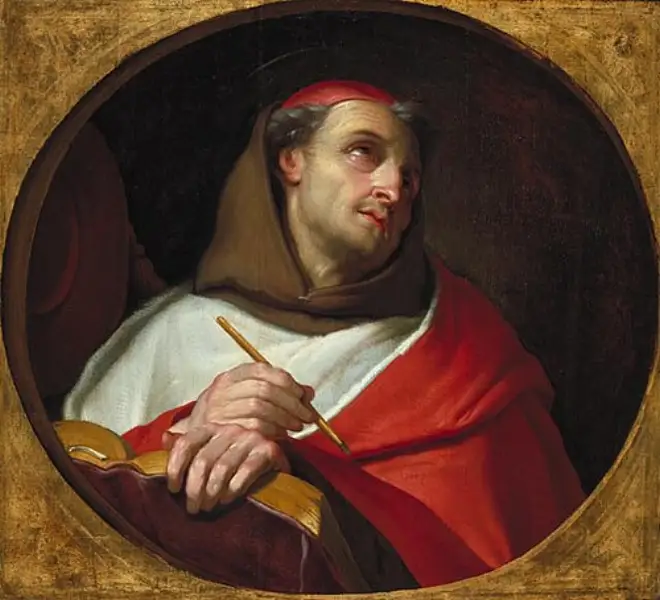
- Cardinal's hat hanging on a bush·Ciborium·Holy Communion·Cardinal in Franciscan robes, usually reading or writing
- Canonization
- Canonized on 14 April 1482 in Rome by Pope Sixtus IV; declared a Doctor of the Church with the title Seraphic Doctor by Pope Sixtus V in 1588
Prayer
Bibliography
Show 9 sources
- Robinson, Paschal (1907). "St. Bonaventure". In The Catholic Encyclopedia. Vol. 2. New York: Robert Appleton Company
- Hammond, Jay M. (2003). "Bonaventure, St.". In Marthaler, Bernard L. (ed.). New Catholic Encyclopedia. Vol. 2 (2nd ed.). Detroit: Thomson/Gale. p. 479. ISBN 0-7876-4006-9
- Adamson, Robert (1911). "Bonaventura, Saint". In Chisholm, Hugh (ed.). Encyclopædia Britannica, 4 (11th ed.). Cambridge University Press. pp. 197–198
- M. Walsh, ed. (1991). Butler's Lives of the Saints. New York: HarperCollins. p. 216. ISBN 9780060692995
- Noone, Tim; Houser, R. E. (2010). "Saint Bonaventure". plato.stanford.edu (Stanford Encyclopedia of Philosophy)
- Schlosser, Marianne (2013). "Bonaventure: Life and Works". In Hammond, Jay M.; Hellmann, J. A. Wayne; Goff, Jared (eds.). A Companion to Bonaventure. Brill. p. 12 n.7. ISBN 978-90-04-26072-6
- Ratzinger, J. (1971). Theology of History in St. Bonaventure, trans. Zachary Hayes. Chicago: Franciscan Herald Press
- Cullen, Christopher M. (2006). Bonaventure. Oxford: Oxford University Press. ISBN 0-19-514925-4
- Calendarium Romanum. Libreria Editrice Vaticana. 1969. pp. 97, 130
Profile text adapted from the Wikipedia article, licensed CC BY-SA 4.0.
Pray with this saint every day
Save St. Bonaventure to your favorites, read the full profile, and get feast-day reminders in the Saints app.
Get the Saints AppFree on the App Store for iPhone and iPad