
c. 1040 – 1115·Feast September 27
St. Bonfilius
Benedictine Bishop of Foligno and Hermit
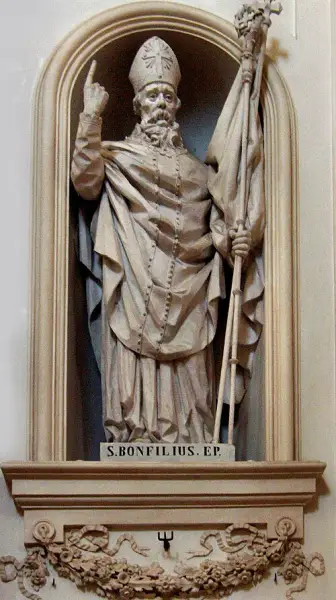
Overview
Bonfilius was born around 1040 at Osimo, not far from Ancona, and in youth joined the Benedictine community of Santa Maria di Storaco, situated near Filottrano. Although the youngest man in that house, he was judged the most learned in Scripture of the whole congregation, and the monks elected him abbot. At some point between 1072 and 1078 he was chosen to govern the diocese of Foligno as its bishop. In that office he proved a patron of new religious foundations: in 1078 he bestowed a gift upon the canons of the church of Folignano, and about 1080 he backed Mainardo's efforts to establish the abbey of Sassovivo. In 1096 the long-held desire to visit the Holy Land took him east, travelling with the pilgrim hosts of the First Crusade. His companions perished on the road one after another, and he came to Jerusalem alone. There he remained as a hermit until 1104, when he made his way back to Italy. Since a certain Andreas had in the meantime occupied the vacant bishopric of Foligno, Bonfilius withdrew first to his old house at Storaco and afterwards to a hermit's life at Santa Maria della Far near Cingoli, where he died peacefully on 27 September 1115. Saint Sylvester Gozzolini, founder of the Sylvestrines, wrote his earliest life and drew fresh zeal from his example; his bones now rest in Cingoli Cathedral.
The Complete Life
A Young Scholar of Osimo
Bonfilius first saw the light around the year 1040 in Osimo, a town of the Italian Marche within sight of Ancona. Drawn early to the monastic life, he entered the Benedictine monastery of Santa Maria di Storaco, which stood near Filottrano. What strikes the reader of his story is the contrast between his youth and his reputation: though he was the most junior member of that community, his knowledge of the Scriptures surpassed that of every brother in the congregation. Such learning did not remain a private accomplishment. When the monks needed a head for their house, they passed over older men and chose this young scholar as their abbot. The episode tells us a good deal about the culture of eleventh-century Italian monasticism, in which mastery of the Bible counted as the first qualification for leadership. It also set the pattern of his later career, since he would be called from the cloister to the government of a diocese before withdrawing once more to solitude. His years at Storaco gave him the formation in prayer and study that would carry him through episcopal office, a crusade-era pilgrimage, and a long hermitage near Cingoli, and they explain the authority with which later writers, above all Sylvester Gozzolini, would describe him.
§ Bonfilius
Bishop, Pilgrim and Crusade-Era Hermit
Between 1072 and 1078, Bonfilius was elected to the bishopric of Foligno, taking with him from the cloister the habits of study and generosity. Two concrete acts of his episcopate are recorded. In 1078 he bestowed a gift on the canons who served Folignano's church, and about two years later he gave his support and encouragement to a man named Mainardo, who was then labouring to found the abbey of Sassovivo, destined to become one of the notable monastic houses of the Umbrian countryside. His care was thus for the institutional as well as the spiritual fabric of his diocese. Yet the desire to see the places where Christ had walked never left him, and in 1096, precisely as the armies of the First Crusade were moving east, he joined them in the spirit of a pilgrim. The journey proved a via dolorosa of its own kind: the companions with whom he set out died one after another along the route, until he entered Jerusalem alone. He did not hurry home. For some eight years he lived hidden in the holy city as a hermit, praying where the mysteries of salvation had occurred, until in 1104 he judged it time to return to the Italy that had given him his faith.
§ Bonfilius
Solitude at Cingoli and a Saintly Biographer
The homecoming of Bonfilius was bittersweet. While he had been praying in Jerusalem, the bishopric of Foligno had not remained empty: a certain Andreas had taken possession of the see, and there was no place for the returning pilgrim in the office he had once held. Bonfilius accepted the situation without a struggle. He went back to the abbey of Storaco, the house of his youth and his abbacy, and settled there for a time before seeking an even quieter refuge. His last dwelling was the hermitage of St Maria of la Far, near Cingoli, where he lived out his remaining years in solitude and prayer. There he died a natural death on 27 September 1115, an old monk who had been abbot, bishop, crusade pilgrim and hermit in turn. His memory did not fade with him. The first account of his life came from the pen of Saint Sylvester Gozzolini, the founder of the Sylvestrine congregation, who acknowledged that Bonfilius's example had inspired his own vocation. The saint's remains were later laid to rest in Cingoli Cathedral, which became his principal shrine. His memory is kept at Cingoli each 28 January, while Osimo honours him on 27 September, the day of his death.
§ Bonfilius
Timeline
- 1040
Born at Osimo, near Ancona, in the Italian Marche
§ Introduction
- 1072
Elected bishop of Foligno at some point between 1072 and 1078, having earlier served as abbot of Storaco
§ Introduction
- 1078
Gave a gift to the canons serving the church at Folignano
§ Introduction
- 1080
Encouraged Mainardo in founding the abbey of Sassovivo
§ Introduction
- 1096
Set out for the Holy Land with the pilgrim forces of the First Crusade, reaching Jerusalem alone after his companions died on the way
§ Introduction
- 1104
Returned to Italy from Jerusalem, finding the see of Foligno occupied by Andreas
§ Introduction
- 27 Sep 1115
Died a natural death on 27 September as a hermit at St Maria of la Far near Cingoli
§ Introduction
The Record
- Patron of
- Patron of Foligno, Italy
- Symbols
- Shepherd staff
- Canonization
- Pre-congregation; ancient veneration in the Roman Catholic Church, with feasts at Cingoli (28 January) and Osimo (27 September)
Prayer
Bibliography
Show 5 sources
- Silvestrini, Monaci Benedettini. "San Bonfiglio (Bonfilio) di Foligno Vescovo". Santi Beati.
- Watkins, Basil (2015). The Book of Saints: A Comprehensive Biographical Dictionary. Bloomsbury Publishing. ISBN 0567664155.
- Parolin, Pietro (3 June 2017). "ST SYLVESTER THE RELEVANCE OF A CHARISM". Symposium held at Fabriano Monastery of St Sylvester.
- Nicolini, Ugolino. "BONFIGLIO, santo". Treccani, Dizionario Biografico degli Italiani, Volume 12 (1971).
- "Saint Bonfils", Nominis.
Profile text adapted from the Wikipedia article, licensed CC BY-SA 4.0.
Pray with this saint every day
Save St. Bonfilius to your favorites, read the full profile, and get feast-day reminders in the Saints app.
Get the Saints AppFree on the App Store for iPhone and iPad