
c. 675 – 754·Feast June 5
St. Boniface
Apostle to the Germans and martyr of Dokkum
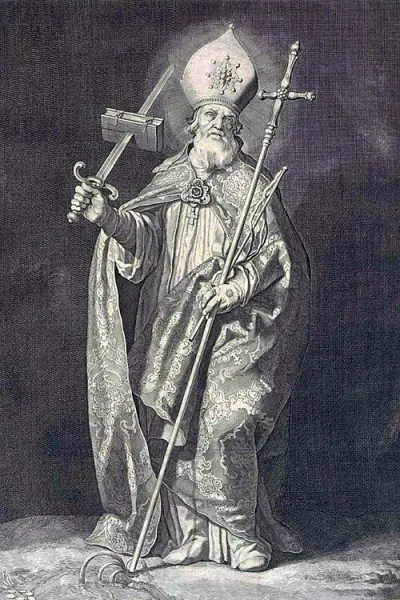
Overview
St. Boniface, born Wynfreth around 675, was an English Benedictine monk who became the leading figure of the Anglo-Saxon mission to the Germanic peoples of Francia in the eighth century. After refusing the abbacy of Nursling, he left England for Frisia in 716 and then traveled to Rome, where Pope Gregory II renamed him Boniface and appointed him missionary bishop for Germania. His felling of the Donar Oak near Fritzlar became the emblem of his preaching, and under the protection of Charles Martel he organized the church in Germany: the pallium from Pope Gregory III in 732 made him an archbishop, his third Roman journey made him papal legate, and in 745 he received Mainz as his metropolitan see. He founded or inspired dioceses and monasteries, most famously Fulda, and labored to reform the Frankish church in alliance with the papacy and the Carolingians. In 754, on a final mission to Frisia, he and fifty-two companions were killed by armed robbers near Dokkum. His remains were carried back to Fulda, where his shrine beneath the cathedral's high altar remains a place of pilgrimage. Known as the Apostle to the Germans, he is venerated by Catholics, Lutherans, Anglicans, and Orthodox alike.
The Complete Life
A Devon Boy in the Monastic Schools
Boniface was born Wynfreth around 675. His birthplace is a matter of tradition rather than contemporary record: the earliest vita does not name it, and only from the early fourteenth century, in Bishop John Grandisson's Legenda Sanctorum, is Crediton in Devon given as the place of his birth. What the earliest life does relate is that as a boy he was sent to a monastery ruled by Abbot Wulfhard at a place written escancastre or Examchester, generally understood to be Exeter, probably one of the small monastic houses that local landowners and churchmen had built; its site is believed to lie beneath the former Church of St Mary Major, beside Exeter Cathedral. One letter of his claims nurture in the synod of London, though the phrase was probably figurative. From Exeter he passed to the Benedictine monastery and minster of Nhutscelle, now Nursling near Winchester, where Abbot Winbert had made a busy center of learning in the tradition of Aldhelm. There Wynfreth studied in a significant library stocked with Donatus, Priscian, Isidore, and other masters, taught in the abbey school, and wrote a Latin grammar, a treatise on verse, and riddles in Aldhelm's manner. At thirty he was ordained a priest. His family was respected and prosperous, and his father opposed his devotion to the monastic life, but the boy's resolve prevailed.
§ Early life
Refusing the Abbey, Choosing the Road
The decisive choice of Wynfreth's early manhood came around 716, when Abbot Wynberth of Nursling died. By custom, and perhaps by kinship, Wynfreth might have expected to succeed him, for hereditary right was still practiced among the early Anglo-Saxons and would have made such a succession natural. He declined the office. The monastery that had formed him, with its industrious school and its rich library, could not hold him against a stronger call: the conversion of the Germanic peoples across the North Sea. In that same year he set out on his first expedition to Frisia, joining the aging Willibrord, the apostle of that people, at Utrecht. The experiment failed through no fault of his own, for the fighting then raging between Charles Martel and King Radbod of the Frisians made all preaching futile, and Wynfreth returned to Nursling after a year. But the pattern of his life was fixed. When he next crossed to the continent he went straight to Rome, put himself at the disposition of the pope, and never returned to England, though he kept up a warm correspondence with his countrymen and kinfolk until his death. The renunciation of the abbacy is the key to all that followed: learning and office surrendered to the mission field, in obedience to the see of Peter.
§ Early life
Apostle and Reorganizer of the German Church
On his second continental journey Wynfreth went to Rome, where Pope Gregory II gave him the name Boniface, borrowed from a martyr of Tarsus of the legendary fourth century, and consecrated him missionary bishop for Germania, a bishop without a diocese for a land that lacked any church organization. His boldest gesture came near Fritzlar in northern Hesse, where, according to his biographer Willibald, he began to chop down the Donar Oak sacred to the pagans; a great wind miraculously brought the ancient tree down, and when the gods failed to strike him dead, the amazed people were converted, and a church built of the oak's wood became the beginning of the monastery of Fritzlar. From 723 he enjoyed the protection of Charles Martel, without which, he confessed to Daniel of Winchester that without such protection he could not govern his church, shield his clergy, or stamp out idolatry. In 732 Pope Gregory III conferred the pallium and raised him to the archbishopric of the German lands, and his third Roman journey, in 737 and 738, made him papal legate. He organized four Bavarian dioceses at Salzburg, Regensburg, Freising, and Passau, founded Würzburg in 741, guided the foundation of Fulda by his disciple Sturm in 742, presided over the Concilium Germanicum of April 743 with its stricter discipline for the clergy, and in 745 received Mainz as his metropolitan see.
§ Early missionary work in Frisia and Germania
The Mind of a Missionary Bishop
Boniface's inner life is best read in his writings. The Bonifatian correspondence, some 150 letters assembled after his death by his successor Lullus, links him with churchmen across Western Europe, with the three popes he served, and with kinsmen in England; many letters deal with reform, liturgy, and doctrine, and some reveal deep affection, especially for his female correspondents. Among them is the letter of 716 to Abbess Edburga of Minster-in-Thanet containing the Vision of the Monk of Wenlock, an otherworld journey in which a dying monk is led by angels to judgment, sees angels and devils contend over his soul, crosses a bridge over a boiling river, and is sent back to warn his brethren to repent while they live, a vision shaped by the Apocalypse of Paul, Gregory the Great, and Bede. His scholarship remained with him all his life: the Ars Bonifacii written for his Nursling students, the Caesurae uersuum, and the Enigmata, twenty acrostic riddles on the virtues and the vices that turn theology into verse, the first sequence moving from truth and faith through patience and peace to virginity, the second marching through carelessness, anger, greed, and pride toward vainglory. He also combated heresy, drafting the charge against Aldebert and Clement condemned at the Roman Council of 745, and studied Irish canon law for the reform of the continental church.
§ Sources and writings
The Last Journey to Frisia
To the end of his life the old dream of winning the Frisians remained alive, and in 754, now some seventy-nine years of age, he journeyed north once more with a company of helpers. Many converts came to baptism, and he appointed a day for their confirmation on a tract of land near Dokkum, lying between Franeker and Groningen. On the appointed day no neophytes appeared; armed robbers came instead. According to his biographers, he bade his men put aside their swords, urging that the gospel forbids repaying evil with evil and conquers it only with good; the bandits cut down the aged archbishop and some fifty-two of his company. Ransacking the baggage, they found not gold and silver vessels but manuscripts, books of sacred texts they tried to destroy. One of these, the Ragyndrudis Codex now kept at Fulda, carries gashes consistent with blows of a blade or axe, and the later Vita altera reports that an eyewitness saw the saint at the moment of death holding up a gospel book as spiritual protection; the Gospel he raised may have been Codex Sangallensis 56, whose damaged margin was later cut back in repair. His remains were carried to Utrecht and then to Mainz, whence, despite sources that disagree about Lullus's role, they were taken to Fulda and entombed in a shrine beneath the high altar of the abbey church, now Fulda Cathedral.
§ Last mission to Frisia
The Grave at Fulda and the Well at Dokkum
Veneration of Boniface at Fulda began immediately after his death. Within about a decade a handsome tomb rose over his burial place, which thenceforth formed the heart of the abbey: incoming abbots knelt there in prayer before their formal welcome, and each Monday the community prostrated itself at the grave and chanted Psalm 50 in his honor. When the church was rebuilt as the Ratgar Basilica, dedicated in 791, his remains were translated to a grave at its new center, and in 819, on 1 November, they were moved again to a new apse. From then on the abbey's patron, was honored as heavenly advocate of its monks and titular proprietor of its lands and goods, every gift to the house being entered under his patronage. Each 5 June his blood was commemorated with a mass Alcuin had composed, and by about the year 1000 another mass, kept on 1 December, recalled his ordination as bishop. At Dokkum too a cult arose: a visitor's horse, mired at the place of the killing, stamped loose a well of sweet water, and by the ninth century a church stood on the site, built, the Vita Liudgeri says, by Ludger himself, a fountain of holiness binding Frisia to the Christendom for which the martyr had died.
§ Veneration
From Fulda to Winnipeg
Boniface's memory has grown for twelve centuries across three countries. Statues stand at Mainz Cathedral and before St. Peter's at Fritzlar; the United Kingdom's national shrine is the Catholic church at Crediton, where a bas-relief of the felling of the oak by Kenneth Carter was unveiled by Princess Margaret. Churches dedicated to him dot Britain from Bunbury to Papa Westray, and the highest point of the Isle of Wight, St Boniface Down, carries his name. St Boniface's Catholic College at Plymouth, founded in 1856, keeps his feast each 5 June, and the Church of England remembers him with a Lesser Festival on the same day. Across the Atlantic his name founded a city: Father Norbert Provencher's log church of 1818 on the Red River became Saint Boniface Cathedral, and the community around it grew into the Franco-Manitoban heart of Winnipeg, where the Grey Nuns opened St Boniface Hospital in 1871. Anniversary celebrations in 1805, 1855, 1905, and 1954 made him a figure of German and European identity; Konrad Adenauer addressed sixty thousand at Fulda in 1954, and Pope John Paul II prayed at the grave in 1980, hailing Boniface as the beginning of the gospel in Germany. In 2019 Devon County Council, with its dioceses and churches, officially recognized him as patron saint of Devon.
§ Veneration
Timeline
- 675
Born Wynfreth, probably in Devon, the tradition later fixing his birth at Crediton in Dumnonia.
§ Early life
- 716
Set out on his first missionary expedition to Frisia and spent a year preaching with Willibrord at Utrecht.
§ Early missionary work in Frisia and Germania
- 723
Came under the protection of Charles Martel, whose support secured his work in Germany.
§ Boniface and the Carolingians
- 732
Received the pallium from Pope Gregory III and was raised to the archbishopric of the German lands.
§ Boniface and the Carolingians
- 737
Made papal legate for Germany during his third Roman sojourn (737–38).
§ Boniface and the Carolingians
- 741
Established the diocese of Würzburg in Frankish, Hessian, and Thuringian territory.
§ Boniface and the Carolingians
- 742
His disciple Sturm founded the abbey of Fulda, with Boniface deeply involved in the foundation.
§ Boniface and the Carolingians
- Apr 743
The Concilium Germanicum, organized by Carloman, adopted stricter guidelines for the Frankish clergy.
§ Boniface and the Carolingians
- 745
Granted Mainz as his metropolitan see, becoming Archbishop of Mainz.
§ Boniface and the Carolingians
- 5 Jun 754
Martyred near Dokkum in Frisia with about fifty-two companions by a band of armed robbers.
§ Last mission to Frisia
- 791
The rebuilt abbey church at Fulda, the Ratgar Basilica, was dedicated, and his remains were translated to a new grave at its center.
§ Veneration
- 1 Nov 819
His relics were translated to a new apse at Fulda, an event the Fulda Martyrology fixes on 1 November.
§ Veneration
In Their Own Words
Cease fighting. Lay down your arms, for we are told in Scripture not to render evil for evil but to overcome evil by good.
The Record
- Major works
- Ars Bonifacii, a Latin grammatical treatise·Caesurae uersuum, a treatise on verse·Enigmata, twenty acrostic riddles in two sequences on the virtues and vices·The Bonifatian correspondence, some 150 letters assembled under Archbishop Lullus·Letter charging Aldebert and Clement with heresy, preserved in the acts of the Roman Council of 745
- Patron of
- patron of Germania and Germany·patron of Fulda·patron of Devon·patron of Winnipeg·patron of England (Orthodox Church)
- Symbols
- bishop's robes·book pierced by a sword·axe·oak·scourge
- Canonization
- Pre-congregation; hailed as a saint immediately after his martyrdom in 754, venerated at Fulda and across Germania and England
Prayer
Bibliography
Show 6 sources
- Schieffer, Theodor (1972) [1954]. Winfrid-Bonifatius und die christliche Grundlegung Europas. Wissenschaftliche Buchgesellschaft. ISBN 3-534-06065-2.
- Talbot, C. H., ed. The Anglo-Saxon Missionaries in Germany: Being the Lives of S.S. Willibrord, Boniface, Strum, Leoba and Lebuin. New York: Sheed and Ward, 1954.
- Levison, Wilhelm (1905). Vitae Sancti Bonifati Archiepiscopi Moguntini. Hahn. ISBN 9783775252935.
- Emerton, Ephraim (1976). The Letters of Saint Boniface. Columbia University Records of Civilization. New York: Norton. ISBN 0393091473.
- Palmer, James T. (2009). Anglo-Saxons in a Frankish World (690–900). Studies in the Early Middle Ages. Turnhout: Brepols. ISBN 9782503519111.
- Padberg, Lutz E. von (2003). Bonifatius: Missionar und Reformer. Beck. ISBN 978-3-406-48019-5.
Profile text adapted from the Wikipedia article, licensed CC BY-SA 4.0.
Pray with this saint every day
Save St. Boniface to your favorites, read the full profile, and get feast-day reminders in the Saints app.
Get the Saints AppFree on the App Store for iPhone and iPad