
623 – 710·Feast January 15
St. Bonitus
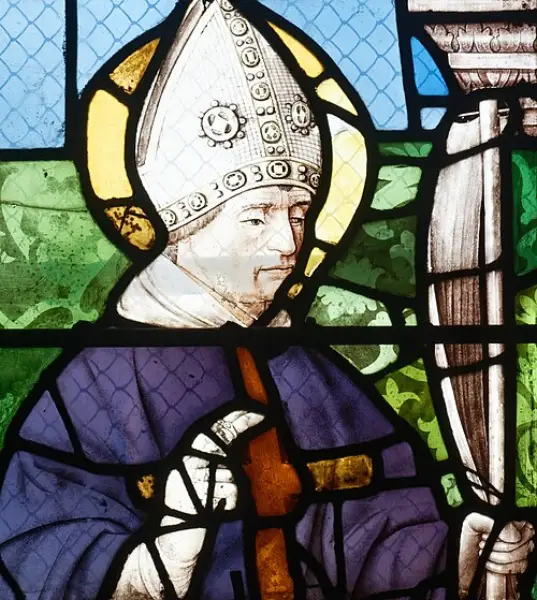
Bishop of Clermont, Governor of Provence
Overview
Bonitus, born in 623 in Auvergne, was a Merovingian churchman and statesman who flourished under four kings. Serving as chancellor and referendary in Francia, he became chancellor to Sigebert III, king of Austrasia, whose intimate friend he was, along with Genesius. After the death of Dagobert II, Thierry III named him governor of Marseille and of all Provence, an office variously dated to 667 and to 680. His elder brother Avitus II, bishop of Clermont in Auvergne, recommended Bonitus as his successor, and when Avitus died in 689 Bonitus was consecrated to the see. Marked by a warm devotion to Mary, he is reported to have been granted a vision of the Mother of God. After governing the diocese for about ten years he was seized by a scruple as to whether his election had been wholly canonical; having consulted the hermit Saint Tilo (Theau), then living in solitude at Solignas, he resigned his dignity. He next spent four years within the Manlieu abbey, then journeyed as a pilgrim to Rome, and at Lyons, suffering from gout, died on 15 January 710 at eighty-six. The principal early source for his life is Alban Butler's Lives of the Saints.
The Complete Life
Chancellor under Four Kings
Bonitus was born in the year 623 in Auvergne, in the heart of what is now France, into a family that would give the Church two bishops: his elder brother Avitus II preceded him in the see of Clermont. The seventh century into which he was born was the age of the Merovingian kingdoms, when Frankish kings drew their administrators from the clergy and when a churchman's career and a statesman's were often the same road. Bonitus rose high on that road. He served as chancellor and referendary in Francia, offices of the royal household, and became chancellor to Sigebert III, king of Austrasia, one of the four monarchs under whom, by his zeal, religion and justice, he is said to have flourished. He was not merely an official at a distance from his sovereign: the sources call him an intimate friend of Sigebert III and of Genesius. After the death of Dagobert II the crown passed to Thierry III, who entrusted Bonitus with the government of Marseille and of all Provence, a civil command over France's great southern port and its hinterland, variously dated to 667 and to 680. In an age of palace intrigue, a reputation for religion and justice sustained across four reigns was itself a remarkable testimony.
§ Life
Bishop of Auvergne and a Scruple of Conscience
The church of Auvergne ran in Bonitus's blood. His elder brother, Saint Avitus II, occupied the bishop's chair at Clermont and, knowing his own end was near, recommended Bonitus to succeed him. When Avitus died in 689, Bonitus was consecrated bishop of Auvergne, passing from the government of Provence to the pastoral care of his native region. As bishop he was marked above all by his devotion to the Blessed Virgin Mary, and tradition records that he was granted an apparition of her, an experience the old hagiographers set at the centre of his spiritual life. His episcopate, however, carried within it the seed of its own ending. Roughly a decade after his consecration, Bonitus was troubled by a scruple: had his election been perfectly canonical? The question gnawed at him precisely because the episcopal elections of the Merovingian era were often shaped by family interest and royal favour, and he could not be certain that his own advancement, recommended by a brother and confirmed in a worldly court, had been free of such taint. Rather than silence the doubt, he sought counsel. He went to Saint Tilo, also called Theau, an Irish-trained hermit then living the eremitical life at Solignas, and on that holy man's advice he took the most drastic remedy available: he resigned his dignity and laid down the government of the church of Clermont, choosing a doubtful conscience cleared over an office retained.
§ Life
Manlieu, Rome and a Death at Lyons
The resignation of Bonitus was not the end of his story but the beginning of its last and most monastic chapter. Having laid down the episcopacy, he retired for a four-year stay at the abbey of Manlieu, exchanging the chancery and the cathedral for the routine of a community living under rule. It was a steep descent for a man who had governed Provence and adorned the courts of four kings, and the sources present it without drama, as the simple completion of what conscience had begun. From Manlieu he set out on pilgrimage to Rome, the journey that every medieval churchman of standing aspired to make at least once, to pray at the tombs of the apostles and to stand in the city where his faith had its centre. He did not reach home. Falling ill with the gout, he died at Lyons on 15 January in the year 710, eighty-six years old, more than half a century after his birth in Auvergne. His death closed a life that had run the full course open to a seventh-century saint: courtier, chancellor, governor, bishop, penitent resigner, monk and pilgrim. Alban Butler, whose Lives of the Saints preserves the narrative, kept his memory in the Western martyrological tradition, and both the Roman Catholic and the Eastern Orthodox Churches venerate him, his feast falling on the anniversary of his death at Lyons.
§ Life
Timeline
- 623
Born in Auvergne, France; the article gives 623 as his birth year.
§ Introduction
- 680
Once Dagobert II had died, Thierry III appointed him governor over Marseille and the whole of Provence; the introduction instead dates this to 667.
§ Life
- 689
His elder brother, Bishop Avitus II of Clermont, died after naming him successor, and Bonitus was consecrated for the see.
§ Life
- 699
Troubled about the canonicity of his election, he consulted the hermit Tilo at Solignas and resigned after a decade governing the see.
§ Life
- 15 Jan 710
Died of gout at Lyons aged 86, after four years retired at the abbey of Manlieu and a pilgrimage to Rome.
§ Life
The Record
- Canonization
- Pre-congregation; venerated in the Roman Catholic Church and the Eastern Orthodox Church
Prayer
Bibliography
Show 2 sources
- Butler, Alban. Lives of the Saints, Vol. I (1866).
- Catholic Online - Saint Bonitus.
Profile text adapted from the Wikipedia article, licensed CC BY-SA 4.0.
Pray with this saint every day
Save St. Bonitus to your favorites, read the full profile, and get feast-day reminders in the Saints app.
Get the Saints AppFree on the App Store for iPhone and iPad