
827 – 907·Feast May 2
St. Boris I of Bulgaria
Baptizer prince of Bulgaria and Equal-to-the-Apostles
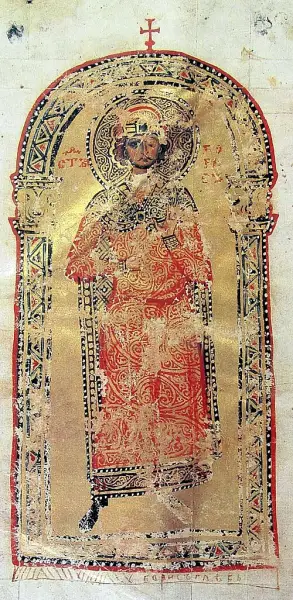
Overview
Boris I, also spelled Bogoris and known after baptism as Boris-Michael, ruled the First Bulgarian Empire as knyaz from 852 to 889 and died on 2 May 907 in a monastery near Preslav. Though his arms often fared badly against Franks, Byzantines, Croats and Serbs, his reign changed the course of European history. In 864 he was secretly baptized at Pliska by Byzantine clergy with Emperor Michael III standing as his godfather, and he then imposed Christianity on his subjects, crushing a revolt of fifty-two boyar families in 865. Playing Rome against Constantinople, he extracted from Patriarch Photios and from Popes Nicholas I and Adrian II a stream of instruction, and in 870 the Fourth Council of Constantinople granted Bulgaria an autocephalous archbishopric. In 886 he received the exiled disciples of Cyril and Methodius, among them Clement of Ohrid and Naum of Preslav, whose schools of Slavonic letters prepared the declaration of Old Bulgarian and the Cyrillic alphabet as official in 893. Boris abdicated in 889 for monastic life, returned in 893 to depose and blind his paganizing son Vladimir and to raise Simeon I to the throne at the Council of Preslav, helped Simeon against the Magyars about 895, and then retired to his monastery until his death.
The Complete Life
A Bulgar Heir Between Two Worlds
Boris was born in 827, the son and successor of Presian I, into a realm where two peoples lived under one ruler. The conquering Bulgars, a minority, formed the military aristocracy, while the far more numerous Slavs kept their own tongue and their own gods; Richard Spence has compared the arrangement to the later relationship between Normans and Saxons in England. Religion deepened the divide, for the Slavs worshiped a polytheistic pantheon while the Bulgar elite reverenced Tangra, the God of Heaven. His father had already tested the dynasty's strength against the Serbs in the war of 839 to 842 and had been beaten, a humiliation Boris inherited along with the throne in 852. His earliest reign was a schooling in the limits of force. He confirmed the peace of 845 with Eastern Francia by embassy and threatened Constantinople with invasion, gaining only a small strip of Strandzha and no signed treaty. In 854 he marched with Rastislav of Moravia against Louis the German and was routed; the Croats, probably paid by Louis, opened a second front, and Boris had to purchase peace with gifts. In 855 to 856 a Byzantine army under Michael III and the caesar Bardas stripped him of Philippopolis, Zagora and the Black Sea ports of the Gulf of Burgas, and in 853 or 854 a Serbian army under Mutimir had captured his own son Vladimir with twelve boyars. A ruler of such mixed fortunes learned early that Bulgaria's survival lay in diplomacy.
§ Military campaigns
The Baptism at Pliska
Why Boris embraced Christianity the sources explain in several voices. One tradition credits a sister who had already converted at Constantinople; another tells of a Greek slave at his court; a third, more fabulous, has him terrified by an icon of the Last Judgment. Richard Spence reads the decision instead as deliberate, practical and politic, and the diplomacy bears him out. Boris sought an alliance with Louis the German, partly to extend his sway over the Slavic world and partly to find an ally against Byzantium, and Louis promised missionaries who would have drawn the Bulgars toward Rome. Constantinople moved first. Late in 863, amid famine and natural disaster in Bulgaria, Michael III declared war, and the surprised Boris had to accept peace on Byzantine terms: baptism according to the eastern rite, in exchange for quiet and for the return of the Zagora region in Thrace. Early in 864, Byzantine churchmen arriving on embassy baptized him in secret at Pliska, along with his family and chosen nobles, and because the emperor stood as his godfather he took the name Michael; scholars therefore often call him Boris-Michael. Beyond diplomacy he also wanted conversion for domestic reasons, since a single faith could fuse Bulgar and Slav into one people, and the title he assumed after baptism, knyaz, marked his entry into the community of Christian princes to the satisfaction of the Eastern Empire.
§ Motivations for baptism and conversion to Christianity
Baptizing a Nation and Founding Its Church
Once baptized himself, Boris set about the baptism of his subjects, working through Byzantine priests from 864 to 866 while asking Patriarch Photios for instruction in Christian living, government, and the creation of an autocephalous church. Finding Photios's reply thin, he turned to Rome: in August 866 the kavhan Peter carried a long list of questions to Pope Nicholas I, complained of abuses by the Byzantine clergy, and brought back 106 detailed answers covering religion, law, politics, custom and personal faith, together with missionaries who worked by the western rite. The shift enraged Photios, whose encyclical of 867 to the eastern clergy attacked western practices and Roman meddling in Bulgaria, an episode known as the Photian Schism and a major step toward the division of the churches. Rome in turn disappointed him: Nicholas sent bishops Paul of Populonia and Formosus of Porto, and Formosus prospered, but the pope refused to make him archbishop of Bulgaria on the ground that moving a seated bishop to another see was uncanonical; Adrian II refused a similar request for Formosus or the deacon Marinus. Bulgaria therefore swung back toward Constantinople, and in 870, at the Fourth Council of Constantinople, Bulgarian envoys reopened the question and the eastern patriarchs ruled for Constantinople, granting Bulgaria an autocephalous archbishopric with an archbishop of its own, a status that a later nominal surrender of Bulgaria to the Papacy left untouched. At home the conversion met armed resistance, and in the summer of 865 Boris crushed a revolt by executing fifty-two boyars with their entire families.
§ Baptism of the Bulgarians and the establishment of the Bulgarian Church
A Church in Her Own Tongue
The deepest Christian achievement of Boris was linguistic and monastic. Toward the close of his reign he deliberately multiplied native clergy, sending Bulgarians to Constantinople for monastic schooling so that they could return as priests of their own people. In 885 the Slavonic-speaking disciples of Cyril and Methodius were driven out of Great Moravia after a German-inspired reaction to Methodius's death, and in 886 Boris's governor at Belgrade received them and forwarded them to Pliska. The ruler welcomed two of the noblest among them, Clement of Ohrid and Naum of Preslav, and put their gifts to work at once, commissioning Clement as a teacher in the province of Kutmichevitsa. From the centers founded at Pliska and Ohrid flowed the growth of Slavonic letters and worship: Clement formed thousands of priests whose mother tongue was Slavonic, displacing the Greek-speaking clerics from Constantinople then serving the Bulgarian church, and where Cyril and Methodius had devised the Glagolitic alphabet, Clement and Naum compiled in Bulgaria the new script later called Cyrillic. With the new letters the Bulgarians no longer leaned on Greek for writing and worship, and a Christian culture of the Slavs took shape that helped to unify the realm. In 893 Cyrillic was declared the official alphabet of the state and Old Bulgarian its official language, a settlement that carried Slavonic letters in the following centuries to other peoples and states, and all of it under the patronage of a prince who kept building churches and monasteries across his land.
§ Changes to Bulgarian culture brought on by Clement and Naum
Two Returns from the Monastery
In 889 Boris laid down the crown and became a monk, and the succession fell to his eldest son Vladimir. The experiment failed. Vladimir attempted to restore the old pagan religion, and in 893 Boris came out of retirement to deal with him: the young ruler was defeated and blinded, his wife was shorn and sent to a monastery, and Boris summoned the Council of Preslav, which set his third son, the future Tsar Simeon I, upon the throne. The father's warning at that council was plain, for he threatened Simeon with Vladimir's fate should he too abandon the faith. That same assembly put native Bulgarian churchmen in the place of the Byzantines and Old Church Slavonic in the place of Greek as the church's tongue. Boris then returned to his monastery, but the world reached him once more: about 895 he came out once more to stand with Simeon against the Magyars, invaders fighting then as Byzantium's allies; once that danger had passed he went back to the monastic life for good. He died on 2 May 907. The house where he spent his last years, and where he may have been buried, is not certainly known: candidates include a site near Preslav, another near Pliska, and the Ravna Monastery near Varna. He thus ended as he had governed, between the old capital and the new, having given the last twenty years of his life to prayer for the nation he had baptized.
§ End of Boris' reign
Equal-to-the-Apostles
The Orthodox Church numbers Boris among its saints, honoring him as Bulgaria's prince and baptizer and ranking him among the Equals-to-the-Apostles. His memory is kept on 2 May, and he is commemorated again in the Synaxis of all venerable and holy Fathers of Bulgaria, a movable observance on the second Sunday after Pentecost. The Bulgarian Orthodox Church dates his canonization to 906, the year before his death. His titles themselves tell the story of his influence: his seals and the inscriptions at Ballsh in modern Albania and at Varna style him by the Byzantine title Archon of Bulgaria, rendered ruler and later knyaz, and historians generally hold that he was titled khan or kanasubigi before baptism and knyaz after it, while the Second Bulgarian Empire retrospectively promoted him to tsar. The consequences of his church settlement ran far beyond the Balkans, for the autocephalous archbishopric of 870 fixed the future of the Bulgarian Orthodox Church, and the alphabet sheltered in 886 became the script of a whole family of Slavic nations. Modern Bulgaria has not forgotten him: he was played by Stefan Danailov in the 1985 film Boris the First, and St. Boris Peak on Livingston Island in the South Shetland Islands of Antarctica carries his name, a baptizer of the medieval Balkans honored on an Antarctic map.
§ Legacy
Timeline
- 852
Succeeded his father Presian I as ruler of Bulgaria and dispatched envoys to the East Frankish court to reaffirm the treaty of 845.
§ Military campaigns
- 854
Joined Rastislav of Moravia against Louis the German; the campaign failed, Croatia attacked in parallel, and peace was bought with gifts.
§ Military campaigns
- 856
Lost Philippopolis, the Zagora region and the ports of the Gulf of Burgas to the Byzantine army of Michael III and the caesar Bardas.
§ Military campaigns
- 863
Byzantine Emperor Michael III declared war on him late in the year, during famine and natural disasters, forcing him to seek peace.
§ Motivations for baptism and conversion to Christianity
- 864
Secretly baptized at Pliska with his family and leading nobles, taking the name Michael with Emperor Michael III as godfather.
§ Motivations for baptism and conversion to Christianity
- 865
Crushed a boyar revolt against forced baptism, executing fifty-two aristocrats together with their whole families.
§ Reactions to religious conversion
- Aug 866
Dispatched emissaries led by the kavhan Peter to Pope Nicholas I with a long list of questions and obtained 106 detailed answers.
§ Baptism of the Bulgarians and the establishment of the Bulgarian Church
- 870
At the Fourth Council of Constantinople the eastern patriarchs placed Bulgaria under Constantinople as an autocephalous archbishopric.
§ Baptism of the Bulgarians and the establishment of the Bulgarian Church
- 886
Welcomed Clement of Ohrid and Naum of Preslav, exiled from Great Moravia, and commissioned Clement as teacher of Kutmichevitsa.
§ Changes to Bulgarian culture brought on by Clement and Naum
- 889
Abdicated the throne in favor of his eldest son Vladimir and withdrew to a monastery.
§ End of Boris' reign
- 893
Left the monastery, defeated and blinded Vladimir, and placed Simeon I on the throne at the Council of Preslav.
§ End of Boris' reign
- 893
The Cyrillic script his scholars compiled was declared the official alphabet, and Old Bulgarian the official language, of the state.
§ Changes to Bulgarian culture brought on by Clement and Naum
- 895
Left retirement again to stand beside Simeon before the Magyar onslaught, mounted then on Byzantium's side.
§ End of Boris' reign
- 906
Canonized by the Bulgarian Orthodox Church as Equal-to-the-Apostles, baptizer of the Bulgarian people.
§ Legacy
- 2 May 907
Died in a monastery near Preslav; the exact house of his retirement remains uncertain.
§ End of Boris' reign
In Their Own Words
uncanonical to transfer an already established bishop from one see to another
The Record
- Major works
- Autocephalous Archbishopric of Bulgaria (church foundation, 870)·Council of Preslav (893)·Schools of Slavonic letters at Pliska and Ohrid (patronage)
- Patron of
- Bulgarian people
- Canonization
- Canonized in 906 by the Bulgarian Orthodox Church; honored as Equal-to-the-Apostles and commemorated also in the Synaxis of the Fathers of Bulgaria
Prayer
Bibliography
Show 8 sources
- Andreev, Yordan; Lazarov, Ivan; Pavlov, Plamen (1999). Koy koy e v srednovekovna Balgariya. Sofia.
- Bulgarian historical review (2005). United Center for Research and Training in History. Pub. House of the Bulgarian Academy of Sciences, v. 33: no. 1-4.
- Gjuzelev, V. (1988). Medieval Bulgaria, Byzantine Empire, Black Sea, Venice, Genoa. Centre culturel du monde byzantin. Verlag Baier.
- Fine, John V. A. Jr. (1991) [1983]. The Early Medieval Balkans: A Critical Survey from the Sixth to the Late Twelfth Century. Ann Arbor: University of Michigan Press. ISBN 0-472-08149-7.
- Nikolov, A. Making a new basileus: the case of Symeon of Bulgaria (893-927) reconsidered. In: Rome, Constantinople and Newly converted Europe. Vol. I. Ed. by M. Salamon, M. Woloszyn, A. Musin, P. Spehar. Krakow-Leipzig-Rzeszow-Warszawa, 2012, 101-108.
- Runciman, Steven (1930). "The Two Eagles". A History of the First Bulgarian Empire. London: George Bell & Sons. OCLC 832687.
- Spence, Richard B. "Boris I of Bulgaria". Dictionary of World Biography, Vol. 2 (Frank Northen Magill, Alison Aves, eds.). Routledge, 1998. ISBN 978-1579580414.
- Sullivan, Richard E. (1994). "Khan Boris and the Conversion of Bulgaria: A case Study of the Impact of Christianity on a Barbarian Society". Christian Missionary Activity in the Early Middle Ages. Variorum: 55-139. ISBN 0-86078-402-9.
Profile text adapted from the Wikipedia article, licensed CC BY-SA 4.0.
Pray with this saint every day
Save St. Boris I of Bulgaria to your favorites, read the full profile, and get feast-day reminders in the Saints app.
Get the Saints AppFree on the App Store for iPhone and iPad