
died c. 680·Feast June 17
St. Botolph of Thorney
Abbot of Icanho and patron of boundaries and travellers
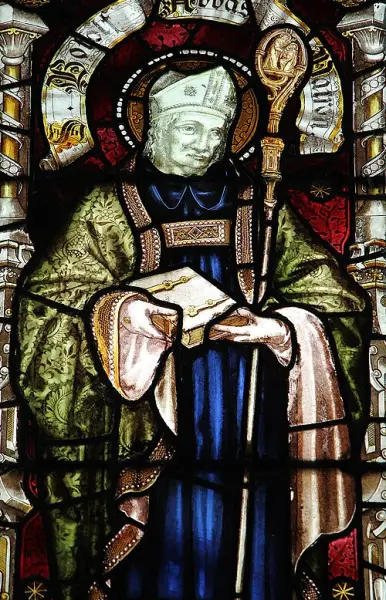
Overview
Botolph of Thorney, also written Botolph, Botulph or Botulf, was a seventh-century English abbot who died around 680. Born early in the century to noble Saxon parents who were already Christians, He and his brother Adulph received their schooling from Saint Fursey at Cnobheresburg monastery then traveled for study to the Continent, where both professed as Benedictines; Adulph remained overseas, reportedly rising to be a bishop. Botolph returned to England and won the favor of a ruler of the southern Angles, whose sisters were known to him from Germany, and obtained from him a desolate tract where he might found a monastery. The Anglo-Saxon Chronicle notes that in 654, the year King Anna was killed, Botolph began to build his church at Ikanho, 'ox hill', identified with Iken on the estuary of the River Alde in Suffolk. There, on what was then a tidal island, he gathered monks and hermits who reclaimed marsh and scrub into grazing and farmland, while he himself traveled as an itinerant missionary through East Anglia, Kent and Sussex. The Life of Saint Ceolfrith records a visit paid to this abbot of remarkable life and learning around 670. Buried at Icanho, his relics were moved for safety to Burgh in 970, then to Bury St Edmunds at Cnut's command, and later divided among Thorney, Ely and Westminster. He is the patron of boundaries, trade, travel and farming.
The Complete Life
A Saxon Nobleman's Sons
The documented life of Botolph is thin, and the fullest narrative, written by the eleventh-century monk Folcard, dates from four hundred years after the abbot's death, so its details must be treated with caution. What can be said is that Botolph was born early in the seventh century into a family of noble Saxon stock whose members were already Christians, at a time when the new faith and the old were still contending for the allegiance of the English kingdoms. He had a brother, Adulph, who shared his upbringing and much of his early path. Both boys were given to Saint Fursey, the Irish missionary abbot, for their education at Cnobheresburg, a monastery in the eastern counties that served as one of the seedbeds of Anglo-Saxon monasticism, and from there the two were sent on to complete their studies on the Continent. In Frankish houses they embraced the Rule of Saint Benedict and were professed as monks. The brothers then separated, Adulph staying on the Continent, where tradition gives him a bishopric, while Botolph turned back toward the country of his birth. The pattern is a common one in the seventh century, a Saxon aristocracy educating its devout sons in Irish and continental schools before returning them to plant monasticism in England, and Botolph's later reputation for learning fits the formation such a course would give.
§ Life and works
A Desert by the Alde
Returning to England as a professed Benedictine, Botolph found favor at the court of a ruler the sources call the king of the southern Angles, an unexpected advantage that the account explains by a German connection: Botolph had known the king's sisters during his years abroad. The king offered him the choice of a tract of desolate land on which to build a monastery, and Botolph chose one of the most unpromising sites imaginable, a place called Icanho, the ox hill, now identified as Iken beside the estuary of the River Alde in Suffolk. In that age the site was an island at high tide, ringed almost entirely by water, a genuine monastic desert, and the Anglo-Saxon Chronicle fixes the beginning of the work in the year 654, an annal that also records the death of King Anna of East Anglia and the conversion of the Middle Angles under the ealdorman Peada. A church still stands on the isolated hill in the parish today. The choice of such a place was itself a statement of vocation: a monk seeking the frontier, the marginal land where prayer could be built out of nothing, and where the claim of Christ could be planted at the very edge between land and sea, kingdom and wilderness, at a moment when the Christian kings of East Anglia were falling in battle.
§ Life and works
Reclaiming Marsh and Preaching the Roads
The mission at Icanho was agricultural as well as spiritual. Botolph attracted other monks and hermits to his tidal island, and the community together turned the surrounding marsh and scrub into productive grazing and farmland, an achievement that would have sustained the house and announced the gospel as civilization to the country round about. The monks built several structures as their numbers grew, and the monastery became an established presence on the Suffolk coast. Botolph was not confined to it. He worked as an itinerant missionary in East Anglia, in Kent and in Sussex, traveling the roads of three kingdoms, and this wandering apostolate is the root of his later patronage of travellers. The quality of the man impressed his contemporaries beyond his own country: the anonymous Life of Saint Ceolfrith, written near the time of Bede, mentions an abbot named Botolph in East Anglia as a man of remarkable life and learning, filled with the grace of the Holy Spirit, and records that Ceolfrith, later the celebrated abbot of Monkwearmouth-Jarrow, visited him about the year 670. A monastery that received such a guest, and an abbot of whom such words were written within living memory, had made itself a station in the network of the Anglo-Saxon church.
§ Life and works
Benedictine Learning and Grace
The spirituality of Botolph is Benedictine in its outlines and is attested, unusually for so obscure a figure, by a near-contemporary. Formed under Fursey in the Irish tradition and professed under the Rule on the Continent, he represents the fusion of the two streams that made Anglo-Saxon monasticism: the missionary fervor and ascetic wandering of the Celtic churches joined to the ordered stability of Benedict's rule for a community living, praying and working together. The Life of Saint Ceolfrith's description of him balances the two halves exactly, praising his life and his learning alike and calling him filled with the Holy Spirit's grace, wording that places holiness of conduct, discipline of study and the free gift of God side by side. His founding choice of a tidal island echoes the desert spirituality of the fathers, the deliberate seeking of a hard place where the world's claims are drowned, and his community's labor on the marsh shows the Benedictine conviction that work is itself prayer. His later cult added the themes his life had implied: he became the patron of boundaries, the liminal man who had settled on the edge between land and water, and by extension of trade and travel, the preacher who had gone out on the roads and received the coming stranger at his gate.
§ Life and works
Death and the Wanderings of the Relics
Botolph died around the year 680 and was buried, it is supposed, in his own foundation at Icanho, though no tomb there has been identified. The afterlife of his body became a long journey in itself, an index of the esteem in which the abbot came to be held and of the dangers of the age. In 970, with Danish raiders threatening the coast, King Edgar I of England granted permission for the remains to be translated to Burgh, near Woodbridge, inland and out of reach of the invaders. There they rested for roughly half a century before King Cnut, the Danish ruler of England, instructed that they be moved again to a tomb of their own at Bury St Edmunds Abbey, the great house growing around the shrine of the East Anglian martyr king. Later the relics traveled once more, together with those of Botolph's brother Adulph, to Thorney Abbey in the fenland, which is the house that gives the saint his usual epithet; his head, however, was taken to Ely Abbey, and various body parts were distributed to other religious houses, including Westminster Abbey. The division was typical of medieval relic practice, spreading the patronage of a popular saint among competing foundations, and it explains why the name of a Suffolk abbot came to be invoked from the fens to the capital.
§ Life and works
The Saint of Boston and the City Gates
Botolph's cult spread chiefly through church dedications, which number among the highest for any Anglo-Saxon saint. The Oxford Dictionary of Saints counts 64 ancient English churches dedicated to him, and later research suggests the true figure may have reached 71, with a heavy concentration in East Anglia. The most famous is St Botolph's Church in Boston, Lincolnshire, known locally as The Stump, and the town's name, originally Botolph's town or Botolph's stone, crossed the Atlantic to give Boston, Massachusetts its name, whence also the St Botolph Club, a street in Back Bay and the President's House at Boston College. Four City of London churches bore his name, all close to gates in the city walls, Billingsgate, destroyed in the Great Fire and never rebuilt, Aldersgate, without-Bishopsgate, where the poet John Keats was baptized, and Aldgate; the dedication suited a patron of travellers arriving and departing, though an alternative explanation holds that his relics passed through those gates when Edgar moved them. St Botolph's Priory at Colchester, the first Augustinian monastery in England, rose on an earlier church of his name, the church at Hardham in Sussex preserves some of the oldest wall paintings in Britain, the village of Botolphs keeps a dedication of 950, and Budolfi Church at Aalborg in Denmark grew into the cathedral of its diocese. Cambridge remembers him in a church, a poetry journal of the 1950s and a hypothetical college of examination papers.
§ Church dedications
Timeline
- 654
Began to build his monastery church at Ikanho, as the Anglo-Saxon Chronicle records for the year in which King Anna was killed.
§ Life and works
- 670
Received a visit from Ceolfrith, whom the anonymous Life of St Ceolfrith describes as praising him as a man of learning.
§ Life and works
- 680
Died and was buried, it is supposed, at his own foundation of Icanho.
§ Life and works
- 950
The Saxon church at Botolphs in West Sussex, first dedicated to him, dates from this year.
§ Church dedications
- 970
Edgar I permitted the removal of his relics to Burgh, by Woodbridge, out of reach of Danish raiders.
§ Life and works
- 1020
After some fifty years at Burgh, his relics were transferred to their own tomb at Bury St Edmunds Abbey on Cnut's instructions.
§ Life and works
In Their Own Words
a man of remarkable life and learning, full of the grace of the Holy Spirit
The Record
- Major works
- Monastery of Icanho at Iken, Suffolk (foundation, 654)
- Patron of
- Travellers·Boundaries, trade and travel·Farming
- Canonization
- Pre-congregation; venerated in the Anglican Communion, Eastern Orthodox Church, Catholic Church and Lutheran Churches, notably in Denmark and Sweden
Prayer
Bibliography
Show 9 sources
- Morris, Richard (1989). Churches in the Landscape. J. M. Dent. pp. 217-221. ISBN 0-460-04509-1.
- "The Diocese of Ely - About Us - The Good and the Great - Botulph". 12 August 2006. Archived from the original on 12 August 2006. Retrieved 25 February 2024.
- Thurston, Herbert. "St. Botulph." The Catholic Encyclopedia Vol. 2. New York: Robert Appleton Company, 1907.
- Ashdown-Hill, John (2009). Mediaeval Colchester's Lost Landmarks. Breedon Books Publishing Company Limited. ISBN 978-1-85983-686-6.
- Ekwall, Eilert (1960). The Concise Oxford Dictionary of English Place-Names (4th ed.). Oxford University Press. ISBN 0-19-869103-3.
- Attwater, D. The Penguin Dictionary of Saints. London (1965).
- Care Evans, A. The Sutton Hoo Ship Burial. London (1986). ISBN 0-7141-0544-9.
- Ryan, George E. Botolph Of Boston. Christopher Publishing House (1971). ISBN 0-8158-0252-8.
- Savage, A. The Anglo-Saxon Chronicles. Godalming (1995). ISBN 1-85833-478-0.
Profile text adapted from the Wikipedia article, licensed CC BY-SA 4.0.
Pray with this saint every day
Save St. Botolph of Thorney to your favorites, read the full profile, and get feast-day reminders in the Saints app.
Get the Saints AppFree on the App Store for iPhone and iPad