
1886 – 1941·Feast May 7
St. Branko Dobrosavljević
Hieromartyr parish priest of Veljun, killed by the Ustaše
Overview
Branko Dobrosavljević, born at Skrad, a village near Vojnić, on 4 January 1886, when the region belonged to Austria-Hungary, was a Serbian Orthodox priest who was murdered by the Ustaše in May 1941, during the genocide of Serbs in the Independent State of Croatia in the Second World War. Educated at the Seminary in Sremski Karlovci, he completed his secondary schooling and his theological training there in 1908, married, and was ordained deacon on 15 March 1909 and presbyter a week later, on 22 March. His ministry was exercised in Buhača, in Radovica and in Veljun, and church and state together honored his labor for his people with the Order of Saint Sava and the Yugoslav Crown decoration of the Fifth Degree. On the Feast of Saint George, 6 May 1941, the day of his own family Slava, he was arrested at Veljun by Ustaše led by Ivan Sajfor, together with his son and with Dimitrije Škorupan, the priest of Cvijanović Brdo. The prisoners were taken to a ditch, made to dig their own graves and hacked to death with axes; Dobrosavljević was forced to pray aloud while his son was killed, and was then tortured, mutilated and flayed before dying. Whether he perished in the Kestenovac forest near Blagaj among the roughly five hundred victims of the Blagaj massacre or at Otočac, the sources differ. His remains were moved to a grave at Veljun in 1946, and in 2000 the Serbian Orthodox Church canonized him. His feast is 7 May, 24 April in the Julian calendar.
The Complete Life
A Kordun Village Childhood
Branko Dobrosavljević was born on 4 January 1886 in the village of Skrad, near Vojnić, a small town in the Kordun region of what was then Austria-Hungary and is now Croatia. The country of his birth was a borderland: Serbian Orthodox settlers had lived for generations among Catholic and Muslim neighbors under Habsburg rule, their villages poor, their church the center of communal life, and their clergy the natural leaders of the people. Into that world Dobrosavljević was born, and from it he was drawn toward the priesthood. His parents sent him to school, and he proved able enough to complete his high school education and go on to the School of Theology at the Seminary in Sremski Karlovci, finishing there in 1908. Sremski Karlovci was the spiritual capital of the Serbs of the Habsburg lands, the seat of the Metropolitanate and the home of the oldest Serbian secondary school and seminary, and to graduate from it was to be formed in the tradition of Serbian church learning and national self-awareness at the turn of the century. The boy from Skrad thus entered adult life equipped for the service of parishes very like the one he had come from, as a married priest of a village church in the same Kordun hills.
§ Biography
Deacon, Priest and Village Pastor
Dobrosavljević's ordination followed the ordinary pattern of a married Serbian Orthodox clergyman of his time, though the dates are recorded with unusual care. He married, since the Serbian church preserves the ancient discipline of a married parish priesthood, and was then ordained deacon on 15 March 1909, being elevated to the rank of presbyter only a week later, on 22 March of the same year. His working life as a priest was spent entirely in the villages of the Kordun and the neighboring country: he carried out his clerical tasks in Buhača, in Radovica and in Veljun, the parish he was serving at the time of his arrest. More than thirty years separated his ordination from his death, years of baptisms, weddings, funerals, liturgies and the endless small administration of a country parish, lived among a people whose Orthodox faith marked them out within the Yugoslav state that was created after the First World War. His service was recognized officially as well as pastorally: church and state together recognized his labor for his people with the Order of Saint Sava and the Yugoslav Crown decoration of the Fifth Degree, marks of honor that speak of a priest respected both by his church and by the wider society, honored precisely for the care of the Serbian communities entrusted to him in those decades between the two wars.
§ Biography
Shepherd of Veljun in the Collapse
The mission of Branko Dobrosavljević can only be understood against the catastrophe that overtook his people. In April 1941 the Kingdom of Yugoslavia was invaded and dismembered, and the Independent State of Croatia was established under Ustaše rule as a client of the Axis powers, committed to a policy that its own leaders described as the removal of a third of the Serbs under its control, the expulsion of another third and the forced conversion of the rest. Persecution of Eastern Orthodox Christians began at once, and the Kordun, with its dense Serbian population, lay in the path of the terror. Dobrosavljević stayed at his post as parish priest of Veljun. He was fifty-five years old, a decorated pastor with a family, and he can have been in no doubt of the danger to a Serbian Orthodox priest in the new state. The choice he made was the choice to remain with his parish, and it was made, as the chronology shows, in the middle of the most sacred rhythm of Serbian village life: he was arrested on the Feast of Saint George, 6 May 1941, which was the very day of his own Slava, the family patronal feast that a Serbian household keeps above all others, with the church's great spring feast and his own household's remembrance falling on the same day. The Ustaše party that took him was headed by Ivan Sajfor, a man from Veljun itself, and they seized his son as well, along with Dimitrije Škorupan, the parish priest of Cvijanović Brdo.
§ Biography
Martyrdom in the Kestenovac Forest
The final hours of Branko Dobrosavljević are among the most terrible recorded of any modern martyr. The sources differ on the immediate scene: some state that he and his companions were held first in the Veljun police station and put to death the following day in the Kestenovac forest by Blagaj, counted among the five hundred or so Serbs slaughtered in the Blagaj massacre, while others count him with the 331 Serbs slain at the village of Otočac. What the accounts agree upon is the manner of the killing. The victims were marched to a ditch, made to dig the graves they were to lie in, and then killed with axes. Dobrosavljević and his son were kept until the end. The father was made to recite prayers while his son was chopped to pieces before him, and he was then tortured with deliberate cruelty: his hair and beard were torn out, his ears were severed and his eyes put out before he was flayed alive. He died on 7 May 1941. In 1946, after the war, his remains and those of the other killed Serbs were gathered and transported to a grave at Veljun, so that the village that had watched him taken away received his body back and buried it among the people he had served. The place of his death was disputed by the sources, but not the fact of his martyrdom nor its character as a priest's death, inflicted on him for who he was.
§ Biography
Numbered Among Serbian Church Saints
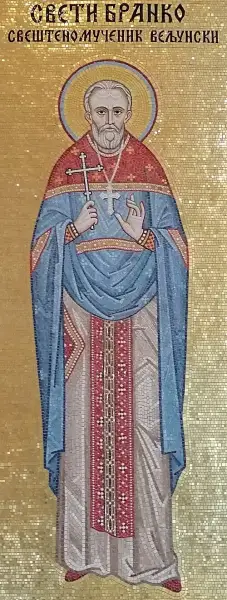
In 2000, nearly sixty years after his death, the Holy Synod of Bishops of the Serbian Orthodox Church canonized Branko Dobrosavljević, and he was officially listed as one of the Serbian Church Saints, taking his place among the new martyrs of the Second World War whom the church had begun to glorify. He is commemorated under the title of hieromartyr, a priest-martyr, and is listed in the calendar of the saints of the Serbian Orthodox Church as Branko of Veljun, the village of his last parish giving him the name by which the church knows him. His feast is kept on the date of his murder, 7 May in the Gregorian reckoning, which corresponds to 24 April in the Julian calendar used by many Orthodox churches; the Serbian Church's own Information Service marked the anniversary of his martyrdom on 7 May 2018 with an account of his life and death. His glorification belongs to the wider reckoning of the genocide of Serbs in the Independent State of Croatia, in which the Serbian church counts its clergy among the victims alongside their people, and modern scholarship, from Aleksandar Stojanovic's study of the beleaguered Serbian church in the NDH to the works of Carlo Falconi and John Cornwell on the wider war, has set his death within that documented history. A mosaic of the saint now stands in the Cathedral of Saint Sava in Belgrade.
§ Biography
Timeline
- 4 Jan 1886
Born at Skrad, a village close to Vojnić, in Austria-Hungary.
§ Biography
- 1908
Finished high school and the School of Theology at the Sremski Karlovci seminary.
§ Biography
- 15 Mar 1909
Ordained deacon after his marriage.
§ Biography
- 22 Mar 1909
Elevated to presbyter.
§ Biography
- 6 May 1941
Arrested at Veljun by Ustaše under Ivan Sajfor on his family's Slava, the Feast of St. George, together with his son.
§ Biography
- 7 May 1941
Martyred with other Serbian prisoners near Blagaj or at Otočac, tortured before death.
§ Biography
- 1946
His remains, with those of other killed Serbs, were moved to a grave in Veljun.
§ Biography
- 2000
Canonized by the Serbian Orthodox Church and entered on its list of saints.
§ Biography
The Record
- Canonization
- Canonized in 2000 by the Holy Synod of Bishops of the Serbian Orthodox Church and listed among Serbian Church Saints
Prayer
Bibliography
Show 6 sources
- Stojanovic, Aleksandar (2017). "A beleaguered church the Serbian Orthodox Church in the Independent State of Croatia (NDH) 1941-1945". Balcanica (48): 275. doi: 10.2298/BALC1748269S.
- Perica, Vjekoslav (2002). Balkan Idols: Religion and Nationalism in Yugoslav States. Oxford University Press. p. 178. ISBN 978-0-19803-389-9.
- Rivelli, Marco Aurelio (1998). Le genocide occulte: etat independant de Croatie, 1941-1945. L'age d'homme. p. 59. ISBN 978-2-82511-152-9.
- "Hieromartyr Branko Dobrosavljevic". spc.rs. Information Service of the Serbian Orthodox Church. 7 May 2018. Archived from the original on 17 January 2021. Retrieved 18 February 2021.
- Falconi, Carlo (1970). The Silence of Pius XII. Little, Brown and Company. p. 278. ISBN 978-0-57109-147-8.
- Cornwell, John (2000). Hitler's Pope: The Secret History of Pius XII. Penguin. pp. 251-252. ISBN 978-0-14029-627-3.
Profile text adapted from the Wikipedia article, licensed CC BY-SA 4.0.
Pray with this saint every day
Save St. Branko Dobrosavljević to your favorites, read the full profile, and get feast-day reminders in the Saints app.
Get the Saints AppFree on the App Store for iPhone and iPad