
c. 585 – c. 651·Feast March 26
St. Braulio of Zaragoza
Bishop, Scholar and Friend of Isidore of Seville
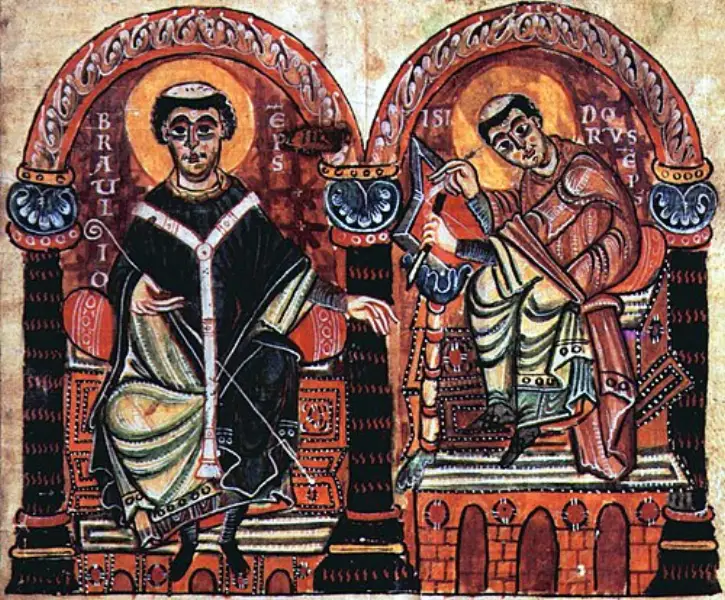
Overview
Braulio, known in Latin as Braulius Caesaraugustanus, was born around 585 into a noble Hispano-Roman family and became bishop of Zaragoza, dying around 651. His father Gregory held the see of Osma, and a sister and two brothers likewise rose high in the Church, so that Braulio belonged to that class of ecclesiastical dynasties which carried Roman learning into the Visigothic age. He took the monastic habit in 610 and studied at the school of Isidore in Seville, by whom he was ordained in 624, joining the clergy of that city. The following year he went back to Zaragoza, over which his brother John presided as bishop, to serve as his archdeacon; on John's death in 631 he succeeded to the see. As bishop he was noted for personal austerity, almsgiving and preaching, and he advised several Visigothic kings, above all Chindasuinth, on whose behalf he recommended the installation of the king's son Recceswinth as associate ruler. He laboured with Isidore to draw the Visigoths away from Arianism, encouraged the older man's encyclopaedic project, and, after Isidore dispatched the great work to him for correction, he split the mass of it into twenty books and named it. He sat at the councils of Toledo of 633, 636 and 638, and answered Rome for the Iberian clergy when Pope Honorius I questioned their diligence over baptised Jews who had lapsed. Blind near the end of his life, he was buried at Zaragoza and was succeeded by his pupil Taius. He is a patron of Aragon and of the University of Zaragoza.
The Complete Life
A Family of the Hispano-Roman Church
Braulio was born around the year 585 into a family that embodied the survival of Roman Hispania under Gothic rule. His father Gregory held the bishopric of Osma, and of his siblings a sister and two brothers all came to occupy key posts in the Catholic Church, a concentration of ecclesiastical office within one household that tells us much about the class from which the learned leadership of the Visigothic kingdom was drawn. These were families in which the Latin literary tradition was transmitted privately, generation to generation, long after the imperial administration had gone, and Braulio's later career as a writer and correspondent shows how thorough that early formation was. The exact place of his birth is not recorded, but his whole life was lived within the Hispanic provinces of the Kingdom of the Visigoths, the realm that endured from the fifth century to the eighth and within which Braulio stands among the most celebrated of saints both as pastor and as writer. The dates of his birth and death, approximately 585 and 651, bracket a maturity that coincided exactly with the great effort of the Spanish church to convert its Gothic rulers from Arianism and to build a Catholic intellectual culture on Roman foundations. To understand Braulio one must see him as a man formed between two worlds, heir of the old provincial aristocracy and servant of a new barbarian kingdom, mediating between them as scholar, bishop and royal counsellor.
§ Life
Monk, Priest, Archdeacon, Bishop
The steps of Braulio's vocation can be followed more closely than those of most men of his century. In 610 he took the habit of a monk, embracing the ascetic discipline that underlay all serious Christian scholarship in Visigothic Spain. His gifts then carried him south to Seville, to the school conducted by Isidore, the most learned man of the age, where he studied under the master with whom his name would be joined ever after. In 624 Isidore ordained him priest, and Braulio entered the body of clergy serving the see of Seville, gaining that experience of diocesan administration which the church of the time demanded of its leading men. The following year, 625, brought him home: he returned to Zaragoza in the Ebro valley, where his brother John now governed as bishop, and there he served as archdeacon, the chief officer of the diocese. When John died in 631, Braulio was chosen to succeed him, and from that seat he exercised the office that defined the rest of his life. The succession of brother by brother within one family was characteristic of a church that still thought in kinship terms, but Braulio's own merits as administrator, preacher and scholar made the choice more than mere family arrangement. From 631 until his death around 651 he ruled the see of Zaragoza, and at his death the succession passed to Taius, called Taio, who had been his pupil, so that his school continued in his own cathedral.
§ Life
Counsel to Kings and Councils
As bishop of Zaragoza Braulio exercised an influence that reached far beyond his diocese. He was present at the councils of Toledo held in 633, 636 and 638, the great assemblies at which the Spanish church and the Gothic monarchy legislated together for the Christian order of the kingdom, and his voice carried weight in that company. He served as advisor and confidant to several Visigothic kings, foremost among them Chindasuinth, and his counsel carried the elevation of Recceswinth, the king's son, to rule as associate king, an act of political theology that secured the succession and spared the realm the turmoil that had dogged earlier reigns. With Isidore he worked to convert the Visigoths from Arianism, the heresy that had long divided rulers from ruled, and that shared labour of eradicating error and leading national councils at Toledo and Seville helped to unify the kingdom under Catholic faith. When Pope Honorius I addressed a charge hinting that the clergy of Iberia had grown careless of their duties, and the reply came from Braulio on behalf of all of them. Among Rome's concerns was the handling of Jews who had accepted baptism and afterwards fallen away from the faith, a question on which the Iberian bishops were suspected of laxity; the exchange belongs to the harder edges of seventh-century churchmanship, and Braulio stood in the middle of it as the responsible spokesman of his episcopate.
§ Life
Austerity, Almsgiving and the Making of the Etymologiae
The character of Braulio's inner life is recorded in three words used by his biographers: austerity, almsgiving and preaching. He kept his own house hard, his purse open, and his voice in the pulpit constant, a triad that the early medieval church regarded as the visible shape of holiness in a bishop. Yet the most remarkable spiritual friendship of his life was literary. Isidore of Seville faced a rising threat of Gothic barbarism, and his strategic answer was teaching, the assembling of the whole inheritance of ancient learning into a form the new age could use. Braulio is said to have encouraged Isidore toward that encyclopaedic enterprise and to have shared in revising what he wrote. When the great compilation was finished, Isidore dedicated it to Braulio and sent it to him for correction; it was Braulio who divided the unwieldy mass into its twenty books, and Braulio who supplied its famous label, Quaecunque fere sciri debentur, roughly 'nearly all that a man need know'. The service was more than editorial. By ordering the work he made it usable, and the Etymologiae became the standard book of the Middle Ages, read in place of the many ancient tomes it had drawn from, some of which ceased to be copied and disappeared as a result. A bishop's humility in serving another man's masterpiece is itself a spiritual document.
§ Life
Blindness and Death at Zaragoza
The close of Braulio's life carried a particular affliction for a man of letters: towards the end he lost his eyesight, and the scholar who had arranged the knowledge of the world for others finished his course in darkness. A bishop who had answered popes and counselled kings now depended on others to read to him, and the preaching for which he was known had to be carried on without notes or sight. He died around the year 651, some nineteen or twenty years after his consecration to the see, and was buried in Zaragoza in what is now the church of Nuestra Señora del Pilar, the great Marian shrine of the city on the Ebro. His remains now rest in La Seo Cathedral, the metropolitan church of Zaragoza, where his shrine is honoured as the major site of his cult. The succession passed to Taius, also written Taio, who had been his pupil and who carried forward the intellectual tradition of the Zaragozan church. The dates given for Braulio's death vary only slightly in the sources, and the feast of the saint is kept on 26 March generally and on 18 March in Spain, the local observance preserving its own calendar loyalty. He died within two decades of Isidore, and with him the generation that had built the Catholic culture of Visigothic Spain began to pass away.
§ Life
Honoured as Patron of Aragon
Braulio belongs to the immense company of saints recognised before the modern process of canonisation existed, and his cult rests on the immemorial veneration of the Spanish church. He is honoured in the Roman Catholic Church and in the Eastern Orthodox Church, and his feast is observed on 26 March, with the particular observance of 18 March kept within Spain itself. His shrine is at Zaragoza, where his remains lie in La Seo Cathedral, and the basilica of Nuestra Señora del Pilar is his major shrine in the city of his burial. Devotion to him has had a distinctly institutional expression in modern times his patronage covers Aragon and the University of Zaragoza, the latter counting him as its heavenly protector, and in 2021 the university revived the celebration of his feast in reduced form, resuming an observance of its patron that had lapsed, as the Spanish press reported at the time. The association of the saint with a university is fitting to his memory, for his own life joined learning and holiness inseparably. No formal decree of canonisation exists because none was needed; the church of the seventh century declared its saints by celebrating them, and the liturgical books of Spain carried Braulio's name into every generation that followed. The authority of his cult is that of a bishop renowned in his own lifetime for austerity, generosity and teaching, remembered without interruption at his tomb.
§ Life
The Letters and the Library of a Kingdom
Several of Braulio's own works have come down to us, and they form a modest but real corpus. He wrote a life of Emilian of Cogolla, the hermit saint of the Rioja, a work that helped fix the memory of one of Spain's native holy men. Forty-four of his letters survive, works not mentioned in antiquity but brought to light in the eighteenth century at Leon, and they show the bishop in correspondence across the learned world of his day, advising, consoling and negotiating. Scholars in numbers attribute to him the Acts of the Martyrs of Saragossa, which preserve the memory of the city's early witnesses, the Passio S. Leocadiae, the passion of Toledo's virgin martyr, may likewise be from his hand. His greatest legacy, however, is the one he did not sign: the Etymologiae of Isidore, which he divided into twenty books and launched into the world, a book that medieval writers used so extensively that it was read in place of its sources and preserved the shape of ancient knowledge for a thousand years. Modern scholarship continues to work on his texts, with editions and translations of the Iberian Fathers keeping his letters in print, and the histories of the Goths in Spain resting partly on the church he served. At Zaragoza his name is borne by the university that claims him as patron, and a digital copy of the 1601 first printing of his Life of Emilian is now accessible online.
§ Works
Timeline
- 585
Born a nobleman of Hispano-Roman stock; his father Gregory ruled the see of Osma
§ Life
- 610
Takes the habit of a monk, and later studies at Isidore's school in Seville
§ Life
- 624
Ordained by Isidore and joins the clergy serving Seville
§ Life
- 625
Returns to Zaragoza, serving as archdeacon to his brother John, the city's bishop
§ Life
- 631
Succeeds his brother John as bishop of Zaragoza
§ Life
- 633
Attends the council of Toledo, the first of three he joins
§ Life
- 636
Attends the council of Toledo for the second time
§ Life
- 638
Attends the council of Toledo for the third and final time
§ Life
- 651
Dies at Zaragoza after losing his eyesight, and is succeeded by his pupil Taius
§ Life
In Their Own Words
Quaecunque fere sciri debentur
The Record
- Major works
- A life of Emilian of Cogolla·Forty-four letters, discovered in the eighteenth century at Leon·"Acts of the Martyrs of Saragossa", attributed to him by many experts·Passio S. Leocadiae, which he may also have written
- Patron of
- Zaragoza·Aragon·University of Zaragoza
- Symbols
- Bishop's vestments·Book, for his division of Isidore's Etymologiae into twenty books
- Canonization
- Pre-congregation; venerated in the Roman Catholic and Eastern Orthodox Churches as bishop and confessor
Prayer
Bibliography
Show 7 sources
- "Braulio of Saragossa", Oxford Quick Reference, Oxford Reference
- Farmer, D.H. (2011), Oxford Dictionary of Saints, 5th ed. rev., Oxford University Press, ISBN 978-0-19-959660-7
- Weber, Nicholas, "St. Braulio", The Catholic Encyclopedia, Vol. 2, New York: Robert Appleton Company, 1907
- Ghezzi, Bert, "Saint Braulio", Voices of the Saints, Loyola Press, ISBN 978-0-8294-2806-3
- Rusche, Philip G. (October 2005), "Isidore's 'Etymologiae' and the Canterbury Aldhelm Scholia", The Journal of English and Germanic Philology 104 (4), pp. 437-455
- Thompson, E. A. (1969), The Goths in Spain, Oxford: Clarendon Press
- Barlow, Claude W. (trans.), ed. (1969), Iberian Fathers: Writings of Braulio of Saragossa, Fructuosus of Braga, Washington, D.C.: Catholic University of America Press
Profile text adapted from the Wikipedia article, licensed CC BY-SA 4.0.
Pray with this saint every day
Save St. Braulio of Zaragoza to your favorites, read the full profile, and get feast-day reminders in the Saints app.
Get the Saints AppFree on the App Store for iPhone and iPad