
5th or 6th century (traditional)·Feast June 4
St. Breage
Irish Nun and Traditional Founder of a Cornish Church
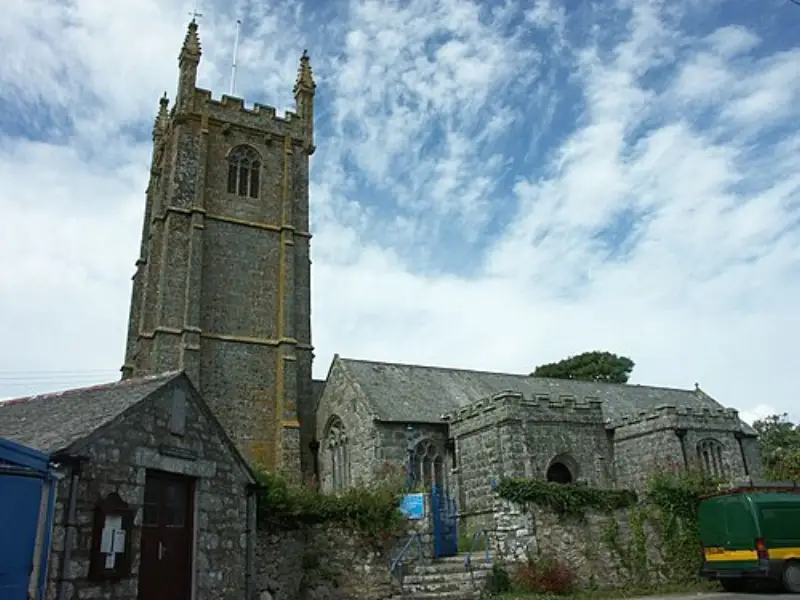
Overview
Breage, or Breaca, a name that appears under many spellings, is the saint honoured in Cornwall and the adjoining south-west of England. Her late hagiography makes her an Irish nun of the fifth or sixth century who founded a church in Cornwall, and the village, civil parish and parish church of Breage all take their name from her. The medieval life that told her story, probably composed in the fourteenth or fifteenth century, is lost, but the antiquary John Leland copied extracts from it into his Itinerary around 1540, and those fragments are the substance of what is known. Leland's text makes her a native of Lagonia and Ultonia in Ireland, perhaps Leinster and Ulster, a nun at an oratory founded by Brigid of Kildare on the plain called Campus Breace in County Meath, and a traveller to Cornwall around 460 in the company of seven other Irish saints, among them Germoe and Sithney. Some of that company were said to have been killed by the tyrant Tewdwr Mawr of Penwith, but Breage pressed on regardless, passing the hill of Pencaire and planting a church at Trenewith, also called Chynoweth. Her feast in later times fell on 4 June and was once prominent in Cornwall and the Diocese of Exeter; William Worcester in 1478 recorded a feast of 1 May and her burial at her church. Scholars regard the whole narrative as late legend built on a lost local cult.
The Complete Life
An Irish Nun of Campus Breace
The traditional account of Breage's beginnings survives only in fragments preserved by John Leland, the antiquary who toured England recording its manuscripts. Her medieval life, probably written in the fourteenth or fifteenth century, has been lost entirely, and it is Leland's extracts, set down in his Itinerary around 1540, that allow any narrative at all. That text gives her birth to the Irish regions of Lagonia and Ultonia, wording that modern readers find unclear but which may point to Leinster and Ulster. As a nun she was attached to an oratory that Brigid of Kildare had founded at Campus Breace, the Plain of Breague, usually identified with Mag Breg in modern County Meath. Scholarship warns, however, that this Irish origin is suspect: in this period it was common in Cornwall to attach a fabricated Irish pedigree to obscure saints, and in Breage's case the suggestion may have arisen simply from the resemblance between her name and that Campus Breace of the Brigidine tradition. The lost life was, moreover, assembled from borrowed material, drawing on a Life of Brigid of Kildare and on Breton traditions of Saint Sithney, together with lives of local Cornish saints such as Elwen, Ia and Gwinear. Its author knew the hagiographical tradition intimately and filled a local need with it. Whatever the history beneath, the text fixes Breage as a consecrated virgin formed, in story at least, in the greatest of Irish women's monasteries.
§ Traditions
The Journey to Cornwall
The legend sends Breage to Cornwall around the year 460 as one of eight Irish saints crossing together: Germoe, Senanus or Sithney, Mavuanus, possibly Mawnan, Elwen, Crowan, Helena and Tecla. The company settled first at Revyer on the River Hayle, an estuary in the west of the county, and there the story turns violent, for some of the immigrants were killed by Tewdwr Mawr of Penwith, a tyrant who appears regularly in Cornish hagiography as the stock persecutor of arriving saints. Undaunted, Breage kept going, crossing Cornwall by way of the hill of Pencaire and planting a church at Trenewith, also called Chynoweth. On her death, the story goes, the church was shifted to its present position, and many miracles were reported at her tomb. Every element of this deserves reserve: the company of fellow saints, the heathen tyrant and the hermitage in a remote part of a later parish are exactly the stock elements that recur in Cornish saints' lives of this kind, and the whole reads as later legend attached to a figure whose genuine history had already been lost. Yet the mission the story encodes is real in one sense: a church existed, a cult attached itself to a female saint's name, and a community grew around it that eventually named its village and parish after her. That material achievement, a named parish around a dedicated church, is the durable core of Breage's mission.
§ Traditions
A Parish that Kept Her Name
Breage's survival is topographical. Her church in Cornwall is documented from 1170, an establishment old enough to have given its name, not received it, to the village and civil parish of Breage around it, and the parish church remains dedicated to her today. She is honoured as a saint in the Eastern Orthodox Church and in the Catholic Church, and her cult once spread beyond the parish, for her feast in later times was kept on 4 June and was evidently a prominent observance in Cornwall and in the Diocese of Exeter in Devon; William Worcester, writing in 1478, had earlier recorded a feast on 1 May and the tradition of her burial at the church. A Breage Fair is still held on the third Monday in June, a continuing echo of the medieval feast. Folk memory added its own accents: an eighteenth-century saying recorded at nearby Germoe held that while that village's patron Germoe had been a king, Breage was a midwife, and in the nineteenth century the people of St Levan held her to be the sister of their own saint Selevan, or Salaman. Scholars have noted that her feast day of 1 May coincides with that of Brioc, a male saint active in the same area in the early Middle Ages, though all medieval mentions of Breage treat her as female, which complicates any simple identification; a Breton Saint Briac also exists. Brief accounts appear later in Alban Butler and Sabine Baring-Gould, both drawn from Leland.
§ Identity
Timeline
- 460
Travels from Ireland to Cornwall with seven companion saints, settling at Revyer on the River Hayle
§ Traditions
- 1170
A church at Breage stands by this date; village and parish take their name from it
§ Traditions
- 1478
William Worcester records her feast on 1 May and her burial at her church
§ Traditions
- 1540
John Leland copies extracts from her lost medieval life into his Itinerary
§ Traditions
The Record
- Major works
- Church at Trenewith or Chynoweth, later moved to the present site of Breage, Cornwall
- Patron of
- Village and parish of Breage, Cornwall
- Symbols
- Nun's veil, from her traditional representation
- Canonization
- Pre-congregation; venerated in Cornwall and South West England in the Catholic and Eastern Orthodox Churches
Prayer
Bibliography
Show 3 sources
- Koch, John (2006), Celtic Culture: A Historical Encyclopedia, ABC-CLIO, ISBN 1-85109-440-7
- O'Hanlon, John T. (1873), Lives of the Irish Saints: With Special Festivals, Vol. 6, J. Duffy & Sons
- Orme, Nicholas (2000), The Saints of Cornwall, Oxford University Press, ISBN 0-19-820765-4
Profile text adapted from the Wikipedia article, licensed CC BY-SA 4.0.
Pray with this saint every day
Save St. Breage to your favorites, read the full profile, and get feast-day reminders in the Saints app.
Get the Saints AppFree on the App Store for iPhone and iPad