
died 29 November 571 (c. 573 in some sources)·Feast November 29
St. Brendan of Birr
Prophet of Ireland and Friend of Columba
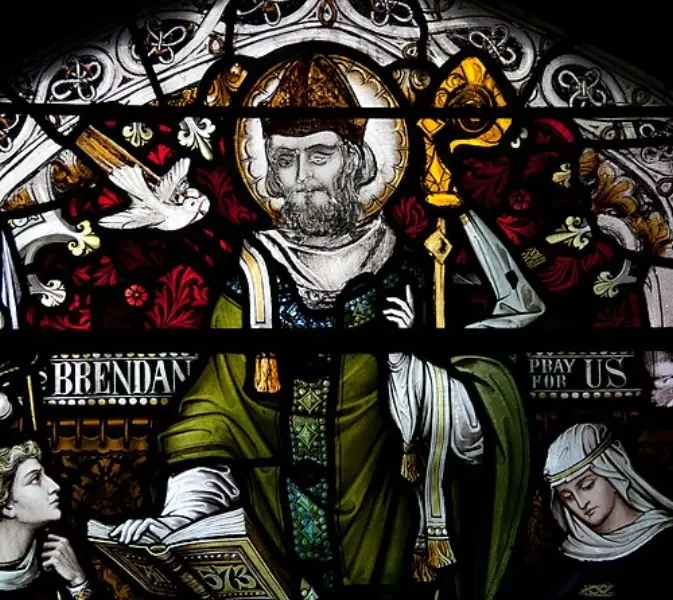
Overview
Brendan of Birr, who died on 29 November 571, was an Irish monk and abbot of the sixth century, known as Saint Brendan the Elder so as not to be confused with his friend Brendan the Navigator of Clonfert, a contemporary. He is said to have come from a noble family of Munster, and he received his formation at the monastic school of Clonard Abbey under Finian, in the decades when the collapse of the druid tradition had opened Ireland to the new faith and its monasteries had become the homes of Latin learning and Christian theology. So renowned was Clonard that its scholars under instruction are said to have averaged three thousand, and twelve of Finian's students won the name of the Twelve Apostles of Ireland, and Brendan of Birr stood among them. At Clonard he formed the friendships that marked his life, with Ciaran of Saigir and with Brendan of Clonfert. Around 540 he founded the monastery at Birr in central Ireland and ruled it as abbot. Early Irish writings draw him as notably hospitable, esteemed for holiness, and discerning in judging character and one of the chief prophets of Ireland, a title the record keeps for him. At the synod of Meltown, called over Columba's part in the battle of Cul Dreimhne in 561, Brendan spoke in Columba's defence and helped win exile rather than excommunication for his friend. Columba is said to have seen a vision of Brendan's soul carried by angels at his death, and to have ordered a Mass in his honour.
The Complete Life
A Noble of Munster at Clonard
Brendan of Birr entered the world as the traditions of Ireland remember such men, in a noble household of Munster, the southern of the island's great provinces. The exact year and place are not recorded, but the age is certain: he was a man of the sixth century, that first great monastic century of Irish Christianity, when the druid tradition of old gave way before the new faith, whose learning passed into a new sort of school. The vehicle of that transfer was the monastery, where the study of Latin letters and Christian theology flourished as nowhere else in the western world at that moment, and the greatest of the Irish schools was Clonard Abbey, conducted by Finian. The scale of the place astonishes even now: instruction at Clonard, it is said, was given on average to three thousand scholars at a time. Out of that multitude twelve students of Finian were afterwards known as the Twelve Apostles of Ireland, the founders and fathers of the Irish church's monastic expansion, and Brendan of Birr is named among them, in the company of Ciaran of Saigir, Ciaran of Clonmacnoise, Columba of Iona, Senan of Iniscathay and the rest. His later fame as an abbot owes its beginning to those student years, in which the friendships and the learning that would shape the Irish church for generations were formed together in one crowded school.
§ Background
The Elder Brendan
At Clonard the young Brendan of Munster found the two friendships that the sources set beside his whole career. The first was with Ciaran of Saigir; the second, and the more consequential, was with the other Brendan of his generation, the man from Clonfert whom the world would call the Navigator. The two Brendans were contemporaries and friends, and to keep them apart in the record the elder of them, the man of Birr, was distinguished as Saint Brendan the Elder. Both were numbered among the Twelve Apostles of Ireland, both founded monasteries, and both lived into the second half of the sixth century; but their reputations took opposite shapes. The younger Brendan sailed into legend, while the elder stayed at the centre of the island and became known for prophecy, discernment and friendship rather than voyaging. It was also at Clonard that Brendan came within the orbit of Columba, then another of Finian's students, whose later friendship and support would produce important connections between the monastery of Birr and the Columban foundations in Scotland and the north. For a monk of this period vocation was not a private matter of conscience but the entry into a web of kinship, tutelage and affection, and the community formed in one schoolroom at Clonard would decide the shape of the Celtic church for a century afterwards. Brendan's own part in it was to hold the middle of Ireland.
§ Life
Abbot of Birr and Advocate at Meltown
In about the year 540 Brendan established the monastery of Birr, in the very centre of Ireland, and governed it as abbot until his death three decades later. Birr stood at a crossing of the island's routes, and the character of its founder matched the position: the early Irish sources describe a generously hospitable man, famed for holiness and spirituality, with the intuition of a born judge of character. It was this last quality, joined to his standing among the churchmen of the day, that produced the most famous act of his career. In 561 the battle of Cul Dreimhne had been fought in which men of Columba's kindred were implicated, and a synod assembled at Meltown to try Columba for his part in the slaughter. Brendan attended and spoke on Columba's behalf, with the result that the assembled clerics imposed exile rather than excommunication, sending Columba to Scotland instead of casting him out of the church. The intervention changed the history of Christianity, for the exile of Columba gave Britain Iona and the northern mission. Brendan's friendship and support for Columba thereafter tied Birr to the Columban foundations in lasting association. In an Irish church where abbots and kin-groups settled the affairs of kings, the abbot of Birr proved that the voice of one holy man could turn a sentence of ruin into a sentence of mission.
§ Life
Prophet of Ireland
The title that Ireland gave Brendan of Birr was Prophet of Ireland, and the sources treat it as no rhetorical flourish but as a considered estimate of his gifts. Ireland counted him among its chief prophets, a rank the record supports both by his formal title and by the one public act in which his discernment is shown, the defence of Columba at Meltown, where the intuition of the man stood against the assembled judgement of the clergy and prevailed. The other marks of his spirituality are the classical virtues of the Irish abbot: hospitality held open at a monastery set where roads meet, generosity that made his house a refuge, and the sanctity that his contemporaries took for granted. The end of his life was honoured by the witness his friend bore to it. One of Columba's advisers told how Columba beheld a vision of angels carrying Brendan's soul away at his death, and at once ordered a Mass in his honour. For two men whose friendship had been formed in a schoolroom at Clonard and tested at a church trial, the vision is a fitting close: the prophet who had spoken for his friend at the hour of his condemnation was met, at the hour of his death, by the sight of angels, and the friend returned the tribute of a Mass. The tradition adds that the judgement of Brendan's character was rarely at fault, the quiet charism of a man who saw what was in people before they showed it.
§ Life
The Gospels of Birr
Brendan died on 29 November in the year 571, and the day has remained his feast in the calendars of the churches that honour him. His monastery outlived him into the flourishing centuries of Irish monasticism and produced its own enduring monument: the MacRegol Gospels, an illuminated Gospel book which survives today in the Bodleian Library at Oxford, one of the great insular Gospel books and a standing reminder that the quiet monastery of the Midlands reached the first rank of artistic achievement. The feast of the saint is kept on 29 November, and his cult is recognised in the Roman Catholic Church, the Eastern Orthodox Church and the Anglican Communion. One curious footnote belongs to his standing: traditional though his veneration is, his name is absent from the Catholic Church's most recent complete official martyrology, the Latin Martyrologium Romanum of 2004, so that his veneration rests on tradition and the calendars of the churches rather than on the modern Roman book. His truest memorial is fraternal: the friendship with Columba, sealed when he saved him from excommunication and greeted his departure into exile, bound Birr to the Columban foundations and left the Elder Brendan standing beside the greatest of the Irish missionaries as their advocate and friend.
§ Life
Timeline
- 540
Founded the monastery at Birr, in central Ireland, around this time and ruled it as abbot
§ Life
- 561
Spoke for Columba at the synod of Meltown, convened over the battle of Cul Dreimhne, winning him exile rather than excommunication
§ Life
- 29 Nov 571
Died at Birr; Columba later told of seeing his soul borne away by angels and ordered a Mass for him
§ Introduction
The Record
- Major works
- Foundation of the monastery at Birr, central Ireland
- Symbols
- Abbot's crozier·Prophet's mantle, from his title Prophet of Ireland
- Canonization
- Pre-Congregation; honoured in the Roman Catholic, Eastern Orthodox and Anglican traditions
Prayer
Bibliography
Show 6 sources
- Duffy, Patrick, "Brendan of Birr, Abbot", Caitlicigh Ar An nGreasan
- "St. Brendan the Elder of Birr", Birr Historical Society, retrieved 12 May 2013
- Gratton-Flood, W.H. (1 March 1907), "The Twelve Apostles of Erin", The Catholic Encyclopedia, Vol. I, New York: Robert Appleton Company
- Farmer, David Hugh (1997), The Oxford Dictionary of Saints, 4th ed., Oxford University Press, p. 72, ISBN 0-19-280058-2
- Lanigan, John (1829), An ecclesiastical history of Ireland, from the first introduction of Christianity to the beginning of the thirteenth century, Printed for J. Cumming, p. 91
- Adomnan of Iona (1995), Life of St Columba, Penguin Books Limited, p. 214, ISBN 978-0-14-190741-3
Profile text adapted from the Wikipedia article, licensed CC BY-SA 4.0.
Pray with this saint every day
Save St. Brendan of Birr to your favorites, read the full profile, and get feast-day reminders in the Saints app.
Get the Saints AppFree on the App Store for iPhone and iPad