
c. 484 – c. 577·Feast May 16
St. Brendan the Navigator
Abbot of Clonfert and Voyager of the Atlantic
Overview
Brendan of Clonfert, born around 484 in the territory of Ciarraighe Luachra near Tralee in Kerry, ranks among the chief early monastic saints of Ireland and is counted one of the Twelve Apostles of Ireland. His people were the Altraige, a clan settled around Tralee Bay, and his parents were called Finnlug and Cara; portents at his birth and baptism by Erc of Slane led to his naming Broen-finn, meaning fair-drop. He was fostered and taught for five years by Íte of Killeedy, the Brigid of Munster, then sent at six to Jarlath's school at Tuam, and later numbered among the pupils of Finnian of Clonard. Ordained priest at twenty-six, he founded monasteries at the Aran Islands and, between 512 and 530, built cells at Ardfert and Shanakeel beneath Mount Brandon, from which the famous voyage is said to have sailed. In legend he is the navigator who set out over the Atlantic with a crew of monks in a hide-covered currach to seek the Isle of the Blessed, the adventure told in the Navigatio Sancti Brendani Abbatis, one of the most widely copied books of the Middle Ages. In history he founded houses across western Ireland, most notably Clonfert, and died around 577 at Annaghdown while visiting his sister Briga, his body being carried secretly back to Clonfert. He is patron of two Irish dioceses, of sailors and travellers, and of the United States Navy.
The Complete Life
A Child of Tralee Bay
Brendan was born in the year 484 on the north side of Tralee Bay in County Kerry, in the south-west of Ireland, in the territory called Ciarraighe Luachra. His people were the Altraige, an Irish clan whose original centre lay on Tralee Bay itself, and his parents are named in the tradition as Finnlug and Cara; the locality of his birth is given as the Kilfenora or Fenit area. The boy was taken for baptism to Tubrid, near Ardfert, where Erc of Slane performed the rite. He was to have been called Mobhi, but signs and wonders attending his birth and baptism led instead to the name Broen-finn, which means fair-drop. His childhood was shaped by the two great institutions of early Christian Ireland, fosterage and the monastic school. For five years Íte of Killeedy, the holy woman called the Brigid of Munster, fostered and taught him, whose house formed several of the saints of the age. At six he passed to the monastery school of Jarlath at Tuam for further schooling, and in due course he is counted among those formed by Finnian of Clonard, the company known ever after as the Twelve Apostles of Ireland. Around these slender facts the whole later legend would grow, but the beginning is a Kerry child, fostered by a saint, taught by bishops, marked out from birth.
§ Early life
Ordination and the First Foundations
Brendan's vocation unfolded through a series of foundations spread across the Irish coast and the neighbouring seas. At the age of twenty-six he was ordained a priest by Erc, the same bishop who had baptised him at Tubrid, and the date implied is around 510. Afterward he founded a number of monasteries. His first voyage of foundation carried him to the Aran Islands, where he established a house, and on the same journey tradition sends him to Hinba in Argyll, a Scottish island, where he met Columcille; the same journey ran on to Wales and ended in Brittany on the French north coast. The circuit shows the reach that an Irish churchman of standing could command even before his greatest work. Between 512 and 530 came the foundations nearest his heart: he built monastic cells at Ardfert in Kerry and at Shanakeel, written Seana Cill and usually rendered the Old Church, at the foot of Mount Brandon, the Kerry mountain that bears his name. From that western launching place he is supposed to have set out on the famous seven-year voyage toward Paradise, and the old Irish calendars preserve a feast for the departure of the family of Saint Brendan, evidence that the memory of an actual embarkation was kept liturgically. The hermit cells at the mountain's foot remained the anchor of his life between voyages.
§ Foundations
Founder of the Western Churches
The historical mission of Brendan, as distinct from the legend of his voyage, was the planting of churches across the west of Ireland and beyond. Ardfert once established as a bishopric, he moved on into Thomond and planted a monastery on Inis-da-druim, the island now called Coney Island, in the parish of Killadysert, County Clare, in or around 550. He then journeyed again to Wales, where he studied under Gildas at Llancarfan, and thence to Iona, leaving traces of apostolic zeal in the place-names Kil-brandon near Oban and Kil-brennan Sound on the Scottish coast. His three-year mission in Britain done, he came home to Ireland and preached through several districts of Leinster, notably at Dysart in County Kilkenny, at Killeney near Durrow, where the well called Tóbar Bó, the Well of the Cow, is remembered, and at Brandon Hill, which carries his name. He established churches at Inchiquin in County Galway and on Inishglora off the County Mayo coast. The crowning foundation came with Clonfert in Galway around 557, and his most celebrated establishment, Clonfert Cathedral, in 563, over which he set Moinenn as prior and head master. His name is perpetuated in landmarks all along the Irish seaboard, among them Brandon Point, Mount Brendan, Brandon Bay, Brandon Head and Brandon Well, a map of his labours written into geography.
§ Later life
The Sea as Desert
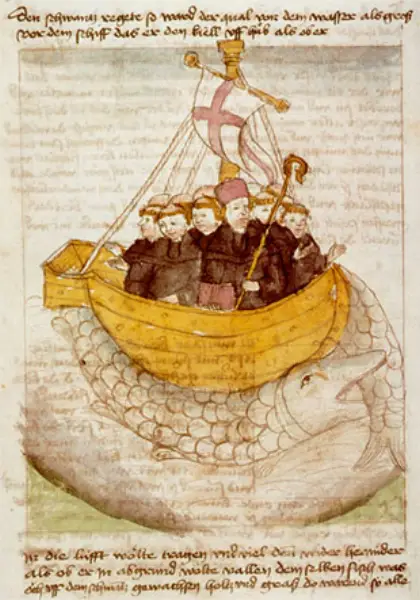
The spirituality of Brendan is inseparable from the Navigatio Sancti Brendani Abbatis, the narrative that made his name known across Europe. On the Kerry coast, the story relates, he built a boat of the currach type, a wattle frame covered by hides cured in oak bark and dressed with butter; mast and sail were then stepped, and after his company had fasted for forty days, put to sea in the name of the Most Holy Trinity. The tale itself belongs to the immram, a genre peculiar to Ireland in which a hero sails through a sequence of wonders; in the Navigatio that inherited form was baptised into an ascetic tradition in which Irish monks set out alone on the ocean as their desert fathers had withdrawn to caves, the sea as désert liquide. The wonders are famous: the island that proves to be the great fish Jasconius, lit afire beneath the monks' cooking pot; the Island of Birds; the community of silent monks on the Island of Ailbe; the pillar of crystal and the fires of Hell, which many modern readers connect with icebergs and Icelandic volcanoes. Scholars caution that the search for real locations behind these scenes misses the author's purpose, whose subject was salvation, obedience in the monastic life, and the faith a pilgrimage of that sort requires. The three late-joining passengers who unbalance the voyage, borrowed from the older tale of Máel Dúin, carry the moral that God's chosen number must be kept.
§ Context
Annaghdown and the Secret Burial
Brendan's last years were spent at Annaghdown in County Galway, the monastery he had founded on Lough Corrib and where he settled after his final return from Wales and Iona. There too he established a convent for his sister Briga, binding his own house to a community of women in the customary Irish fashion. He had reached old age by the standards of his century, in his ninety-third year by the traditional reckoning. Around the year 577 he died at Annaghdown while on a visit to his sister. What followed is one of the most human episodes in the early Irish records: fearing that devotees would fight over his remains as relics once he was gone, he had arranged beforehand that his body should be returned secretly to Clonfert, concealed in a luggage cart, and so it was done. The stratagem speaks volumes about the cult of relics in sixth-century Ireland, fierce enough that a dying abbot had to smuggle his own corpse past his admirers, and about the attachment of Brendan to the great foundation of his middle years. He was interred in Clonfert Cathedral, where his shrine remained the centre of the house's life; the abbacy of Clonfert was counted from 563 to 577 in the lists of his successors, Seanach Garbh following him in the office. He died as he had lived, a monk among monks, and even his burial was an act of government.
§ Later life
Feast on the Sixteenth of May
The Catholic Church acknowledged Brendan's sanctity in the ordinary way of the early Middle Ages, by the consent of the Christian people and the entry of his name in the calendars, long before any formal process of canonisation existed. 16 May is his feast, kept alike by Catholics, Anglicans and Orthodox, the three communions that together inherited the calendar of the undivided Western church. His major shrine was at Clonfert, where he was buried, and as the story of the seven years' voyage ran abroad, Ardfert drew crowds of pilgrims and students; houses arose at Gallerus and Kilmalchedor, at Brandon Hill and among the Blasket Islands, to serve those seeking the saint's spiritual direction. Devotion to him has taken institutional form in the modern church: he is the patron of two Irish dioceses, Kerry and Clonfert, and his protection is invoked by boatmen, mariners, sailors, travellers, divers and even whales, together with the United States Navy and, in a striking modern extension, those who portage canoes overland. The scuba diving industry has adopted him as its patron saint. The earliest datable witness to his cult is the notice of Adamnán in the Life of Columba written between 679 and 704, with the Martyrology of Tallaght in the ninth century the first to call him a seafarer.
§ Veneration
The Legend that Sailed On
No Irish saint has enjoyed so long an afterlife in the European imagination. The Navigatio survives in over a hundred manuscripts across the continent, in many translations, and its earliest extant version was set down around the year 900, a composition scholars date to the second half of the eighth century, by whose end Aengus the Culdee was already invoking its hero's companions. Around 1121 Benedeit turned the legend into Anglo-Norman verse for Adeliza of Louvain, second wife of Henry I of England, producing the earliest surviving narrative text of that literature and a precursor of the Old French romances. A Dutch version of the twelfth century, De Reis van Sinte Brandaen, remodelled the story as a penance for a monk who had thrown a book of the miracles of creation into the fire. Charts of the later Middle Ages marked a Saint Brendan's Isle in the western ocean, placed anywhere from the south of Ireland to the Canaries, the Faroes, the Azores or Madeira, and maps of Columbus's time still carried it; Paul Chapman has argued that Columbus learned from the Navigatio the pattern of winds and currents he followed on all his voyages. In the late 1970s Tim Severin sailed a leather-clad boat of the Navigatio's description from Ireland toward America, proving the crossing possible and inspiring Shaun Davey's orchestral suite The Brendan Voyage. Novels, poems and songs from Tolkien to Christy Moore have kept the voyage afloat.
§ Tale of reaching North America
Timeline
- 484
Born in the Fenit or Kilfenora area on the north side of Tralee Bay, of the Altraige clan
§ Early life
- 490
Sent at the age of six to Jarlath's monastery school at Tuam
§ Early life
- 510
Ordained a priest at the age of 26 by Erc, who had baptised him at Tubrid near Ardfert
§ Foundations
- 512
Begins in the years from 512 to 530 to build monastic cells at Ardfert and Shanakeel at the foot of Mount Brandon
§ Foundations
- 530
Sails from Shanakeel on the legendary seven-year Atlantic voyage in search of the Isle of the Blessed
§ Legendary journey
- 550
Proceeds to Thomond and founds a monastery at Inis-da-druim, now Coney Island, County Clare
§ Later life
- 557
Founds the monastery of Clonfert in Galway
§ Later life
- 563
Establishes Clonfert Cathedral, his most celebrated foundation, appointing Moinenn as prior and head master
§ Establishments
- 577
Dies at Annaghdown while visiting his sister Briga, his body carried secretly to Clonfert and interred in the cathedral
§ Later life
- 900
The earliest extant version of the Navigatio is recorded, to be copied in over one hundred manuscripts
§ The Voyage of Saint Brendan the Abbot
- 1121
Benedeit translates the Anglo-Norman Voyage of Saint Brendan for Adeliza of Louvain, the earliest Anglo-Norman narrative text
§ Anglo-Norman version
- 1574
The Chiesa di San Blandano at Bronte in Sicily replaces an older chapel of the same dedication
§ Brontë in Sicily
- 1641
Following the Reformation, the ancient cathedral of Clonfert is dismantled
§ Establishments
- 1978
Tim Severin's film The Brendan Voyage documents a leather-clad boat reaching North America
§ Tale of reaching North America
In Their Own Words
the sixty who accompanied St. Brendan in his quest for the Land of Promise
great demons threw down lumps of fiery slag from an island with rivers of gold fire
The Record
- Major works
- Monastic cells at Ardfert and Shanakeel, County Kerry·Monastery at Inis-da-druim, County Clare·Monastery and convent at Annaghdown, County Galway, the convent for his sister Briga·Clonfert Cathedral and monastery, County Galway
- Patron of
- Patron of sailors, mariners, boatmen, divers and travellers·Patron of whales and of elderly adventurers·Patron of the portaging of canoes·Patron of the Dioceses of Kerry and Clonfert·Patron of the United States Navy
- Symbols
- Whale·Priest celebrating Mass aboard a ship while fish gather to listen·Group of monks in a small boat
- Canonization
- Pre-congregation; recognised as a saint by the Catholic Church and honoured by Anglicans and Orthodox on 16 May
Prayer
Bibliography
Show 8 sources
- MacPherson, Alan G., "Pre-Columbian Discoveries and Exploration of North America", in John Logan Allen (ed.), North American Exploration, University of Nebraska Press, 1997, ISBN 9780803210158
- Anderson, John D., "The Navigatio Brendani: A Medieval Best Seller", The Classical Journal 83, 4 (1988), pp. 315-322
- Burgess, Glyn, The Voyage of St Brendan, University of Exeter Press, 2002
- Mackley, Jude S., The Legend of St Brendan, Brill, 2008, ISBN 9789004166622
- Severin, Timothy, "The Voyage of the 'Brendan'", National Geographic Magazine 152:6 (December 1977), pp. 768-797
- Severin, Tim, The Brendan Voyage: A Leather Boat Tracks the Discovery of America by the Irish Sailor Saints, McGraw-Hill, 1978, ISBN 0-07-056335-7
- Selmer, Carl (ed.), Navigatio Sancti Brendani Abbatis, Indiana: University of Notre Dame Press, 1959
- O'Donoghue, Denis, Brendaniana, Dublin: Browne & Nolan, 1893
Profile text adapted from the Wikipedia article, licensed CC BY-SA 4.0.
Pray with this saint every day
Save St. Brendan the Navigator to your favorites, read the full profile, and get feast-day reminders in the Saints app.
Get the Saints AppFree on the App Store for iPhone and iPad