
c. 370 – 444·Feast November 13
St. Brice of Tours
Wayward Disciple of Saint Martin and Fourth Bishop of Tours
Overview
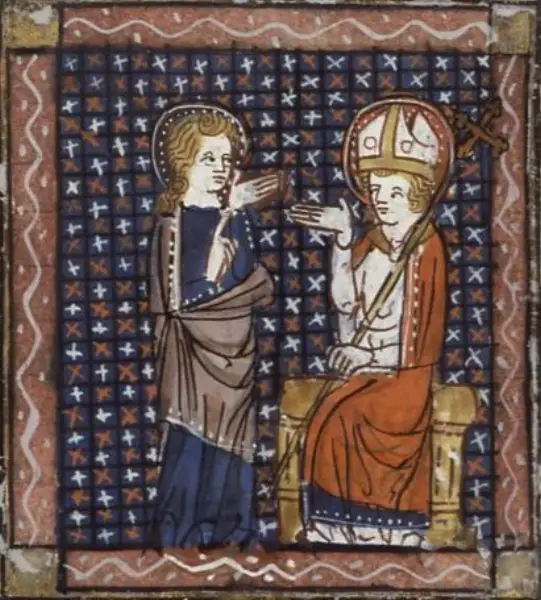
Brice — Latin Brictius, also written Bricius, Brixius, or Briktius — was born around 370 and became the fourth bishop of Tours, inheriting the chair in 397 on the death of Martin, the most celebrated bishop Gaul ever produced. The two men could hardly have been less alike. Brice was an orphan whom Martin rescued and brought up at the monastery of Marmoutier; he took the monastic habit and rose to be Martin's archdeacon, yet contemporaries found him ambitious, quick-tempered, and fond of show — horses in his stables, fine servants in his house. When Martin predicted that this difficult pupil would succeed him, the clergy of Tours objected, and Martin answered with a comparison to Judas that has never been forgotten. As bishop for thirty years Brice was repeatedly accused of worldly living, and each investigation cleared him. Then a child born to a nun in his service was rumored to be his; he carried glowing coals in his cloak to Martin's tomb and showed the garment unburnt, but the townspeople drove him out. Absolved by the pope after seven years in Rome, he returned, built a chapel over Martin's grave, served humbly, and died in November 444 with a reputation for sanctity.
The Complete Life
An Orphan at Marmoutier
Brice entered the world around the year 370, into a Gaul that was still formally part of the Roman Empire but whose western structure was beginning to give way. The old accounts describe him as an orphan, without family protection of the kind that ordinarily launched a Gallic clerical career, and it was Martin, bishop of Tours, who found him, rescued him, and brought him to be raised in the monastic community at Marmoutier outside the city. Christianity had been the official religion of the empire since the close of the fourth century, and Gaul was well advanced in its Christianization; yet the political ground was shifting under everyone's feet, with Germanic kingdoms forming in the course of the migrations and the future deeply uncertain. Brice belonged to the generation of Augustine of Hippo and lived to see the era of the council of Ephesus. In the monastery he received his formation and eventually took the monastic habit, but his character was everything Martin's was not — where the older man was austere and reluctant, the younger was volatile, clever, and openly ambitious. He advanced to the office of archdeacon, the bishop's right hand, which put the contrast between the two men on daily display to the whole city. The clerics of Tours, who had their own views about who should govern them after Martin, watched this trajectory with something close to despair, and eventually petitioned Martin to have the young troublemaker sent away rather than kept in positions of trust.
§ Early life
Martin's Difficult Inheritance
The heart of Brice's vocation lies in Martin's stubborn refusal to give up on him. Warned that this pupil would one day occupy his own chair but would meet many troubles there, and pressed by his clergy to dismiss the young man outright, Martin made the comparison that biographers have quoted ever since: Christ tolerated Judas among the twelve, so he could tolerate Brice among his own. It is one of the sharpest and most self-aware sayings attributed to the great bishop, and it fixed Brice's reputation before he had done anything to earn it. The medieval gossip about the archdeacon's way of living — that he quit the monastery to keep handsome horses and attractive household slaves — comes to us encrusted with later moralizing, and it is impossible to weigh it fairly now. What is clear is that Brice's vocation was not a matter of natural affinity between temperament and office. He was not drawn to the desert or to the bishop's chair by the same gravity that pulled his master; he was, rather, held in the church by another person's patience, and his path to sanctity would run through failure rather than through early excellence. That pattern — the unpromising candidate whom a saint carries anyway — became the interpretive key to his whole later story. Church historians have long read in the legends of Brice a reflection of the real tensions of the era, the friction in Tours between the monastic regular clergy formed at Marmoutier and the secular priests of the city, each side telling the story of the other's bishop in a light favorable to itself.
§ Early life
Trial by Fire and Seven Years in Rome
Brice succeeded Martin as bishop of Tours in 397 and governed the see for three decades. He performed the duties of his office, but the old complaints never fully died: he was said to yield to worldly pleasure, and charges of secular ambition and other failings were brought against him more than once — each time, church investigations examined the matter and released him. The crisis broke in the thirtieth year he held the see. One of the nuns, employed in the episcopal household as a laundress, delivered a baby, and calumny named the bishop as its father. To answer the charge he underwent a public trial by fire, bearing live embers wrapped in his garment over to the grave of the man who had raised him, then showing the cloth untouched by flame as proof that he was innocent. The people of Tours were not persuaded; they threatened him with stoning and forced him out of the city. Brice made his way to Rome, where he sought and obtained absolution from the pope, and he remained in exile there for seven years. During his absence the see was not left empty: several other bishops were appointed to Tours in turn. When at last the last of them died, Brice returned, fully vindicated by the apostolic see, and quietly took up his duties again. One of his first acts was to build a chapel dedicated to Saints Peter and Paul to protect the grave of Martin — a public act of reverence toward the man who had put up with him for so many years.
§ Career
Sanctity After Failure
What distinguishes Brice in the gallery of Gallic saints is that his holiness, if the word can be used, is entirely retrospective. The sources agree that he served his final years with such humility that at his death in November 444 he was already venerated as a saint. That sentence contains a whole spirituality. Brice's claim on the church's memory is not contemplative depth or pastoral genius but endurance: he stayed. He stayed when his own monks distrusted him, stayed when investigations were opened against him, accepted the ordeal of the coals rather than defend himself with words alone, left when the city forced him out, waited seven years in Rome for a judgment he could have engineered his way around, and came back to a diocese that had replaced him several times over. The hot coals in the cloak, which became his standing emblem in art, make the point exactly: the sign of his innocence is the willingness to be consumed if he is guilty. Later iconography added the child in his arms, an image that holds the scandal and its resolution in one figure. Read plainly, his life argues that reputation is not the same as character, that vindication may take decades, and that a man's worst years may not be his last word. For every Christian who has been the difficult disciple — tolerated by someone else's charity long past the point of deserving it — Brice is the patron whether or not anyone has formally named him so.
§ Career
Return and a Humble End
The closing chapter of Brice's life is the inversion of everything that went before. He came back from Rome not as an ambitious prelate resuming a prize but as an absolved penitent resuming a burden, and the sources agree that the manner of his service changed. The last of the bishops appointed in his absence had died just before his arrival, which removed any contest over the see; there was no faction to defeat, only a diocese to care for. In these years he built the chapel of Saints Peter and Paul over the tomb of Martin, an act at once practical and devotional — the grave of the city's greatest saint was given a worthy covering by the successor who had once been his most exasperating pupil. Brice then governed until his death in November of 444, and the tradition that he was venerated as a saint immediately at his passing suggests that the last decade did what the first thirty years of his episcopate had not: it reconciled the city to the man. His memorial was fixed on 13 November. The bones of the bishop who had once fled the threat of stones were themselves later moved: Gregory of Tours translated them to Clermont, and they rest today in the church of San Michele in Pavia, in northern Italy — a long posthumous journey for a saint whose whole life had been about staying put.
§ Veneration
A Saint Before Saints Were Made
Brice belongs to the pre-congregation era, canonized by the common consent of the church centuries before any formal process existed to examine a candidate's life. No bull of canonization exists for him; what exists instead is a memory that survived the collapse of Roman Gaul, the conversion and re-conversion of the Frankish kingdoms, and the Carolingian reordering of the Gallic church, and that emerged on the far side with his name on altars. He is honored in the Eastern Orthodox Church and in the Anglican Communion as well as in the Roman Catholic Church, one of the comparatively small company of Merovingian-era bishops whose cult crossed all later divisions of western Christianity. Biographers across the centuries have found him a genuinely controversial figure, and modern church historians treat the stories that cluster around him — the coals, the nun, the exile — as narrative expressions of the tensions between the regular clergy of Marmoutier and the secular priests of Tours, each community shaping the legend of the other's bishop. That scholarly caution does not diminish the cult; it explains it. A saint like Brice is kept precisely because his story is uncomfortable: the church that honors him is confessing that grace sometimes arrives late, that holy men can be difficult, and that the judgment of a community in one decade may need to be revisited in another.
§ Veneration
The Saint Behind a Massacre's Name
Brice's afterlife in history is oddly double. On one side stands the quiet legacy: churches named for him across France and beyond, and his relics honored first at Clermont and now at San Michele in Pavia. On the other side stands an accident of the calendar that has given his name an entirely different resonance in the English-speaking world. His memorial fell on 13 November, and on that day in the year 1002 the Danes in England were killed in what became known as the St Brice's Day massacre — an act of royal policy under Æthelred II that borrowed the saint's name for reasons having nothing to do with him. The association has been examined by modern historians and remains the most-cited fact attached to his feast outside France. In England, too, the town of Stamford in Lincolnshire long kept 13 November as the day of its traditional bull-running, another folk custom fixed to his date. In art Brice appears as a bishop, marked out either by the glowing coals in his robe or by the child held in his arms — the two images of his crisis, innocence attested by fire and the scandal transformed into tenderness. He stands in the calendar as the great counterexample among the successors of the great confessors: proof that a difficult beginning is not a final verdict, and that the church's memory can hold, without embarrassment, a saint whom nobody at the time much wanted.
§ Veneration
Timeline
- 370
Born around this year, according to legend an orphan rescued by Bishop Martin and raised at the monastery of Marmoutier
§ Early life
- 397
On Martin's death, succeeded him as the fourth Bishop of Tours
§ Career
- 427
Thirty years into his episcopate, a newborn child in his household was rumored to be his; his coal-carrying ordeal convinced no one, and the crowd drove him from Tours
§ Career
- 434
After seven years of exile in Rome, absolved by the pope, he returned to Tours and resumed his duties as bishop
§ Career
- Nov 444
Died after years of humble service and was venerated as a saint
§ Career
- 13 Nov 1002
The killing of the Danes in England on his feast day became known as the St Brice's Day massacre
§ Feast day
In Their Own Words
If Christ could put up with Judas, why should I not put up with Brice?
The Record
- Major works
- Chapel of Saints Peter and Paul at Tours, built to protect the tomb of St. Martin
- Symbols
- bishop's vestments·glowing coals carried in his robe·a child in his arms
- Canonization
- Pre-congregation; venerated in the Roman Catholic, Eastern Orthodox, and Anglican churches
Prayer
Bibliography
Show 7 sources
- Gregory of Tours, "History of the Franks": "De episcopis Turonicis" ("On the bishops of Tours")
- Monks of Ramsgate. "Brixius". Book of Saints, 1921. CatholicSaints.Info, 7 September 2012
- Butler, Alban. "Saint Brice, Bishop and Confessor". Lives of the Fathers, Martyrs, and Principal Saints, 1866. CatholicSaints.Info, 13 November 2013
- DiPippo, Gregory. "The Feast of St Brice, St Martin's Bad Disciple", New Liturgical Movement, 13 November 2015
- Maurey, Yossi. Medieval Music, Legend, and the Cult of St Martin, Cambridge University Press, 2014, p. 3, ISBN 9781107060951
- "Brice, Saint", The Cyclopedia of Biblical, Theological, and Ecclesiastical Literature, James Strong and John McClintock eds., Harper and Brothers, New York, 1880
- Cavendish, Richard (November 2002). "The St Brice's Day Massacre". History Today 52 (11): 62–63
Profile text adapted from the Wikipedia article, licensed CC BY-SA 4.0.
Pray with this saint every day
Save St. Brice of Tours to your favorites, read the full profile, and get feast-day reminders in the Saints app.
Get the Saints AppFree on the App Store for iPhone and iPad