
c. 1304 – 1373·Feast July 23
St. Bridget of Sweden
Mystic, Widow, and Foundress of the Bridgettines
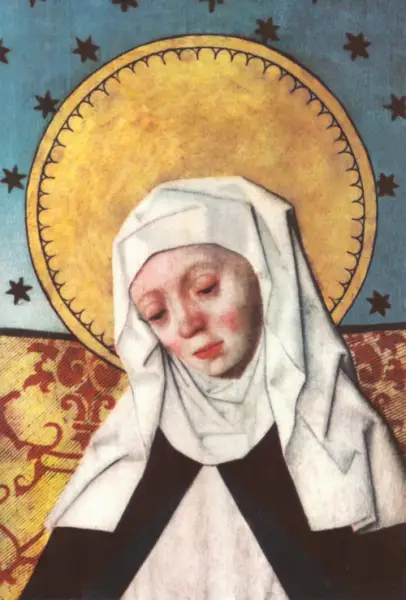
Overview
Bridget — in Swedish, Birgitta Birgersdotter, heliga Birgitta, and also Birgitta of Vadstena — born around 1304 in Uppland, is the most celebrated saint Sweden has produced, a mystic, a widow, and the foundress of the Order of the Most Holy Saviour, the Bridgettines. Her father Birger Persson, of the family of Finsta, was governor and lawspeaker of Uppland and among the richest landowners of the kingdom; through her mother Ingeborg Bengtsdotter she was kin to the Swedish kings of her day. Married at thirteen to Ulf Gudmarsson, lawspeaker of Östergötland, she bore eight children, six of whom survived infancy; her second daughter is honored as St. Catherine of Sweden. Widowed in 1344, she joined the Third Order of Saint Francis and conceived the plan of a double religious community of men and women living in separate cloisters, richly endowed at Vadstena by King Magnus IV and Queen Blanche. From 1350 she lived in Rome, agitating for the papacy's return from Avignon and for reform, until her death on 23 July 1373. Her Revelationes coelestes, recorded and translated into Latin by her confessors, made her at once famous and controversial. Canonized in 1391, she was named a patron saint of Europe in 1999.
The Complete Life
Daughter of Uppland
Bridget entered the world around 1304 in Uppland, the heart province of medieval Sweden, into a family positioned at the very top of the kingdom's secular aristocracy. Her father, Birger Persson of the family of Finsta, served as governor and lawspeaker of Uppland and ranked among the richest landowners in the country; her mother, Ingeborg Bengtsdotter, came of the Folkunga family's so-called Lawspeaker line, a connection that made Bridget a kinswoman of the Swedish kings of her era. The exact date of her birth went unrecorded, but the milieu is entirely clear: a household of wealth, legal learning, and serious piety, in a kingdom then consolidating its institutions under a lawspeaker elite. Her parents' tomb survives in Uppsala Cathedral, a material reminder of the family's standing. She was a girl of notable religious sensibility from the first. At about the age of ten she received the vision that set the course of her interior life: she saw the Lord Jesus hanging upon the cross, and when she asked who had so treated him, he answered that it was those who despised him and spurned his love. The Passion of Christ remained from that moment the center of her spirituality, and the revelations that had begun in her childhood grew more frequent as she matured. She was known outside Sweden as the Princess of Nericia, a title reflecting the reach of her family's connections.
§ Biography
Wife, Mother, Widow, Tertiary
In 1316, aged thirteen, Bridget was married to Ulf Gudmarsson of the family of Ulvåsa, a nobleman who held the office of lawspeaker of Östergötland — a union of two legal dynasties, arranged as such marriages were, and by every account a genuine partnership. She bore Ulf eight children, four daughters and four sons, of whom six survived infancy, an unusually fortunate proportion for the age. The eldest daughter, Märta Ulfsdotter, became a figure of note in her own right; the second is honored today as St. Catherine of Sweden; the youngest was Cecilia Ulvsdotter. Marriage and motherhood did not curtail Bridget's religious energy. She became known across Östergötland for works of charity, directed with particular care toward the province's unmarried mothers and their children, a group the age found it convenient to forget. In her early thirties she was called to court as principal lady-in-waiting to the new queen, Blanche of Namur, placing her beside the young King Magnus IV and his consort whose later conduct she would prophesy against so fiercely. In 1341 she and Ulf went on pilgrimage together to Santiago de Compostela, the great journey of their married life. Soon after their return, in 1344, Ulf died at the Cistercian abbey of Alvastra in Östergötland. Widowed at about forty, Bridget entered the Third Order of Saint Francis and gave herself to a life of prayer and to the service of the poor and the sick — the hinge on which her public vocation turned.
§ Biography
A Double Monastery and a Voice in Rome
Out of her widowhood came Bridget's great institutional work. She conceived a religious community that became the Order of the Most Holy Saviour — the Bridgettines — Vadstena, its chief house, was afterward endowed lavishly by King Magnus IV and his consort Blanche of Namur. The order's houses were double monasteries: men and women formed one joint community while living in separate cloisters. The constitutions she envisaged were exacting in their poverty — members were obliged to keep poor convents and to hand every surplus to the needy — yet remarkably liberal in one respect: they were allowed as many books as they pleased. From Rome and the Holy Land she sent back precise instructions for the building of the Vadstena monastery, with the requirement that a female superior, standing for the Virgin Mary, should head both the sisters and the brothers. Authorization, however, had to come from Rome, and Rome was in Avignon. In the Jubilee Year 1350 she braved a plague-stricken Europe to journey to Rome accompanied by Catherine, her daughter, together with a handful of priests and followers, in quest of papal approval for the new order and pursuing her self-imposed mission to raise the moral tone of the age. The wait lasted twenty years: only in 1370 did Pope Urban V, during his brief attempt to restore the papacy to Rome, confirm the Rule. Meanwhile she had made herself universally beloved in the city by her kindness and good works, going to confession daily, her face habitually bright.
§ Biography
Revelations and the Passion
Bridget's spiritual life was visionary in the strict sense. From childhood she received revelations, and after the decisive vision of the crucified Christ at ten they grew into a continuous current. These were recorded and put into Latin by Matthias, a canon of Linköping, and by Peter Olafsson, prior of Alvastra and her confessor, as the Revelationes coelestes, the "celestial revelations," which acquired an enormous vogue during the Middle Ages. They made her famous to some and suspect to others. Her accounts of purgatory circulated widely. Most consequential for the arts were her visions of the Nativity: shortly before her death she described the newborn resting upon rather than wrapped in clean cloths laid on the ground, giving off a light of his own, and the Virgin as fair-haired, kneeling at prayer just as she had been immediately before a birth that came upon her of itself. Later depictions followed her scene closely: the ox and donkey, the reduced light sources emphasizing the child of light, Joseph carrying a single candle, and God the Father above. The pose of the kneeling Virgin — the "Adoration of the Child" — became among the most common depictions of the fifteenth and sixteenth centuries, largely displacing the reclining Virgin in the West. The famous fifteen prayers with their promises, long circulated under her name, are of doubtful authorship, and in 1954 the Holy Office ruled the alleged promises unreliable while leaving the prayers themselves untouched.
§ Visions
Jerusalem, Bethlehem, and Death in Rome
Save for occasional pilgrimages, Bridget remained in Rome from 1350 until her death, and her last years were full of motion within that fixed residence. In 1373, old and ailing, she made the pilgrimage to Jerusalem and Bethlehem, walking the ground of the Passion that had stood at the center of her prayer since childhood; from the Holy Land she continued to dispatch instructions for the monastery rising at Vadstena, whose construction she directed from abroad. Her Roman decades were not serene. She was hounded by debts, and her tireless work against ecclesiastical abuses earned her determined opposition; the years in the city were, by the record, far from happy. Through all of it she kept up her campaign for the return of the papacy from Avignon, agitating for the move over many years until Urban V's brief restoration gave her the confirmation of her Rule. She never saw Sweden again. Bridget died in Rome on 23 July 1373, urging ecclesiastical reform to the end, and was buried first at San Lorenzo in Panisperna. Her remains were afterward brought back to Sweden, to Vadstena Abbey, where her body is venerated today by Lutheran and Catholic believers alike — a fitting end for a saint whose memory would be kept by two divided churches.
§ Biography
A Saint Confirmed Three Times Over
The process of Bridget's canonization was unusually protracted and was confirmed at three levels, which itself tells us how contested her legacy was. After Queen Margaret of Scandinavia had worked on Pope Urban VI and his successor for the cause, Bridget was canonized on 7 October 1391 by Pope Boniface IX — eighteen years after her death, with many of her contemporaries still alive and divided about her. Because discussions about her writings continued, the Council of Constance in 1415 confirmed the canonization itself, and in 1436 the Council of Basel examined her revelations afresh and confirmed their orthodoxy. Six centuries later the question was weighed again, this time in her favor and with magisterial precision: Pope Benedict XVI, in his general audience of 27 October 2010, recalled the letter Spes Aedificandi of John Paul II, which separated the Church's recognition of Bridget's holiness from any ruling on her revelations taken singly, while accepting that her interior experience was, as a whole, authentic. That careful formula — holiness affirmed, each private revelation left to God — remains the standing Catholic position on the Revelations. Her cult preceded formal recognition in the liturgy by centuries of local devotion, and her eventual calendar placement, discussed below, was itself twice adjusted by Rome.
§ Sainthood
Patroness of a Divided Continent
Bridget's legacy divides naturally into an order, a calendar, and an ecumenical memory. The Bridgettines survived their foundress and spread; Vadstena Abbey, the "Blue Church," remains the principal shrine, holding her relics and drawing Catholic and Lutheran pilgrims to the same spot. Her feast, absent from the Tridentine calendar, was inserted into the General Roman Calendar in 1623 for 7 October, the anniversary of her canonization; five years later it was moved to 8 October, where it stayed until the calendar revision of 1969 set it on 8 October, while the church in Sweden keeps the 7th; her dies natalis of 23 July is kept by the Church of England, the Third Order of Saint Francis, and others. On 1 October 1999 John Paul II named her a patron saint of Europe, joined in that honor by Benedict of Nursia, by Cyril and Methodius, by Catherine of Siena, and by Teresa Benedicta of the Cross. Her afterlife also contains sharp dissent: Martin Luther dismissed her visions as ravings and nicknamed her die tolle Brigit, the foolish Bridget, while Evangelical-Lutheranism nonetheless kept her in its own calendar of saints, rejecting only the invocation of saints. The reconciliation culminated on 8 October 1991, when John Paul II and two Lutheran bishops prayed together before the burial place of St. Peter — the first such joint prayer of the two communities. Nineteenth-century writers cast her as a forerunner of the Reformation for her attacks on unworthy clergy; but she never criticized the church's teaching or the church as such.
§ Veneration
Timeline
- 1304
Born at Uppland, daughter of the lawspeaker Birger Persson and Ingeborg Bengtsdotter; the exact day is unrecorded.
§ Biography
- 1316
Married at thirteen to Ulf Gudmarsson, a noble and lawspeaker of Östergötland, later bearing eight children.
§ Biography
- 1341
She and her husband make a pilgrimage to Santiago de Compostela.
§ Biography
- 1344
Shortly after their return Ulf dies at Alvastra Abbey; Bridget joins the Third Order of Saint Francis.
§ Biography
- 1350
During the Jubilee Year she crosses a plague-stricken Europe to Rome with her daughter Catherine, seeking approval for a new order.
§ Biography
- 1370
Pope Urban V, during his brief return of the papacy to Rome, confirms the Rule of her order.
§ Biography
- 1373
Makes her final pilgrimage, to Jerusalem and Bethlehem, dispatching instructions for building the Vadstena monastery.
§ Biography
- 23 Jul 1373
Dies in Rome, urging ecclesiastical reform; her feast is kept on the date of her death.
§ Biography
- 7 Oct 1391
After advocacy by Queen Margaret, Pope Boniface IX canonizes her on 7 October.
§ Sainthood
- 1415
The Council of Constance confirms her canonization.
§ Sainthood
- 1436
The Council of Basel confirms the orthodoxy of her revelations.
§ Sainthood
- 1623
Her feast enters the General Roman Calendar, assigned to 7 October, the anniversary of her canonization.
§ Veneration
- 1628
Five years on, her feast is transferred to 8 October, though Sweden keeps the 7th.
§ Veneration
- 1651
The Brigitta Chapel is erected in Vienna.
§ Veneration
- 1969
The revision of the General Roman Calendar settles her feast definitively on 8 October.
§ Veneration
- 8 Oct 1991
Pope John Paul II and two Lutheran bishops pray together at St Peter's tomb for the sexcentennial of her canonization.
§ Veneration
- 1 Oct 1999
Pope John Paul II declares her one of the patron saints of Europe.
§ Veneration
In Their Own Words
They who despise me, and spurn my love for them.
which recognized Bridget's holiness without ever pronouncing on her individual revelations, has accepted the overall authenticity of her interior experience
O Lord, come quickly and light the night! ... Show me the way and arrange to follow it. ... I come to you as the wounded man goes to the doctor for help. ... Give, O Lord, peace to my heart!
The soul of the Virgin, as soon as it was separated from the body, was raised by God wonderfully above all the heavens and had dominion over the whole world. God made her Queen of Heaven for Eternity.
The Record
- Major works
- Revelationes coelestes ("Celestial revelations"), recorded in Latin by Matthias of Linköping and Peter Olafsson·Rule of the Order of the Most Holy Saviour (the Bridgettines)·The Fifteen 'O's (fifteen Our Fathers and Hail Marys, attributed)
- Patron of
- patron saint of Europe·patron saint of Sweden·patron of widows·invoked for a holy death
- Symbols
- pilgrim's hat, staff and bag·crown·writing-book·heart with a cross·book and quill
- Canonization
- Canonized on 7 October 1391 by Pope Boniface IX; the canonization was confirmed by the Council of Constance in 1415
Prayer
Bibliography
Show 7 sources
- Kirsch, Johann Peter (1907). "St. Bridget of Sweden". Catholic Encyclopedia, Vol. 2
- Pirlo, Paolo O., SHMI (1997). "St. Bridget". My First Book of Saints. Sons of Holy Mary Immaculate, pp. 158–159, ISBN 971-91595-4-5
- Duffy, Eamon (1992). The Stripping of the Altars: Traditional Religion in England, c.1400–c.1580. New Haven: Yale University Press, ISBN 978-0-300-05342-5
- Schiller, Gertrud (trans. Seligman, Janet) (1971). Iconography of Christian Art, Vol. I: Christ's Incarnation, Childhood, Baptism, Temptation, Transfiguration, Works and Miracles. London: Lund Humphries
- Benedict XVI. Saint Bridget of Sweden, General Audience, 27 October 2010
- John Paul II. Proclamation of the Co-Patronesses of Europe, Apostolic Letter, 1 October 1999
- Calendarium Romanum (Libreria Editrice Vaticana 1969), p. 98
Profile text adapted from the Wikipedia article, licensed CC BY-SA 4.0.
Pray with this saint every day
Save St. Bridget of Sweden to your favorites, read the full profile, and get feast-day reminders in the Saints app.
Get the Saints AppFree on the App Store for iPhone and iPad