
c. 451 – c. 525·Feast February 1
St. Brigid of Kildare
Abbess of Kildare and Patroness of Ireland
Overview
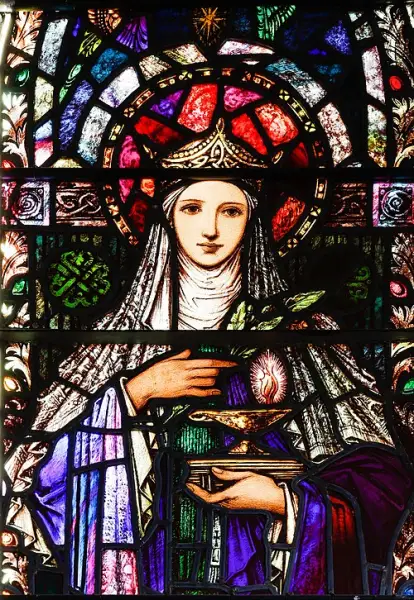
Brigid of Kildare — Naomh Bríd in Irish, Brigit in Old Irish, Brigida in Latin — is the patroness or 'mother saint' of Ireland, standing with Patrick and Columba among the country's three national saints. Medieval Irish hagiography remembers her as the foundress of the great abbey of Kildare, Cill Dara, the 'church of the oak,' and of other convents of nuns; in truth, little about her can be established historically, since the earliest Lives are chiefly anecdotes and miracle stories, many rooted in Irish pagan folklore. They make her the daughter of a Leinster chieftain, Dubhthach, and of Broicsech, an enslaved Christian woman baptized by Patrick; fostered in a druid's household, she was born into slavery and freed only after her father's attempt to sell her collapsed before the King of Leinster. Consecrated as a virgin — the tradition names either Bishop Mac Caille or St. Mél as the officiant — she gathered seven companions and, around 480, founded the double monastery of Kildare, ruling as its first abbess beside Conleth, its first bishop. She is invoked as patroness of poetry, learning, healing, blacksmithing, livestock, and dairy work; a perpetual fire burned at Kildare for centuries in her honor, and her feast of 1 February, coinciding with Imbolc, has been a public holiday in Ireland since 2023.
The Complete Life
Born on a Threshold
The historicity of Brigid is itself the first fact about her. There is debate over whether she was a real person; the Oxford dictionary of saints observes that few historical facts survive, the early Lives being mainly anecdotes and wonders, some deeply rooted in Irish pagan folklore. Some scholars hold that she was not a historical individual at all but a Christianisation of the Celtic goddess Brigid — the two share a name, patronage of poetry, healing, smithcraft, and domestic animals, and a feast at Imbolc — while others hold she was real and that the goddess's traits settled onto her memory. The medieval Lives, for their part, tell a coherent story. Her birth is usually set in 451 or 452. One tradition locates it at Faughart, just north of Dundalk in the old kingdom of Ulaid; another at Ummeras near Kildare. All early sources agree she belonged to the Fothairt, a people of Leinster. Three biographies make her mother Broicsech, an enslaved Christian woman baptized by St. Patrick, and her father Dubhthach, a Leinster chieftain. When Broicsech was found pregnant, Dubhthach's wife forced him to sell her to a druid, and Brigid was born into slavery — delivered at dawn on the threshold of the druid's house, a liminal detail that itself smells of older lore. The stories of her childhood are wonders: butter given away and replenished, a white cow with red ears that sustains her, a druid stepfather who sees she is special and eventually frees mother and child. Around ten she returned to her father's house as a servant, where her charity stripped his belongings for the poor.
§ Early life
The Veil and the Refused Bride Price
Brigid's vocation unfolded against the economics of women in early Ireland. Her brothers resented her promise of chastity because it cost them a bride price; a suitor named Dubthach maccu Lugair came to woo her and was sent by her to the woods behind his house, where her prophecy of a marriageable maiden came true. In the most violent of the stories, a man mocked her beauty with a jest about betrothal, and she struck her own eye rather than be a temptation — a tale probably borrowed from the lore of St. Lucy — and then drew a spring from the earth with her staff when her brothers could find no water to wash the wound. The formal step came when she was veiled as a consecrated virgin. The sources divide on the officiant: either Mac Caille, bishop of Cruachán Brí Éile, or St. Mél of Ardagh at Mág Tulach in what is now County Westmeath — and the tradition adds that Mél gave her the powers of an abbess, an office, not merely a blessing. Cogitosus, writing two centuries later, remembers her youth differently: farm work, churning butter, shepherding the flocks, tending the harvest — the sanctity of a laboring childhood. Both strands belong to her calling. What the Irish church received in Brigid was a woman who refused the two futures on offer to her — slave and wife — and accepted a third that barely existed yet: the consecrated religious woman living under rule, of whom she would become, with seven initial companions, the organizer for all of Ireland.
§ Religious life
The Church of the Oak
Around the year 480 Brigid founded her monastery at Kildare, Cill Dara, the church of the oak, a name that preserves the memory of a tree sacred to the druids. With an initial group of seven companions, she is credited with having organized common consecrated religious life for women across Ireland, establishing two houses, one of monks and one of nuns — the double monastery that would define Kildare for centuries. To join her she called Conleth, a hermit of Connell, who became Kildare's first bishop. A common saying gives her the conferral of canonical jurisdiction upon him, but Archbishop Healy corrected the point: all she did was pick the man to whom the church itself gave jurisdiction — her biographer's words are that she chose him to govern the church in company with herself. Down the centuries the house at Kildare was governed by paired lines of abbot-bishops and abbess-bishops, its abbess honored as superior general over the monasteries of Ireland, and every successor in her line received episcopal honour. The oratory Brigid built there became a center of religion and learning and grew into a cathedral city. Under Conleth she founded a school of art — metalwork and illumination — and the Kildare scriptorium produced the Book of Kildare, praised extravagantly by Gerald of Wales, who said nothing he had ever seen was comparable and judged its every page the work of angels; it disappeared during the Reformation. The Trias Thaumaturga sends her through Connacht founding churches in the diocese of Elphin and records visits to Longford, Tipperary, Limerick, and the south of Leinster. The Book of Armagh preserves the tradition of her friendship with Patrick, the two called the pillars of the Irish people, of one heart and one mind.
§ Religious life
Miracles of Butter, Beer, and Cloaks
Brigid's power, as one modern scholar has put it, is expressed in helping: healing, feeding the hungry, rescuing the weak from violence. Where Patrick's legend is grand, hers are mostly small deeds done for the lowly, and the dynastic politics of the day are never steered by her. The catalogue of Cogitosus clusters around healing, charity, cows and sheep and dairy, the harvest, fire, and her virginity. She multiplies butter, bacon, and milk; she is an expert dairywoman and brewer who turns water into beer; her prayers still the wind and rain. The most famous story is the cloak: asking the King of Leinster for land and refused, she requested as much ground as her cloak would cover, and when four sisters took up its corners and ran toward the four points of the compass, the garment spread over many acres — a tale probably inspired by the legend of Dido. Another story has her heal two mute sisters with a touch of her own blood after a fall. A fisherman of her community cuts open a catch to find the silver brooch a nobleman had thrown into the sea to enslave the woman he had falsely accused of theft — an Irish version of a story also told of St. Mungo. The lore has shadows modern readers must handle honestly: one account in Cogitosus describes her blessing a nun who had broken her vow and conceived, causing the child to disappear, a purported miracle the Vatican has never approved and whose historicity has been questioned. Through all of it runs the constant theme of her devotion — food for the hungry, freedom for the endangered, and a fire that would not go out.
§ Miracles
A Death Foretold and a Succession
The close of Brigid's life is told with the domestic tenderness that marks the best of Irish hagiography. When her final illness came, Ninnidh administered the last rites; he later sheathed his right hand in metal, lest it ever again be profaned — hence his surname, Ninnidh of the Pure Hand. By tradition her death at Kildare fell on 1 February of a year usually reckoned as 524 or 525. Her succession had been arranged in the most Brigid-like manner possible: her favorite pupil Darlugdach — whose name means daughter of the god Lugh, another fossil of the old religion — was so devoted that she wished to die with her mistress; Brigid replied with a prophecy: Darlugdach would go to God exactly one year after her, on the anniversary of her passing — which is what happened, with the pupil becoming second abbess of Kildare and the church assigning both women the same feast of 1 February. The earlier story of the two women is told by Ultan of Ardbraccan: Darlugdach, in love with a young man, once slipped out of the bed she shared with Brigid to meet him, then relented, placed burning embers in her shoes, and stood on them — by fire putting out fire, by pain extinguishing pain — returning to bed while Brigid feigned sleep; when morning came Brigid told her the burning of desire and of hell alike no longer threatened her, and cured her scorched feet. The dying abbess left behind a monastery already old in miracles, a scriptorium, a school of metalwork, and a community that would keep a fire burning in her name for centuries.
§ Death
The Making of Ireland's Mother Saint
No process canonized Brigid; the Irish church simply never knew a time without her. The earliest accounts are two Old Irish hymns of the seventh century — Ultan's hymn by St. Ultan of Ardbraccan and Broccán's hymn by St Broccán Clóen — which salute her as a golden flame leading the faithful to the eternal realm. Two Hiberno-Latin prose Lives followed in the seventh and eighth centuries, the first perhaps the work of St Aleran, who read at Clonard, and the second that of the Kildare monk Cogitosus; a vellum scrap carrying her name goes back to around the year 700, among the earliest relics of any Irish saint's cult. An Old Irish prose Life, Bethu Brigte, came in the ninth century, and further Latin and Irish Lives afterward, including a verse Vita sometimes ascribed to St Coelan but more likely the work of Donatus, the Irish monk who became bishop of Fiesole in 824 — the same Italian connection that would carry an Irish Bridget to Tuscany. Discussion of the annals and of dates relating to Brigid continues among scholars, and the argument over whether a historical woman underlies the legend has never been settled. What is beyond argument is the cult: by the end of the seventh century Kildare was a great double monastery regarding her as its foundress, and side by side with Patrick and Columba she held rank among Ireland's three national saints — the Mary of the Gael of Irish speech, the country's mother saint.
§ Sources
The Fire That Never Went Out
Brigid's legacy is unusually tangible. Her grave lay at the high altar of Kildare's first cathedral, beneath a tomb dressed in jewels, in gold and silver crowns and precious stones. Around 878, Viking raids carried her relics to Downpatrick, into the tomb of Patrick and Columba; found in 1185 by John de Courcy, the three saints' remains were solemnly reburied in Down Cathedral on 9 June 1186, and destroyed in 1538 under Lord Grey — except the head, saved by clergymen and carried to Neustadt in Austria, then presented by Emperor Rudolph II to the Jesuit church in Lisbon in 1587, where part of her skull is venerated at the Igreja de São Roque while another portion, at Lumiar, may have reached Portugal as early as 1283. Gerald of Wales, in the late twelfth century, reported nineteen nuns keeping a perpetual fire at Kildare in her honor, ringed by a hedge no man might cross, with Brigid herself said to keep the flame on every twentieth night; the fire, some suggest, had first burned in a temple of the goddess. Her name is among Ireland's most widespread placenames — dozens of Kilbrides, Knockbridges, and Brideswells across the island, with St Brides in Wales, the Kilbrides of Scotland, and St Bride's in Fleet Street carrying it abroad. Her crosses of woven rushes hang over Irish doors against fire and evil; her holy wells draw pilgrims; and since 2023 her day, 1 February, has been a public holiday in the Republic — the first named for a woman.
§ Veneration
Timeline
- 451
Brigid is born, usually placed in 451 or 452; one tradition names Faughart, another Ummeras near Kildare
§ Early life
- 480
Brigid founds the monastery of Kildare, 'church of the oak,' with an initial community of seven companions
§ Religious life
- 1 Feb 525
Given the last rites by Ninnidh of the Pure Hand, she dies at Kildare; the year is usually placed around 524 or 525
§ Death
- 526
Darlugdach, her favorite pupil, succeeds as second abbess and, as Brigid foretold, dies on the first anniversary of Brigid's death
§ Death
- 650
Cogitosus, a monk of Kildare, composes one of the earliest Latin Lives of Brigid, circa this year
§ Iconography
- 878
Her relics are moved for safety from Viking raids to Downpatrick, laid to rest beside Patrick and Columba
§ Relics
- 1185
John de Courcy discovers the relics of Brigid, Patrick and Columba
§ Relics
- 9 Jun 1186
John de Courcy has the relics of the three saints solemnly reburied in Down Cathedral
§ Relics
- 1538
The Down Cathedral remains are ruined under Lord Grey's deputyship; clergy rescue her head and carry it to Neustadt in Austria
§ Relics
- 1587
Emperor Rudolph II presents her head to the Jesuit church in Lisbon, the present Igreja de São Roque, where part of her skull is venerated
§ Relics
- 1884
Cardinal Moran of Sydney obtains a tooth relic from Cologne for the Brigidine Sisters in Melbourne
§ Relics
- 2023
St. Brigid's Day, 1 February, becomes a public holiday in the Republic of Ireland, the first named for a woman
§ Saint Brigid's Day
In Their Own Words
Brigit, ever good woman A sparkling golden flame May she lead us to the eternal realm The shining bright sun.
Between St. Patrick and St. Brigid, the pillars of the Irish people, there was so great a friendship of charity that they had but one heart and one mind. Through him and through her Christ performed many great works.
all this is the work of angelic, and not human skill
The Record
- Major works
- Kildare Abbey, the double monastery of nuns and monks·The school of art and scriptorium of Kildare, associated with the lost Book of Kildare·Churches founded across Connacht and the Diocese of Elphin
- Patron of
- patroness of Ireland·patron of Kildare·healers·poets·blacksmiths·livestock and dairy workers
- Symbols
- Brigid's cross·crozier of an abbess·flames or a lamp·a cow, or geese
- Canonization
- Pre-congregation; venerated since the early Middle Ages as one of the three national saints of Ireland
Prayer
Bibliography
Show 8 sources
- Farmer, David. The Oxford Dictionary of Saints, Fifth Edition Revised. Oxford University Press, 2011, pp. 66–67, 467–470
- Ó hÓgáin, Dáithí. Myth, Legend & Romance: An Encyclopaedia of the Irish Folk Tradition. Prentice-Hall Press, 1991, pp. 60–61
- Hutton, Ronald (1996). Stations of the Sun: A History of the Ritual Year in Britain. Oxford University Press, pp. 134–138
- Flood, William Henry Grattan (1907). "St. Brigid of Ireland". Catholic Encyclopedia, Vol. 2
- Charles-Edwards, Thomas. "Early Irish Saints' Cults and Their Constituencies". Ériu, vol. 54, 2004, pp. 84–85, 88–89
- Burns, Paul (1998). Butler's Lives of the Saints: New Full Edition: February. Burns & Oates, pp. 1–4
- Berger, Pamela (1985). The Goddess Obscured: Transformation of the Grain Protectress from Goddess to Saint. Beacon Press, p. 73
- Wright, Brian. Brigid: Goddess, Druidess and Saint. The History Press, 2011, pp. 36–37
Profile text adapted from the Wikipedia article, licensed CC BY-SA 4.0.
Pray with this saint every day
Save St. Brigid of Kildare to your favorites, read the full profile, and get feast-day reminders in the Saints app.
Get the Saints AppFree on the App Store for iPhone and iPad