
c. 409 – c. 500·Feast May 1
St. Brioc
Welsh Abbot and Founder of Saint-Brieuc in Brittany
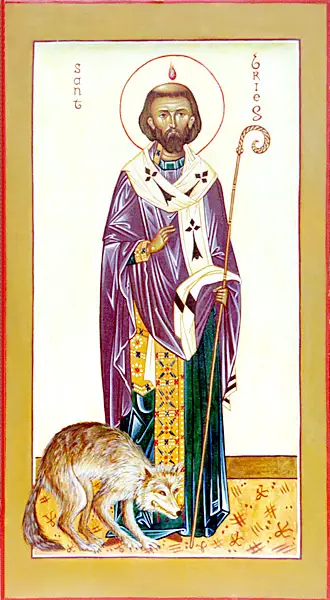
Overview
Brioc — Brieg in Breton, Briog in Welsh, Breock in Cornish, Brieuc in French — was a Welsh holy man of the early sixth century who served as the first abbot of Saint-Brieuc in Brittany and is counted among the seven founder saints of that land. Little about his youth is secure, because the Acta compiled about him in the ninth century cannot be trusted throughout. They give him a home in Ceredigion, where the church of Llandyfriog was first placed under his patronage. Ireland was the place of his schooling; afterward he studied in Paris under Germain, and tradition holds that he sojourned at Rothesay on Bute in Scotland, where a church honors him and the yearly St. Bruix Fair keeps his memory. Crossing eventually to Armorica, he planted a monastery at Landebaeron, then pushed on into Upper Brittany and raised an oratory at St Brieuc-des-Vaux, lying between St. Malo and Land Triguier, taking charge as abbot of the community that gathered around it. There he died and was buried in the cathedral church of Saint Stephen. His Acta credit him with many wonders, above all the healing of Count Riguel, who rewarded him with the palace and estates of Champ-du-Rouvre.
The Complete Life
A Welshman of the Old Tradition
The records of Brioc's beginnings are thin, and the main narrative source — his Acta, written down in the ninth century, centuries after his death — cannot be taken at face value. What it preserves, filtered through legend, is a Welsh origin: he came from Ceredigion, the western coastal kingdom of Wales, and the church at Llandyfriog in that country was originally dedicated to him, a local memory that long outlasted his departure. The dates attached to him by tradition make him a man of the fifth and sixth centuries, the age of the great Celtic migrations to Brittany, when Welsh and Cornish and Irish churchmen crossed the narrow seas and planted monasteries on the Armorican peninsula. His formation followed the pattern of that world. He was sent to Ireland for his schooling, as so many British churchmen of the era were, Ireland then being the scholarly powerhouse of the western Celtic church. From there the Acta carry him to the continent, to study under Germain of Paris, placing a future Breton abbot for a time in the Frankish capital and suggesting a breadth of formation unusual even in that cosmopolitan age. Tradition further connects him with a sojourn at Rothesay on the Scottish isle of Bute, where a church was placed under his patronage and where the yearly fair of St. Bruix long kept his memory — one of several signs that his influence was remembered across the whole Gaelic and Brythonic world rather than in Brittany alone.
§ Life
Founding in Armorica
The second half of Brioc's life was spent as a founder. At some point he crossed to Armorica — the Celtic name for the peninsula the Franks were already calling Brittany — and established a monastery at Landebaeron, his first foundation on the continent. Not content to remain there, he pressed on into Upper Brittany, and there, in the country lying between St. Malo and Land Triguier, he raised an oratory at the place that still carries his name, St Brieuc-des-Vaux. Around that oratory a monastery grew, and Brioc became its first abbot, the spiritual father of a community that would in time give its name to a city, a diocese, and one of the four historic Breton sees. Brittany honors him among its seven founder saints, the company of holy men — alongside Pol, Samson, Malo, Patern, Corentin, and Tugdual — whose missions in the fifth and sixth centuries gave the peninsula its Christian shape; their cult was traditionally celebrated together in the Grand Pardon of the seven saints. The pattern of his mission — monastery first, then movement outward, then a second foundation further on — is the classic Celtic method of evangelization, in which the monastic community rather than the territorial parish was the unit of Christian expansion. A city grew where the oratory stood, and the cathedral that succeeded his monastery kept his name at its heart.
§ Life
Death and Burial at Saint-Brieuc
Brioc ended his life in the house he had built. The authorities differ on the year of his death: the traditional dates give c. 500, while the narrative sources suggest he more likely died late in the sixth century. He died inside the monastery he himself governed at St. Brieuc-des-Vaux, surrounded by the brethren he had drawn to the place, and was buried in the cathedral there, which stood under the patronage of Saint Stephen. The burial of a founder inside the church he founded was the decisive act for any medieval cult: the grave became the fixed point around which the devotion of the community organized itself, and the cathedral of Saint-Brieuc grew literally over his bones. His Acta, whatever their historical worth, remember the closing phase of his life as a season of wonders, and the miracles they record follow the conventions of Celtic hagiography — cures of the powerful, gifts of land, signs of divine favor at the moment of ordination. Most notable among them is the healing of Count Riguel, who in gratitude handed over to the abbot his own palace of Champ-du-Rouvre together with its whole manorial estates, an endowment that secured the material future of the monastery. Whether every detail stands, the outline does: a Welsh abbot, a Breton foundation, a death among his monks, and a grave that immediately became a shrine.
§ Veneration
The Saint Who Named a City
Few early Celtic saints have left a name so plainly on the map. The city of Saint-Brieuc, the cathedral, the diocese of Saint-Brieuc and Tréguier of which he is patron, all carry his name, and his major shrine remained St Brieuc-des-Vaux. His relics have had a long history of their own: they were moved to the church of Saints Sergius and Bacchus of Angers in 865 — a common precaution in the Viking era — translated again with greater ceremony on 31 July 1166, and finally, in 1210, a portion was brought back to St. Brieuc Cathedral, where his ring is preserved to this day. His feast is kept on 1 May, although since 1804 the town has staged its festival on the second Sunday after Easter. England, Ireland, and Scotland all have churches under his patronage, including the parish church of St Breock in Cornwall, and places as far apart as Brixham in Devon and St Briavels in Gloucestershire are thought to preserve his name. In honor of the connection between his native and adopted lands, the twinning of St Brieuc with Aberystwyth dates from 1974. Pursemakers claim him as their patron, and artists show him treading on a dragon or accompanied by a column of fire, the sign recalled from his ordination.
§ Veneration
Timeline
- 409
Tradition places his birth around this year in Ceredigion, Wales
§ Introduction
- 500
Tradition gives around this year for his death at his monastery of St Brieuc-des-Vaux, where he is buried in the cathedral of Saint Stephen
§ Life
- 865
His relics are moved to the Church of Saints Sergius and Bacchus at Angers
§ Veneration
- 31 Jul 1166
His relics are translated a second time with greater solemnity
§ Veneration
- 1210
A portion of his relics is restored to St. Brieuc Cathedral, where his ring is also preserved
§ Veneration
- 1804
After being kept on 1 May, his festival begins to be held on the second Sunday after Easter
§ Veneration
- 1974
The town of St Brieuc is twinned with Aberystwyth, honouring his link between Ceredigion and Brittany
§ Veneration
The Record
- Major works
- Monastery at Landebaeron in Armorica·Oratory and abbey of St Brieuc-des-Vaux in Upper Brittany
- Patron of
- patron of the Diocese of Saint-Brieuc and Tréguier·patron saint of pursemakers
- Symbols
- abbot's habit·treading on a dragon·a column of fire as seen at his ordination
- Canonization
- Pre-congregation; one of the seven founder saints of Brittany
Prayer
Bibliography
Show 7 sources
- Grattan Flood, W.H. (1913). "St. Brieuc". Catholic Encyclopedia, Vol. 2
- Mooney, Ambrose. "St. Brioc the Traveller, Bishop of Brittany". Celtic Saints
- Woods, J. Douglas; Pelteret, David A. E. (1986). The Anglo Saxons: Synthesis and Achievements. Wilfrid Laurier University Press, p. 84, ISBN 9780889201668
- McDowall, David (2010). Bute. The Laird Press, Surrey
- Price, Kevin Roy. "Town Twinning - Aberystwyth Council". www.aberystwyth.gov.uk
- Cornish Church Guide (1925). Truro: Blackford, p. 64
- Dictionary of Christianity, edited by J. C. Cooper, 2013, p. 36
Profile text adapted from the Wikipedia article, licensed CC BY-SA 4.0.
Pray with this saint every day
Save St. Brioc to your favorites, read the full profile, and get feast-day reminders in the Saints app.
Get the Saints AppFree on the App Store for iPhone and iPad