
fl. 374 – died 385/386·Feast May 6
St. Britto of Trier
Fourth-Century Bishop of Trier and Conciliar Father
Overview
Britto governed the church of Trier in the last decades of the fourth century and died in 385 or 386. He first appears in the surviving record at an assembly of the bishops of Gaul held at Valence on the Rhône in 374, where he maintained that Christians who had fallen away during the persecution under the emperor Julian could be received back into communion under defined conditions. In 382 he acted as a delegate of the Gallic church at a Roman synod over which Pope Damasus I presided; that meeting dispatched a letter to the Eastern bishops, and Britto's signature stands third on it, directly after the pope's own and that of Ambrose of Milan. He was likewise present at the court of the emperor Maximus at Trier during the proceedings against Priscillian, who stood accused of heresy and sorcery, and there encountered Martin of Tours and Ambrose, who had traveled to Trier in a vain attempt to spare the accused from execution. Britto was laid to rest in St. Paulinus' Church in Trier, where the diocese still honors him with a local feast on 6 May.
The Complete Life
A Voice in the Gallic Church
Almost everything known about Britto comes from the moments when he stood up in public and spoke. The man himself stays in shadow: the record preserves no birthplace, no family, and no path to holy orders. His first datable appearance comes in 374, at a gathering of the bishops of Gaul convened at Valence on the Rhône. The question before the fathers was pastoral and painful. A dozen years earlier the emperor Julian, called the Apostate by Christians, had used the machinery of the state to harass and unsettle the church without open martyrdoms, and many believers had weakened under that pressure. Britto argued at Valence that such people could be restored to the eucharistic community once stated conditions were met. The position placed him among those fourth-century pastors who treated failure of nerve as a wound to be healed rather than a crime to be punished forever. Within a decade he had risen to the chief see of northern Gaul, succeeding Bonosus at Trier around 384, a city that was then one of the real capitals of the Roman world and a place where church and empire met daily.
§ Biography
Synods, Signatures and the Priscillian Affair
In 382 Britto traveled to Rome as a representative of the churches of Gaul for a synod chaired by Pope Damasus I. That gathering produced a letter addressed to the church's leaders in the East, and the order of signatures has preserved Britto's standing among his contemporaries: only Damasus himself and Ambrose of Milan signed ahead of him. A bishop of Trier who could sign in that company was clearly regarded as one of the leading pastors of the Latin West. His other recorded public involvement was darker. At the imperial court of Maximus at Trier he was present during the trial of Priscillian, a Spanish layman accused of heresy and sorcery, whose case ended in the first known execution of a Christian for heresy by a Christian state. At Trier on that occasion Britto met Martin of Tours and Ambrose of Milan, who had come to the city in an unsuccessful effort to prevent the execution. The sources do not record what position Britto took in the affair, only that he was there among the churchmen who watched the precedent being set.
§ Biography
Cult and Feast at Trier
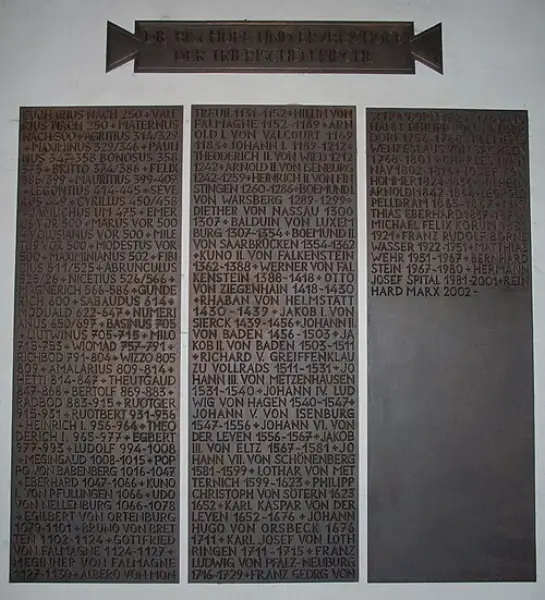
Britto died in 385 or 386, after roughly two years on the throne of Trier according to the episcopal lists, and was buried in St. Paulinus' Church in the city. No formal canonization process existed in his age; sanctity in fourth-century Gaul was conferred by local memory and local liturgy, and that is precisely what Britto received. The diocese of Trier, one of the oldest in Germany, has kept his memory alive and honors him with a feast on 6 May, a date that stands in the church's calendar long before any congregation existed to ratify it. The modern lists of the bishops of Trier place him between Bonosus, whom he succeeded around 384, and Felix, who followed him. His inclusion in the standard reference works on the see shows that the cult never entirely lapsed. He belongs to that numerous company of early bishops whose claim on the church's gratitude rests not on writings or miracles but on presence: present at Valence when mercy was argued, present at Rome when the West spoke to the East, present at Trier when the church first confronted the power of the state over belief.
§ Biography
Timeline
- 374
Appears at a meeting of the bishops of Gaul held at Valence, where he argued that Christians lapsed under Julian's persecution could be readmitted under conditions.
§ Biography
- 382
Represented the Church of Gaul at the synod of Rome chaired by Pope Damasus I, signing third, after Damasus and Ambrose, its letter to the Eastern bishops.
§ Biography
- 384
Listed as Bishop of Trier from 384 to 386, succeeding Bonosus.
§ Titles of the Great Christian Church
- 386
Died in 385 or 386 and was buried in St. Paulinus' Church, Trier.
§ Biography
The Record
- Canonization
- Pre-congregation; ancient local veneration in the Diocese of Trier, feast kept on 6 May
Prayer
Bibliography
Show 2 sources
- NewAdvent.org Trier
- GCatholic.org Diocese of Trier
Profile text adapted from the Wikipedia article, licensed CC BY-SA 4.0.
Pray with this saint every day
Save St. Britto of Trier to your favorites, read the full profile, and get feast-day reminders in the Saints app.
Get the Saints AppFree on the App Store for iPhone and iPad