
died c. 1231·Feast September 2
St. Brocard
Early prior of the hermits of Mount Carmel
Overview
St. Brocard, sometimes called Burchard, was a Frenchman who became a hermit monk on Mount Carmel in Palestine and is remembered as one of the first leaders of that community. When Berthold of Calabria, the superior of the hermits, died around 1195, Brocard was chosen to lead the brotherhood in his place. His decisive hour came around 1207, when he approached Albert Avogadro, the papal legate and Latin Patriarch of Jerusalem, and sought a formula of common life for the brethren on Carmel. Albert, a canon regular himself, answered with a compact rule of sixteen chapters, addressed to a brother known only as 'B.', traditionally identified with Brocard. The receipt of that document marks the origin of the Carmelite Order as an institution. Tradition adds that Brocard was deeply versed in Scripture and that Albert intended to bring him to the next Lateran Council, but the patriarch was murdered before the council assembled. Brocard died about 1231. The Carmelite general chapter decreed his cult in 1564, suppressed in the reformed breviary of 1585, restored in 1609, and confirmed with proper lessons by the Sacred Congregation of Rites in 1672, though his feast has since been suppressed again.
The Complete Life
From France to the Holy Mountain
Brocard was of French ancestry, and by the late twelfth century he had made his way from the West to Mount Carmel, the ridge above the plain of Haifa that had long been associated with the prophet Elijah and had lately become a refuge for Christian hermits. There he joined the community of holy men living in cells and caves on the mountain, a brotherhood of western pilgrims and settlers in the crusader kingdom of Jerusalem. He is sometimes called by the variant name Burchard, and nearly every detail of his personal history is wrapped in uncertainty, for the earliest Carmelite generations left few records and later writers filled the gaps with legend. What is certain is the shape of his commitment: he bound himself to a life of solitary and communal prayer in one of the harshest sacred landscapes in the world, far from his native land. The hermits of Carmel belonged to no established order at that time. They were simply religious men who had gathered on a holy mountain, waiting on God in silence, long before they possessed a rule, a superior with recognized authority, or a place in canon law.
§ History
Superior After Berthold
Around the year 1195 the community on Carmel suffered a loss in the death of Berthold of Calabria, the superior under whom the hermits had been organized. Brocard was elected to succeed him, becoming, in the traditional telling, the second leader of the incipient Carmelite brotherhood. The choice of a Frenchman to lead a community of mixed western origins suggests the international character of the mountain settlement, where men from England, France, Italy, and Provence lived side by side under a common discipline. As superior, Brocard faced the practical question that every young community must answer: what form should its life take, and by what authority should that form be guarded? The hermits had customs, but a custom is not a rule. Later tradition also credited him with deep familiarity with Scripture, a qualification that fitted him to interpret the prophetic character of Carmel and to speak for his brethren before the greatest ecclesiastical authorities in the Holy Land. In an age when the patriarchate of Jerusalem presided over a Church under siege, the quiet election of a hermit superior would have drawn little notice, yet it set the Carmelites on the path to institutional life.
§ History
The Rule That Founded an Order
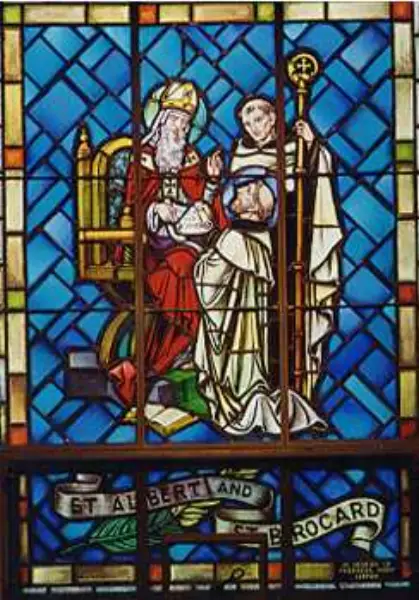
Around 1207 Brocard performed the act for which history remembers him. He approached Albert Avogadro, the papal legate and Latin Patriarch of Jerusalem, and sought Albert's help in framing a rule of life in common for the Carmelite brethren. Albert, a canon regular with long experience of church government in the West, and he responded with characteristic economy: a brief formula vitae of sixteen chapters, sketching how the hermits should live, pray, work, keep silence, and choose a prior. Its addressee is a brother whose name appears only as 'B.', the figure tradition has always identified with Brocard, although no historical record clearly establishes the identification or the recipient's full name. With that letter the hermits of Mount Carmel received the charter that would make them an order. The Church now calls it the Rule of St. Albert, and the Carmelite Order regards its receipt as the moment of its foundation. Every later development, the migration to Europe, the transformation from hermits to mendicants, the great schools of Carmelite spirituality, traces its origin to the exchange between a patriarch with a pen and a prior with the courage to ask.
§ History
A Death on the Mountain
Tradition preserves a poignant glimpse of Brocard's last years. His knowledge of Scripture was so esteemed that Albert, the patriarch who had given the Carmelites their rule, planned to take him to the coming Lateran Council, presumably to represent the cause of the Holy Land and its religious communities before the assembled bishops of the West. The plan came to nothing: Albert was murdered in 1215, before the council took place, cut down in the streets of Acre by a man whose affairs he had censured. Brocard remained on Carmel, and there, around the year 1231, he died. The mountain that had received him as a young pilgrim now held his grave. Within a generation the situation of the Latin kingdom deteriorated, and the Carmelites themselves would migrate to Europe, carrying their rule and the memory of their early superiors with them. Brocard's death in 1231 thus belongs to the closing chapter of the Latin presence on the mountain. The brotherhood he had led outlived the kingdom that had sheltered it, and it preserved his name, though little else, across the centuries that followed.
§ History
A Cult Granted and Restored
Brocard's veneration traveled with the Carmelite Order through the medieval and early modern centuries. His cult received institutional confirmation when the general chapter of 1564 ordered that it be kept, a decree that belongs to the era of Carmelite renewal after the Council of Trent. The story of his liturgical honors did not run smoothly. The reformed breviary of 1585 removed his office, part of a wider pruning of cults that lacked solid historical documentation, and his case was exactly the kind such reforms targeted, resting as it did on tradition rather than records. Yet the Order did not let him go. In 1609 his cult was taken up again, and in 1672 the Sacred Congregation of Rites approved proper lessons for his office, giving liturgical expression to the Life of Brocard that the Carmelites cherished. In the further liturgical reforms of later centuries his feast has been suppressed once more, though his memory remains secure in the history of the Order. The pattern of his cult, granted, removed, restored, and confirmed, mirrors the historian's judgment on the man himself: the details are uncertain, but the foundation he obtained for Carmel is beyond dispute.
§ History
Timeline
- 1195
Chosen superior of the hermits on Mount Carmel after the death of Berthold of Calabria.
§ History
- 1207
Approached Patriarch Albert Avogadro, who composed a sixteen-chapter rule of common life for the Carmelites.
§ History
- 1231
Died on Mount Carmel around this year.
§ History
- 1564
The general chapter of the Carmelite Order decreed that his cult be kept.
§ History
- 1585
His cult was removed from the reformed breviary.
§ History
- 1609
His cult was taken up again in the Carmelite calendar.
§ History
- 1672
Proper lessons in his honor were approved by the Sacred Congregation of Rites.
§ History
The Record
- Major works
- Petition for the Carmelite Rule of St. Albert, the founding rule of the Order
- Patron of
- Carmelite Order
- Canonization
- Cult ordered by the Carmelite general chapter of 1564; lessons approved by the Sacred Congregation of Rites in 1672
Prayer
Bibliography
Show 3 sources
- Attwater, Donald and Catherine Rachel John. The Penguin Dictionary of Saints. 3rd edition. New York: Penguin Books, 1993.
- Staring, Adrian. "Brocard", carmeltnet (PDF), archived from the original on 2013-11-04.
- "The Martyrology for September", The Monastery of Christ in the Desert, archived from the original on 2015-02-13.
Profile text adapted from the Wikipedia article, licensed CC BY-SA 4.0.
Pray with this saint every day
Save St. Brocard to your favorites, read the full profile, and get feast-day reminders in the Saints app.
Get the Saints AppFree on the App Store for iPhone and iPad