
c. 1204 – 1259·Feast September 1
St. Bronislava of Poland
Thirteenth-Century Polish Norbertine Nun
Overview
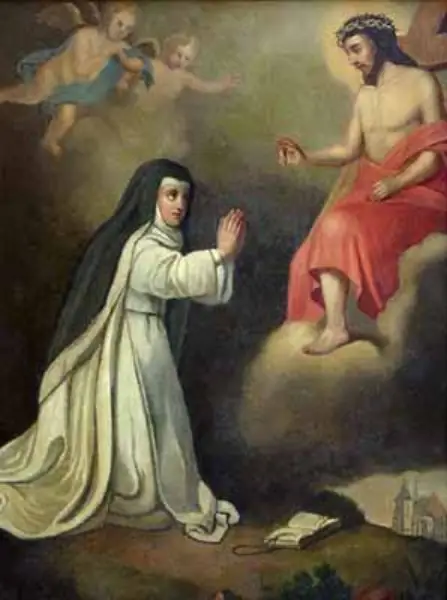
Bronislava Odrowaz, born around 1204 at Kamień in Włodawa County in eastern Poland, though some sources give 1200 or 1203, was a Polish nun of the Premonstratensian, or Norbertine, order. Her parents were Count Stanislaus and Countess Anna of the Prandata-Odrowaz family, and she was a cousin of Saint Hyacinth of Poland. When she was sixteen, Hyacinth brought her to the Norbertine religious house at Zwierzyniec near Kraków. She then labored among the ill and the destitute across several monasteries, keeping her own life hard and spare, and tradition holds that the Virgin Mary appeared to her at the hour of Hyacinth's passing in 1257. Death came to her naturally at Zwierzyniec on 29 August 1259. Her cult arose quickly; the year 1707 saw her named a patron of Poland and of its orphans, and Gregory XVI beatified her on 23 August 1839, an act attributed to her protection of Zwierzyniec from cholera in 1835. Her feast is kept on 1 September.
The Complete Life
An Odrowaz Childhood
Bronislava was born into one of the great families of medieval Poland. Her home was Kamień, in Włodawa County in the eastern part of the kingdom, and the year was approximately 1204, although some sources place her birth in 1200 and others in 1203. Her father was Count Stanislaus and her mother Countess Anna of the Prandata-Odrowaz line, a house that in the same generation gave the church Saint Hyacinth, her cousin. The Odrowaz kinship was to prove the single most consequential fact of her life. The family belonged to that aristocratic layer of Polish society from which the new mendicant and canonical orders of the thirteenth century drew so many of their members; when Hyacinth returned from his travels burning with the ideals of the reforming church, he did not have to look beyond his own relatives for disciples. Bronislava grew up amid the expectations that attached to a count's daughter in a young and ambitious Christian kingdom, and the fruit of that upbringing showed early: at sixteen she left the world of the castle for the enclosure, and she never returned to it.
§ Early life
Zwierzyniec
The decisive intervention in Bronislava's life came from her cousin. At sixteen, Hyacinth presented her to the Norbertine sisters at Zwierzyniec, on the wooded hill above Kraków where the canons and canonesses of Prémontré had settled. The Norbertines were canons regular, living a liturgical life in community under a rule that joined priest, brother and sister in a common discipline, and for a woman of Bronislava's rank the Zwierzyniec house offered a life at once enclosed and deeply engaged with the city at its foot. She did not remain stationary within it. She went on to labor among the sick and the destitute in a series of houses, and her manner of living was most austere, a phrase that compresses a lifetime of fasting, vigil and hardship voluntarily undertaken. Her ties of blood and spirit to Hyacinth endured to the end of his life; at the moment he died in 1257, tradition holds, Mary the Mother of God appeared to her, a grace that bound the two cousins together in the memory of Polish piety. She herself died of natural causes at Zwierzyniec on 29 August 1259.
§ Religious vocation
Austerity and Service
The shape of Bronislava's inner life has to be read from the few strong strokes the record preserves, and those strokes are consistent. A woman who served the ill and the destitute across a whole succession of religious houses was no recluse; Norbertine houses of the thirteenth century existed to serve the church around them, and the care of the ill was among the most demanding of those services, undertaken in an age when disease carried off the young and the strong without appeal. At the same time she lived austerely, in the fullest sense of the word. The combination is the oldest ideal of Prémontré: liturgy, discipline and works of mercy held together, none of them allowed to excuse the others. The vision of the Virgin Mary at the hour of Hyacinth's death, believed of her by later generations, completes the picture of a soul whose attention was fixed on the company of heaven even while her hands were occupied on earth. No foundations, writings or public office are credited to her, and the omission is itself instructive: her sanctity was the ordinary sanctity of the vowed life, pursued over four decades without relaxation, and it proved durable enough to carry her name across eight centuries of Polish memory.
§ Religious vocation
Beatification
Bronislava's veneration began soon after her death in 1259, and its subsequent history follows the pattern of many medieval cults formally recognized only in modern times. The year 1707 saw her named a patron of Poland, with orphans placed under her care as well, a charge that fits the bent of her life among the destitute. The decisive step came on 23 August 1839, when Pope Gregory XVI beatified her, an act attributed to her protection of Zwierzyniec from an outbreak of cholera in 1835. The epidemic had threatened the convent district where she had lived and died, and her intercession was understood to have walled it off. The date is worth pausing over: 1839 stands in the middle of a great wave of Polish causes advanced at Rome in the difficult years of the partitions, when the nation existed on maps only as territory of its neighbors and its blessed served as guarantors of its identity. Beatification placed her cult, until then local and domestic, under the authority of the whole church, with her feast assigned to 1 September. She remains blessed rather than canonized, honored in the Roman Martyrology's wider family of the beatified and remembered each year at Zwierzyniec.
§ Beatification and remembrance
Remembrance
Bronislava's afterlife in Polish culture has been unusually varied. In Kraków she is commemorated by the Blessed Bronisława Chapel, a landmark of the city where she spent her religious life; her image in stained glass stands in the cathedral of St. John the Baptist in Wrocław, reproduced from the portrait by Wojciech Eljasz-Radzikowski of 1849. Farther afield, a minor planet found in 1933 received the name Bronislawa for her sake, an astronomical tribute listed in the standard dictionary of minor planet names, and a street in the Ligota-Panewniki district of Katowice carries her name. Such a range of memorials, from chapel to street to asteroid, measures the place she holds in the affections of a nation: a Norbertine of the thirteenth century who worked with the sick and the poor, cousin and contemporary of Hyacinth, patroness declared of Poland and of orphans. Her story connects the great age of the Polish church's foundations with its nineteenth-century revival, and her feast on 1 September keeps the connection alive in the liturgy year by year, a reminder that holiness of the most unadvertised kind can outlast empires.
§ Beatification and remembrance
Timeline
- 1204
Born at Kamień in Włodawa County to Count Stanislaus and Countess Anna of Prandata-Odrowaz
§ Early life
- 1257
The Virgin Mary is believed to appear to her as Saint Hyacinth dies
§ Religious vocation
- 29 Aug 1259
Dies of natural causes at Zwierzyniec
§ Religious vocation
- 1707
Named a patron of Poland, with orphans under her care
§ Beatification and remembrance
- 1835
Credited with protecting Zwierzyniec from an outbreak of cholera
§ Beatification and remembrance
- 23 Aug 1839
Beatified by Pope Gregory XVI
§ Beatification and remembrance
- 1933
A newly discovered minor planet is named Bronislawa in her honor
§ Beatification and remembrance
The Record
- Patron of
- Patron of Poland (designated 1707)·Patron of orphans
- Symbols
- Norbertine (Premonstratensian) habit·Care of the sick and the poor
- Canonization
- Beatified by Pope Gregory XVI on 23 August 1839; venerated as patron of Poland and of orphans since 1707
Prayer
Bibliography
Show 7 sources
- Cholewczuk, Piotr. "Błogosławiona Bronisława". Siostry Norbertanki. Archived from the original on 2017-03-25. Retrieved 2014-09-05.
- "Blessed Bronislava of Poland". Saints.SQPN.com. 24 August 2014. Retrieved 1 September 2014.
- Petit, François (2011), Spirituality of the Premonstratensians: The Twelfth and Thirteenth Centuries, Cistercian Publications ISBN 978-0-87907-242-1 (p. 136)
- Fos, Henryk; Sowa, Franciszek (2007). Księga imion i świętych. Part VI. Kraków.
- Gryczyński, Michał (27 August 2004). "Św. Bronisława". Katolicki Przewodnik.
- Schmadel, Lutz (1992), Dictionary of Minor Planet Names, Volume 1, Springer-Verlag ISBN 3-540-00238-3 (p. 108)
- Katowice – Plan miasta. Demart SA. 2009–2010.
Profile text adapted from the Wikipedia article, licensed CC BY-SA 4.0.
Pray with this saint every day
Save St. Bronislava of Poland to your favorites, read the full profile, and get feast-day reminders in the Saints app.
Get the Saints AppFree on the App Store for iPhone and iPad