
c. 1045 – 1123·Feast July 18
St. Bruno of Segni
Benedictine Bishop, Abbot of Montecassino and Scriptural Scholar
Overview
Bruno, born around 1045 at Solero in Piedmont to parents named Andrea and Guglielmina, was an Italian Benedictine who served as Bishop of Segni from 1079 until his death and as Abbot of Montecassino from 1107 to 1111. Educated by the Benedictines near Asti and at Bologna, where he wrote an early commentary on the Gallican Psalter, he became a canon of Siena cathedral in 1073 after illness interrupted a journey to Montecassino. In Rome he came to the attention of Gregory VII, who had him elected to the see of Segni and consecrated him bishop personally. A trusted counselor of four successive popes, he spoke at the Roman synod of February 1079 against Berengarius of Tours on the Eucharist, served as librarian of the Holy Roman Church under Victor III, and accompanied Urban II through southern Italy and France, including the Council of Clermont of 1095. Entering the monastic life at Montecassino around 1102, he was elected its abbot in 1107. His refusal to accept Paschal II's concessions to Henry V after the Concordat of Ponte Mammolo led to his forced resignation of the abbacy in 1111 and return to Segni, where he died in mid-1123 and was buried in the cathedral.
The Complete Life
From Solero to Siena
Bruno was born around 1045 at Solero, a town in Piedmont between Asti and Alessandria; the sources do not agree on the standing of his parents, Andrea and Guglielmina, some making them nobles and others people of modest means. His formation was Benedictine and northern Italian. He pursued theological studies in the Benedictine house of Santa Perpetua near Asti, and then went on to Bologna, where the university's famous schools gave him the humanities and the liberal arts alongside his sacred learning. Already in these years his bent toward Scripture showed itself: one of his earliest works, an exposition of the Gallican Psalter, was dedicated to his bishop at Asti, Ingo, who held the see from 1072 to 1079. The course of his life then turned on an accident. Bruno had decided to become a monk at Montecassino and set out for the great abbey, but he fell ill at Siena and was detained there under Bishop Rudolfus, who named him to the cathedral chapter as a canon in 1073. He later recalled his years among the canons of Siena, and his ordination to the priesthood is probably to be placed in the same period, together with an assignment as a pastor in the city.
§ Early career
A Bishop Made Against His Will
In 1079 Bruno was in Rome and took part in the Sixth Roman Synod of Pope Gregory VII, where he was among those who spoke on the synod floor for the real presence of Christ in the Eucharist against the position of Berengarius of Tours; there Berengarius withdrew his teaching and received absolution from the pope. While in the city Bruno stayed with Pietro Igneo, Bishop of Albano, and it was through that friendship that his future was decided. Gregory, who valued Bruno's counsel and sought it often, sent the Bishop of Albano to Segni to persuade the cathedral canons to elect Bruno as their bishop. According to the account of Peter the Deacon, Bruno at first pleaded his unworthiness, as custom required, and then attempted outright flight when he understood that a consecration was being arranged; on the road at night he encountered a woman arrayed as an empress, her face radiant as daylight, a personification of the church of Segni, who rebuked him for running from his bride. Struck by the vision, Bruno turned back and accepted. Gregory VII consecrated him bishop himself. His time as a pastor was immediately embittered by politics: Adolfo di Segni, a supporter of Henry IV who coveted the lordship of the town, imprisoned him for three months, and during the imperial siege of Rome Bruno was confined again, this time in Castel Sant'Angelo together with Gregory himself.
§ Episcopate
Counselor of Four Popes
Bruno's reputation for orthodox teaching, scriptural learning and piety made him one of the most useful men of the reforming papacy, and he counseled four consecutive popes. Under Victor III he was named librarian of the Holy Roman Church, a post he held until he left for Montecassino at the end of the century. With Urban II, elected in 1088, his association became close and constant. He traveled with the pope through southern Italy, subscribed privileges at Salerno in 1093, and consecrated the cloister chapel at the monastery of S. Maria de Panso. In 1095 he followed Urban into France: the party is found at Tarascon, Avignon and Cluny in September and October, and Bruno was there at Clermont on 18 November 1095 when the assembly launched what became the First Crusade. He then accompanied the pope to Limoges, Charroux, Poitiers, Tours, where he consecrated the infirmary chapel at Moyenmoutier, Nîmes and Saint-Gilles, returning to Italy by September 1096. Under Paschal II he continued in the papal service, and in 1104 and again in 1106 he served as legate to France; on the second mission, which he shared with Prince Bohemond I of Antioch, he presided at a Poitiers council on 25 June 1106, given over chiefly to preaching the crusade. He also consecrated Landolfo as Archbishop of Benevento in 1108 and drafted the postulatio for the canonization of his friend Pietro di Anagni in 1109.
§ Career in Roman curia
Scholar of the Scriptures
Bruno's mind was above all an exegete's. His published works are, for the most part, commentaries: expositions of the Psalms, of the Gallican Psalter, of the Book of Job and of the four Gospels, together with 145 homilies that survive. He wrote the lives of Pope Leo IX and of Pietro di Anagni, and before 1109 he produced the Libellus de simoniacis, a pointed condemnation of the buying and selling of spiritual offices that stood squarely in the Gregorian reform. His collected works fill two volumes of Migne's Patrologia Latina. One instructive error is his: he once claimed that priests who had committed simoniacal acts could not validly perform the sacraments, and was shown to be wrong, since simony, however grave a sin, did not undo the sacrament of ordination. The mixture is characteristic of the man, a scholar whose zeal for reform occasionally outran his theology, and a monk-bishop whose learning was placed wholly at the service of the church's discipline. In an age when the interpretation of Scripture was inseparable from the struggle over investiture, his exegesis carried political weight; modern study of his commentaries has traced the allegory with which he read the events of his own day into the biblical text. An anonymous biography of Bruno, known as the Acta Brunonis, was composed toward the end of the twelfth century.
§ Works
The Quarrel over Investiture
Toward the end of 1102, in the months from August to December, Bruno became a monk at Montecassino. He had accompanied Paschal II to Benevento, had taken part in the synod there, and had fallen gravely ill during the journey; in that sickness he resolved to withdraw from secular pursuits into the cloister. The people of Segni were displeased and complained to the pope, who demanded to know why Bruno had retired without papal permission and ordered him to take care of his sheep; Bruno refused both the pope and his own flock, and a compromise was reached whereby he served the Roman church for forty days each year. After the death of Abbot Otto he was elected abbot of Montecassino on 13 November 1107. The decisive crisis came with Henry V's coercion of Paschal II. Held captive for sixty-one days, the pope granted the emperor a privilegium on investiture, sealed at Ponte Mammolo on 18 April 1111, and the concession was denounced everywhere. Bruno wrote to Paschal, condemned the agreement as treacherous, and asked the pope to reaffirm his constitution against investiture; pressed by others for his view, he imprudently replied that the pope neither liked nor consulted him, while he himself still followed the policy of Gregory VII and Urban II. At the Lateran council of March 1112 Paschal retracted his grant, and Bruno was present. In March 1116 he rose publicly and thanked God that the pope repented of having subscribed to what Bruno called heresy, an outburst that provoked an uproar. Paschal's patience ended: Bruno was obliged to resign the abbacy and return to his diocese, leaving Montecassino on 13 October 1111 according to the chronology of his deposition, and he ceased to subscribe papal documents thereafter. He died at Segni in mid-1123 and was buried in the cathedral, his feast of 18 July sometimes being taken for the date of his death.
§ Return to the diocese
Canonization
Bruno's sanctity was recognized by the church with unusual speed and formality for the period. On 5 September 1181, Pope Lucius III presided at Segni itself over the celebration of Bruno's canonization, less than sixty years after the bishop's death, in the diocese he had governed for over four decades. He has been honored ever since as the patron saint of the town. His liturgical standing was strengthened in 1584, when a special Office in his honor was approved by Pope Gregory XIII, giving his cult a proper textual form for the diocesan liturgy. One question left open by the sources is whether Bruno had also been a cardinal. Some accounts say that he declined the cardinalate; others hold that he was named Cardinal-Bishop of Segni, even though no suburbicarian see of Segni existed at the time; scholars disagree over whether Urban II created him a cardinal in 1086 or whether the promotion dated from 18 July 1079, and one modern student of the question has argued that he was never a cardinal at all. The dispute itself is a measure of his standing: a man so close to the popes of the reform that later writers simply assumed he must have worn the red. What is beyond dispute is the feast of 18 July and the tomb in the cathedral of Santa Maria Assunta at Segni, where the canonization was celebrated and where he still rests.
§ Sainthood
Legacy
Bruno of Segni occupies a singular place in the history of the investiture controversy: he was the man who told a pope, to his face and in public, that a concession to temporal power was heresy, and who paid for it with the finest office in the Benedictine world. The episode has kept his name alive among historians of the Gregorian reform, and a substantial body of modern scholarship, from Gigalski's 1898 biography through Grégoire, Hoffmann, Hüls and Robinson, shows a figure still seriously studied. His scriptural works earned him a permanent place in the Patrologia Latina and a readership that long outlived the controversy his commentaries served. As abbot of Montecassino for four years he stood at the head of Western monasticism; as bishop of Segni for over forty he embodied the continuity of local pastoral care amid the storms of Roman politics. His story also carries a human warning. The same uncompromising clarity that made him valuable to Gregory VII and Urban II made him impossible for Paschal II, and the sources record both his imprudence in correspondence and his theological error on simoniacal orders. Zurbarán painted him with Urban II; Segni keeps him as its patron; and the church remembers in him a scholar who believed that the interpretation of Scripture could never be separated from the liberty of the church.
§ Works
Timeline
- 1045
Born at Solero in Piedmont, to Andrea and Guglielmina
§ Early career
- 1073
Falls ill at Siena while traveling to Montecassino and is made a canon of the cathedral by Bishop Rudolfus
§ Early career
- 1079
Chosen Bishop of Segni by that city's cathedral canons at Gregory VII's urging
§ Episcopate
- Feb 1079
Speaks at Gregory VII's Sixth Roman Synod against the teaching of Berengarius of Tours on the Eucharist
§ Episcopate
- 1080
Consecrated a bishop by Pope Gregory VII himself
§ Episcopate
- 4 May 1082
Attends the eighth Roman synod of Pope Gregory VII
§ Episcopate
- 1082
Confined a second time, in Castel Sant'Angelo alongside Pope Gregory VII during Henry IV's siege
§ Episcopate
- 1086
Named librarian of the Holy Roman Church by Pope Victor III, an office he holds until 1099
§ Career in Roman curia
- 18 Nov 1095
Accompanies Urban II to the Council of Clermont, where the First Crusade is inaugurated
§ Career in Roman curia
- 1102
Falls seriously ill while traveling with Paschal II and resolves to enter the monastic state at Montecassino
§ Bruno and Paschal II
- 25 Jun 1106
Serves as papal legate to France with Prince Bohemond I of Antioch and holds a council at Poitiers
§ Bruno and Paschal II
- 13 Nov 1107
Elected abbot of Montecassino, five years after entering the cloister there
§ Bruno and Paschal II
- 4 Jun 1109
Welcomes Pope Paschal II at Segni for the canonization of Pietro di Anagni and is credited with writing the postulatio
§ Bruno and Paschal II
- 1111
Condemns the Concordat of Ponte Mammolo in a letter that provokes the anger of Paschal II
§ Bruno and Paschal II
- 13 Oct 1111
Obliged to resign the abbacy, he departs Montecassino and returns to Segni as its bishop
§ Return to the diocese
- Mar 1112
Present at the Lateran council where Paschal II retracts his grant on investiture
§ Bruno and Paschal II
- Mar 1116
Publicly declares at the Lateran synod that the pope has repented of subscribing to heresy
§ Bruno and Paschal II
- 1123
Dies at Segni in mid-1123 and is buried in the cathedral
§ Return to the diocese
- 5 Sep 1181
Canonized by Pope Lucius III at Segni
§ Sainthood
- 1584
A special liturgical Office in his honor is approved by Pope Gregory XIII
§ Sainthood
In Their Own Words
Let us praise God and give Him thanks, because our lord and head repents that he had subscribed to that heresy.
The Record
- Major works
- Expositio in psalterium Gallicanum (commentary on the Gallican Psalter)·Libellus de simoniacis (treatise against simony, written before 1109)·Commentaries on the Book of Job, the Psalms and the four Gospels·Lives of Pope Leo IX and Pietro di Anagni·145 preserved homilies (collected in the Patrologia Latina, vols. 164–165)
- Patron of
- Patron of Segni
- Symbols
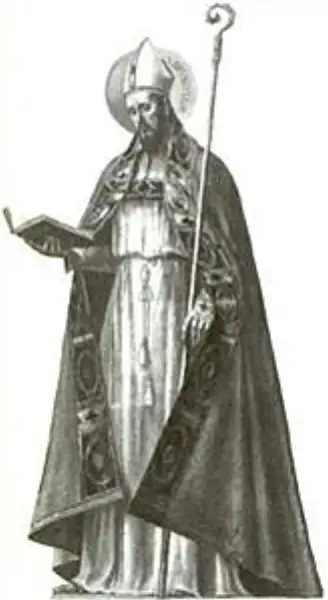
- Benedictine habit·Episcopal attire·Pastoral staff
- Canonization
- Canonized by Pope Lucius III at Segni on 5 September 1181
Prayer
Bibliography
Show 8 sources
- Gigalski, Bernhard (1898). Bruno, Bischof von Segni, Abt von Monte-Cassino (1049-1123): sein Leben und seine Schriften: ein Beitrag zur Kirchengeschichte im Zeitalter des Investiturstreites und zur theologischen Litteraturgeschichte des Mittelalters. (in German) Kirchengeschichtliche Studien; 3. Bd., 4. Heft. Münster: H. Schöningh, 1898.
- Grégoire, Réginald (1965) Bruno di Segni, exégète médiéval et théologien monastique (in French) Spoleto: Centro Italiano di Studi sull'Alto Medioevo: 1965.
- Grégoire, Réginald (1970). "Note Sur Bruno de Segni". (in French) Recherches de Théologie Ancienne et Médiévale, vol. 37, Peeters Publishers, 1970, pp. 138–142.
- Hoffmann, Hartmuth (1972). "Bruno di Segni." (in Italian) Dizionario biografico degli Italiani 14 (1972), pp. 644–645.
- Hüls, Rudolf (1977), Kardinal, Klerus und Kirchen Roms: 1049-1130 (in German). Tübingen: Max Niemeyer 1977. pp. 129–130.
- Robinson, I. S. (1983). "'Political Allegory' in the Biblical Exegesis of Bruno of Segni." Recherches de Théologie Ancienne et Médiévale, vol. 50, Peeters Publishers, 1983, pp. 69–98.
- Sollerio, Joannes Baptista (1725). "De S. Brunone episcopo". (in Latin) Acta Sanctorum Julii Tomus IV (Antwerp: Jacobus de Moulin), pp. 471–488.
- Birkhaeuser, Jodoc Adolphe. "St. Bruno." The Catholic Encyclopedia Vol. 3. New York: Robert Appleton Company, 1908. 13 April 2020
Profile text adapted from the Wikipedia article, licensed CC BY-SA 4.0.
Pray with this saint every day
Save St. Bruno of Segni to your favorites, read the full profile, and get feast-day reminders in the Saints app.
Get the Saints AppFree on the App Store for iPhone and iPad