
c. 1005 – 27 May 1045·Feast May 17
St. Bruno of Würzburg
Eleventh-Century Prince-Bishop and Psalms Commentator
Overview
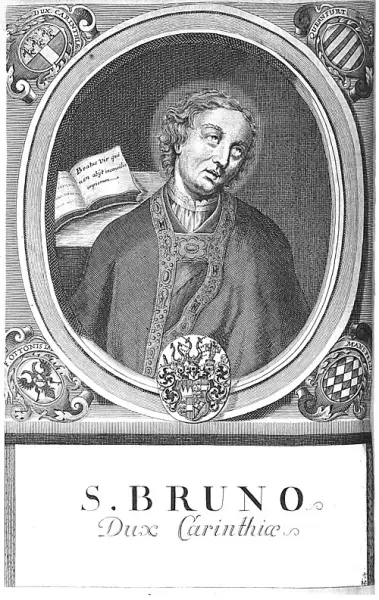
Bruno of Würzburg, also called Bruno of Carinthia, was born around 1005 into the family of Duke Conrad I of Carinthia and his wife Matilda of Swabia, a cousin of the Salian emperor Conrad II. He held the post of imperial chancellor in Italy from 1027 until 1034, and from 1034 until his death as prince-bishop of Würzburg, being succeeded by his nephew Adalbero. On behalf of Conrad's son and successor, Henry III, he conducted the courtship of Agnes of Poitou. A builder bishop, he began the construction of Würzburg Cathedral around 1040 and in 1042 dedicated the rebuilt Abbey of St. Burchard. He also composed a widely circulated glossed commentary on the Psalms, known as the Expositio Psalmorum, consisting largely of extracts from the Church Fathers, though some scholars dispute his authorship. In 1045 he accompanied Henry III on the emperor's second Hungarian campaign and died at Persenbeug on the Danube, in present-day Lower Austria, after the floor of a banqueting hall collapsed beneath the guests of Countess Richlinde of Ebersberg. He was buried in the crypt of his cathedral, whose consecration on 16 June 1045 was joined to his burial.
The Complete Life
A Carinthian in the Imperial Family
Bruno was born around 1005 into the highest aristocracy of the Salian empire. His father was Conrad I, Duke of Carinthia; his mother, Matilda of Swabia; and through them he stood as a cousin to Emperor Conrad II, the founder of the dynasty. The alternative name by which he is known, Bruno of Carinthia, preserves the memory of this descent. His life belongs entirely to the great century of the imperial church, when German kings drew their bishops from the royal kin and used them as the instruments of government, and Bruno's career is a textbook case of that system. Before he ever held a see, he ran the imperial chancery for Italy between 1027 and 1034, one of the key posts through which the Salian monarchs administered their transalpine kingdom; his uncle-by-marriage's court, and later Henry III's, counted on men of exactly his stamp, at once churchman, administrator and relative. Even after he became a bishop, imperial business remained his business: he acted as suitor for Agnes of Poitou on the part of Conrad's son and heir Henry III, arranging the marriage that would bind the empire to the house of Poitou.
§ Origin and Imperial politics
Builder of Würzburg
In 1034 Bruno exchanged the chancellorship of Italy for the see of Würzburg, which he would hold until his death eleven years later. His episcopate is remembered above all as one of construction. Many cathedrals were rising in that period, and from 1040 Bruno directed the building of a new Würzburg Cathedral, laying its cornerstone himself. Two years later, in 1042, he dedicated the Abbey of St. Burchard, which Abbot Willemund had rebuilt, a work of restoration that bound his name to the memory of the see's first great bishop. The cathedral he began was not finished in his lifetime, but the crypt beneath it was ready by the summer of 1045, and the consecration of that crypt on 16 June 1045 was joined to the burial of its founder, an accidental liturgy that the faithful of Würzburg could hardly fail to read as a sign. A prince-bishop who spent his revenues on stone and on prayer rather than on display, Bruno governed a diocese that stood at the crossroads of the empire's eastern politics, close to the marches where the king's campaigns against Hungary were mounted, and it was precisely on such a campaign that his life ended.
§ Origin and Imperial politics
Death at the Banquet
In 1045 Bruno accompanied the young Henry III on his second Hungarian campaign. The imperial retinue halted at the residence of Countess Richlinde of Ebersberg, a widow then occupied with dividing the estate left by her late husband, Count Adalbero II. During a great banquet she gave, a load-bearing pillar of the hall gave way and the entire floor collapsed. The king escaped with slight injuries, but the countess, Bishop Bruno and Abbot Altmann of Ebersberg Abbey were hurt so gravely that none of them survived more than a few days. The Annals of Niederaltaich attach a legend to the bishop's end: before the feast, while the party passed the Strudengau stretch of the Danube near Grein, Bruno was said to have been confronted and threatened by the devil, and the bishop repelled him. The story gave the accident the shape of a final spiritual combat, and the faithful of the eleventh century would have heard it that way. Bruno's body was carried back to Würzburg, to the residence and the unfinished cathedral of the see he had served. He was succeeded by his nephew Adalbero, keeping the episcopate, as so often in that age, within the circle of the imperial kin.
§ Death
Cult Without a Canonization
Bruno was never formally canonized by the Roman Catholic Church, yet he is nevertheless revered as a saint. His is the common case of the early medieval episcopate: sanctity conferred by local devotion, by a tomb in one's own cathedral, and by entry into the liturgical books. The Roman Martyrology keeps his feast on 17 May, and this, not the 27th of May, is the proper date according to that authority, even though the date of his death was 27 May 1045. The double date is a small window into how such cults were fixed: the day the church kept was not always the day the man died. The joining of his burial to the consecration of the cathedral crypt on 16 June 1045 gave his tomb a liturgical setting from the first hour, and the shrine of a builder bishop in his own building carried an authority that no later process was needed to confirm. Pilgrims and the clergy of Würzburg sustained his memory through the Middle Ages, and the modern diocese still honors him among its saints.
§ Burial and cultus
The Psalter of St. Bruno
The most durable monument to Bruno is a book. Popularly attributed to him is a well-known glossed commentary on the Psalms, sometimes called the Expositio Psalmorum, which gathers passages drawn mostly from the Fathers of the Church into a running gloss around the psalm text. For a glossed psalter the work enjoyed exceptional popularity, surviving in many manuscript copies and again in the earliest printed books, an extraordinary record of circulation for an eleventh-century compilation. Its incunable editions, printed at Nuremberg by Anton Koberger in 1497 and at Leipzig in 1533 under the title Psalterium beati Brunonis episcopi herbipolensis, carried Bruno's name to the eve of the Reformation, and digitized copies of both are extant today. Some scholars dispute his authorship, so the attribution rests on tradition rather than on demonstration. Even so, the conjunction of builder and commentator is what makes Bruno characteristic of his century: an imperial prelate who laid the cornerstone of a cathedral and, in the same years, put into circulation a psalter that ordinary clergy could read, pray and preach from for the next five hundred years.
§ Works
Timeline
- 1005
Born around 1005, son of Conrad I, Duke of Carinthia, and Matilda of Swabia
§ Origin and Imperial politics
- 1027
Becomes imperial chancellor of Italy under Emperor Conrad II
§ Origin and Imperial politics
- 1034
Leaves the chancellorship on becoming prince-bishop of Würzburg
§ Origin and Imperial politics
- 1040
Begins construction of Würzburg Cathedral
§ Burial and cultus
- 1042
Dedicates the Abbey of St. Burchard, rebuilt by Abbot Willemund
§ Origin and Imperial politics
- 27 May 1045
Dies on 27 May at Persenbeug on the Danube, injured when a banqueting hall floor collapsed
§ Death
- 16 Jun 1045
Buried in his cathedral on 16 June 1045, the consecration of the crypt being combined with his burial
§ Burial and cultus
The Record
- Major works
- Expositio Psalmorum, a glossed commentary on the Psalms drawn largely from the Church Fathers (popularly attributed; authorship disputed by some scholars)
- Symbols
- Bishop's vestments of a prince-bishop of the Salian era·Psalter, for his famous commentary
- Canonization
- Never formally canonized; nevertheless revered as a saint, with his feast in the Roman Martyrology
Prayer
Bibliography
Show 5 sources
- Schütz, Markus. "St. Burkard – das erste Kloster in Würzburg – Geschichte (German)". Haus der Bayerischen Geschichte – Klöster in Bayern. Retrieved 1 February 2018.
- Lins, Joseph. "Diocese of Würzburg." The Catholic Encyclopedia Vol. 15. New York: Robert Appleton Company, 1912. 10 June 2018
- "May 17th". The Roman Martyrology. boston-catholic-journal.
- Kraebel, A. B. (December 2012), "John of Rheims and the Psalter-commentary attributed to Ivo II of Chartres", Revue Bénédictine, vol. 122, no. 2, pp. 160–161, doi: 10.1484/J.RB.5.100836.
- Peter Kolb and Ernst-Günthe Krenig (eds.), 1989: Unterfränkische Geschichte, pp. 229–232. Würzburg
Profile text adapted from the Wikipedia article, licensed CC BY-SA 4.0.
Pray with this saint every day
Save St. Bruno of Würzburg to your favorites, read the full profile, and get feast-day reminders in the Saints app.
Get the Saints AppFree on the App Store for iPhone and iPad