
c. 830/840 – 880·Feast February 2
St. Bruno of Saxony
Duke of Saxony and Martyr of Lüneburg Heath
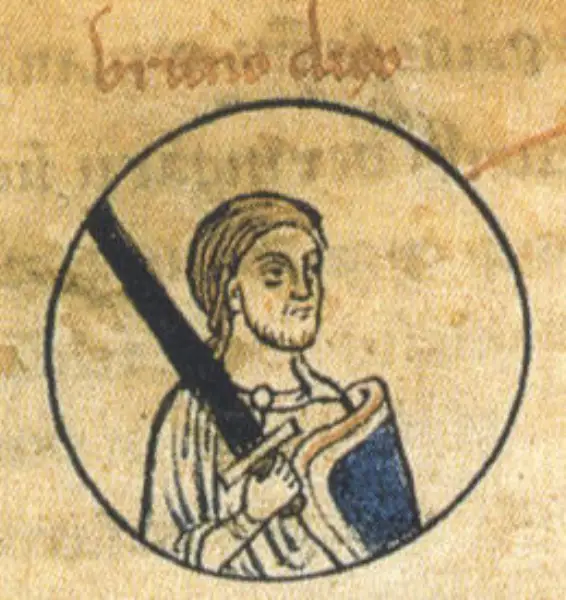
Overview
Bruno, called also Brun or Braun, born about 830 or 840, was a member of the Ottonian dynasty, duke of Saxony from 866 until his death in 880, and is honoured among the Ebsdorf Martyrs. He was the eldest son of Count Liudolf of Saxony, who died in 866, and of Oda; the family lands lay in Eastphalia along the Leine, where Liudolf raised the monastery of Brunshausen in 852. Bruno succeeded his father, and a notice of 877 styles him a count; where Liudolf had led the East Saxons, Widukind of Corvey suggests his son may already have ruled all Saxony. His sister Liutgard married the Carolingian prince Louis the Younger in 874, after which the Annales Fuldenses call him 'duke and the queen's brother'. Of his own wife and children nothing is known. He fought beside Louis the Younger against the emperor Charles the Bald, and leading the Saxons against the Vikings he fell at the battle of Lüneburg Heath on Candlemas Day, 2 February 880, against Norse warriors, most likely a Danish detachment of the Great Heathen Army later defeated by King Alfred the Great. The bishops of Minden and Hildesheim and twelve Saxon counts died with him; Thietmar says he perished in a flooded river. His brother Otto the Illustrious succeeded him, and Otto's son Henry the Fowler took the East Frankish throne in 919. About 1160 his relics were carried to Ebstorf Abbey, later a great pilgrimage site; tradition also names him founder of Brunswick and ancestor of the Brunonids.
The Complete Life
Heir of the Liudolfings
The man whom history calls Bruno, and whom the sources also name Brun or Braun, entered the world around 830 or 840, a member of the house that posterity knows as the Ottonian dynasty, though to contemporaries it was simply the family of Liudolf. Count Liudolf, who died in 866, was his father, and Oda his mother. The family's strength lay in Eastphalia, the eastern half of Saxony, where Liudolf's broad estates ran along the river Leine and where, in 852, he founded the monastery of Brunshausen, first seed of a great monastic line. Bruno grew up heir to this rising house, in a Saxony that formed the far march of the East Frankish kingdom, open to the Slavic east and, ever more, to Norse raiders out of the north. His father bears the style dux orientalis Saxonum, leader of the East Saxons, yet the Res gestae saxonicae of Widukind of Corvey hints that the son may already have held the fuller dignity of duke over all Saxony. One marriage shows how far the house had risen within East Francia: in 874 Bruno's sister Liutgard was wed to the Carolingian prince Louis the Younger, second son of King Louis the German, and from that time the Annales Fuldenses call Bruno ducem et fratrem reinæ — duke and the queen's brother. Of Bruno's own marriage and children nothing is known; whether he stands at the root of the later Brunonid counts is disputed.
§ Life
The Battle of Lüneburg Heath
Bruno's public career belongs to the wars of the late Carolingian world. He stood by his brother-in-law Louis the Younger in that prince's struggles against his uncle, the Emperor Charles the Bald, a family quarrel of the Carolingians in which Saxon arms weighed heavily. His last campaign, though, was fought against the enemy common to all the age. As commander of the Saxon forces in the Viking wars, Bruno led his men against a Norse host — probably a Danish detachment of the Great Heathen Army, the same force King Alfred the Great was to break in the west. They joined battle on Candlemas Day, 2 February 880, upon Lüneburg Heath, in the depth of a north German winter, and the day ended in ruin for the Saxons. Duke Bruno fell; with him died the bishops of Minden and Hildesheim, twelve Saxon counts and a number of other nobles — a catastrophe that stripped a whole region of its leadership between sunrise and sunset. Bishop Thietmar of Merseburg, the chronicler, records that Bruno met his end in a flooded river, most likely in the press of the battle or on the retreat, as fleeing men broke through the winter ice. His younger brother Otto the Illustrious succeeded him in the duchy, and Otto's son Henry the Fowler became King of East Francia in 919, so that the house for which Bruno died reached the throne itself within two generations.
§ Life
The Ebsdorf Martyr
In the Catholic Church Bruno is honoured as saint and martyr, kept on 2 February as St. Bruno of Saxony; the Eastern Orthodox Church also venerates him, and with the nobles who fell beside him he is counted among the Ebsdorf Martyrs. Around 1160 the Dannenberg counts translated his relics to Ebstorf Abbey near Uelzen, and from the fourteenth century that spot was fixed upon as the battlefield of 880 and grew into a major site of pilgrimage; the great medieval Ebstorf Map was drawn in the same abbey that kept his bones. Two further claims attach to him by tradition: that he founded Brunswick, and that he was forefather of the local count Brun I — a candidate at the royal election of 1002 — and of the Brunonid line after him. The names run consistently enough to suggest kinship, yet the sources deceive, and some mentions seem rather to belong to an earlier Saxon margrave called Brun the Younger, who may have been Bruno's grandfather; the affiliation therefore remains uncertain. His memory today rests less on genealogy than on the bare fact of 2 February 880: a winter defeat on the heath in which a duke, two bishops and twelve counts fell together against the Norsemen — an image of a church and a people standing, and falling, as one.
§ Veneration
Timeline
- 840
Born around 830/840, eldest son of the Saxon count Liudolf and his wife Oda.
§ Life
- 852
His father Liudolf founded the Brunshausen monastery on the family estates in Eastphalia along the Leine river.
§ Life
- 866
Succeeded his father Liudolf as duke of Saxony.
§ Life
- 874
His sister Liutgard married the Carolingian prince Louis the Younger, and the Annales Fuldenses styled Bruno 'duke and the queen's brother'.
§ Life
- 877
First mentioned as a count.
§ Life
- 2 Feb 880
Killed on Candlemas Day, commanding the Saxons against Norse warriors in the Battle of Lüneburg Heath.
§ Life
- 1160
Around this year the Dannenberg counts carried his relics to Ebstorf Abbey, near Uelzen.
§ Veneration
The Record
- Patron of
- Patron of Brunswick·Honoured among the Ebsdorf Martyrs
- Symbols
- Ducal dress and sword·Palm of martyrdom
- Canonization
- Pre-congregation; venerated as a saint and martyr in the Catholic Church and Eastern Orthodox Church, one of the Ebsdorf Martyrs
Prayer
Bibliography
Show 3 sources
- Reuter, Timothy (trans.). The Annals of Fulda. Manchester Medieval series, Ninth-Century Histories, Volume II. Manchester: Manchester University Press, 1992.
- AF (Annales Fuldenses), 880, p. 88 and n4.
- Gesta Francorum, listing three counts named Bardo among the twelve killed fighting the Danes in 880.
Profile text adapted from the Wikipedia article, licensed CC BY-SA 4.0.
Pray with this saint every day
Save St. Bruno of Saxony to your favorites, read the full profile, and get feast-day reminders in the Saints app.
Get the Saints AppFree on the App Store for iPhone and iPad