
c. 1030 – 1101·Feast October 6
St. Bruno of Cologne
Founder of the Carthusians and Master of Reims
Overview
Bruno of Cologne, born about 1030 into one of the leading families of his native city, became the founder of the Carthusian Order and one of the most respected teachers of eleventh-century Europe. After studying theology at Reims he returned home, was probably ordained priest around 1055, and held a canonry at St. Cunibert's in Cologne. Bishop Gervais recalled him to Reims in 1056, and for eighteen years he directed the episcopal school there, training a generation of prelates that included the future Pope Urban II. Made chancellor of the archdiocese in 1075, he helped bring about the suspension of the violent archbishop Manasses de Gournai, then withdrew from ecclesiastical ambition altogether. In 1084, with six companions, he accepted from Hugh, Bishop of Grenoble, a desolate alpine spot called Chartreuse, where the little community built an oratory and separate cells and lived in solitude and poverty. Called to Rome in 1090 by his former pupil Urban II, he served as a discreet advisor in the Lateran while refusing the archbishopric of Reggio Calabria. In 1091 he settled a second hermitage in the forested valley of Squillace in Calabria under the patronage of Count Roger I of Sicily, and there he died on 6 October 1101. He wrote commentaries on the Psalms and the Pauline Epistles, two surviving letters, a profession of faith, and an elegy on contempt for the world. He is honored as a patron of Calabria and of Germany.
The Complete Life
A Son of Cologne
Born in Cologne around the year 1030, Bruno belonged by tradition to the Hartenfaust, or Hardebüst, line, counted among the chief houses of that city. His boyhood left no trace in the record; what survives begins with his studies, in theology, at Reims in present-day France, after which he went home to the Rhineland. There, probably about 1055, came priestly ordination together with a canonry at the church of St. Cunibert. A quiet, prosperous course seemed set — until Bishop Gervais, who knew his quality, called him back to Reims in 1056. Within a year the episcopal school was in his hands, and with it a charge far wider than a single classroom: he directed the schools of the city and oversaw every teaching establishment in the diocese. From 1057 to 1075, eighteen years in all, he kept this office with such success that the lustre the school had enjoyed under earlier masters — Remi of Auxerre among them — did not fade. His reputation as philosopher and theologian stood high, and his classroom stocked the Church with leaders. Among the young men who sat under him were Eudes of Châtillon, the future Pope Urban II; Rangier, who became a cardinal and Bishop of Reggio; Robert, later Bishop of Langres; and a great crowd of abbots and prelates besides. When the crisis of the next decade broke over Reims, it found Bruno at the centre of the diocese's life, the most trusted teacher of his generation in northern Europe.
§ Life
The Chancellor Who Walked Away
The year 1075 raised Bruno to the chancellorship of the archdiocese, and so into the daily conduct of its affairs. The times were bad for scholars. Gervais de Château-du-Loir, the pious bishop and Bruno's friend, had been followed by Manasses de Gournai, a violent nobleman with no real calling to the Church. Urged on by Bruno and the clergy, a council meeting at Autun suspended Manasses in 1077. The reply was thoroughly of the age: the archbishop's retainers razed the houses of those who had accused him, seized their property, sold their benefices, and even carried an appeal to Rome. Bruno kept away from the cathedral city until 1080, when a definitive sentence — underlined by rioting — drove Manasses out and into the protection of Henry IV, the emperor who opposed Gregory VII so fiercely. That struggle settled Bruno's own future. On the eve of promotion to a bishopric he chose rather to redeem a private vow and abandon worldly affairs. Two friends, the canons Raoul and Fulcius, went with him. The little company first lodged for a while among Robert of Molesme's hermits at Sèche-Fontaine, in the Diocese of Langres — the same circle from which the first Cistercians would come in 1098. Then Bruno, now with six companions, presented himself to Hugh of Châteauneuf, Bishop of Grenoble, who in 1084 settled them at Chartreuse, a desert fold in the lower Alps of the Dauphiné not far from Grenoble. An oratory went up, and around it small separate cells; there they lived, poor and apart from one another.
§ Refusal to become a bishop
Advisor in the Lateran
The desert did not hide Bruno from the needs of the Church. In 1088 his old pupil Eudes of Châtillon mounted Peter's throne as Urban II, resolved to carry forward the Gregorian reform and forced to contend with the antipope Clement III and with Henry IV. Needing men both able and devoted, he summoned his old master to Rome in 1090. What exactly Bruno did there is not easy to say — fittingly, for the man himself. Housed within the Lateran beside the pontiff, taken into his closest confidence, he advised while staying out of sight, aloof from the savage factions that divided Rome and the curia. Soon after he arrived, Henry IV's descent on the city with the antipope in his train forced the papal party south. Efforts were then made to raise Bruno to the metropolitan see of Reggio Calabria; he resisted, putting forward instead one of his own former pupils lodged in a Benedictine house near Salerno, and pleaded to be allowed back to the solitude of Dauphiné, as a letter he wrote to his brethren shows. Urban's wishes prevailed: Bruno stayed in Italy, within call of the papal court. He is absent from the rolls of Clermont, where the First Crusade was preached, yet he seems to have sat at the council of Benevento in March 1091. History gives him no scene and no speech; the popes he served needed no chronicler for the help he gave.
§ Refusal to become a bishop
Prayer, Mortification, and Our Lady
Those who had been his disciples named three virtues as the signature of his soul: a mighty spirit of prayer, harsh mortification, and devotion to the Blessed Virgin. The evidence comes from the mortuary rolls sent round after his death; 178 witnesses, many of them his personal acquaintance, celebrated how wide his learning ran and how fruitful his teaching was. Strangers, the rolls record, marvelled chiefly at his knowledge and his gifts; his own followers pointed beyond them to holiness. Mary stands at the centre of his foundations. The two churches he raised in the wilderness were both consecrated to her — Our Lady of Casalibus in Dauphiné and Our Lady Della Torre in Calabria — and the Carthusian Statutes, keeping his inspiration, name the Mother of God first and chief patron over every house of the order, whatever its other patron may be. He wrote as well as founded. On the Psalms and on Paul's epistles he left commentaries; two letters of his hand survive, with a profession of faith and a brief elegy on contempt of the world, proof that he practised verse. The commentaries betray a little Hebrew and Greek, and long acquaintance with the Fathers, Augustine of Hippo and Ambrose above the rest. Dom Rivet judged his Latin concise, clear, nervous and simple, a composition hard to match for solidity and light.
§ Bruno's legacy
The Valley of Squillace
In 1091, with a few followers who had gathered to him, Bruno fixed on the site of a second retreat: a small, wooded high valley lying in the Diocese of Squillace. There the band put up a modest wooden chapel and rough cabins. Their patron proved to be Roger I of Sicily — the count who ruled Sicily and Calabria, uncle to the Duke of Apulia — and he granted the hermits the lands they had taken; a warm friendship followed between the two men. Bruno travelled to the Guiscard court at Mileto twice to visit the sick count, in 1098 and again in 1101, and in 1097 he baptised the count's infant son Roger, who would reign as King of Sicily. More often it was the count who came out to the hermits, building himself a plain house among them. At his expense the monastery of St. Stephen arose in 1095 beside the first hermitage, which was dedicated to the Virgin. Then, at the turn of the century, death removed his friends one after another: Urban II in 1099; Landuin, prior of the Grande Chartreuse and Bruno's first companion, in 1100; Count Roger himself in 1101. Bruno followed them on 6 October 1101 at Serra San Bruno, and found his grave in the small cemetery of the Santa Maria hermitage.
§ Refusal to become a bishop
A Saint Without a Ceremony
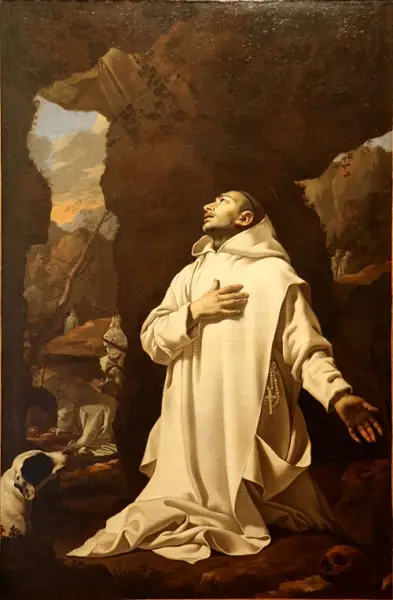
No formal process ever declared Bruno a saint. The Carthusians, whose rule presses humility to the utmost, never sought one, and so he stands in the calendar without a canonisation to his name. Pope Leo X in 1514 authorised his cult for the Carthusian Order — the year commonly marked as his beatification — and Gregory XV extended it to the universal church on the 17th of February 1623, with Clement X raising it in 1674 to the rank of a double. He had no place in the Tridentine calendar; the insertion of his feast on 6 October in the General Roman Calendar came only with Gregory XV in 1623. A humbler sign had come a century before: in 1513 his bones were unearthed in the cemetery of the Santa Maria hermitage, beneath an epitaph reading 'Haec sunt ossa magistri Brunonis' — these are the bones of the master Bruno. Nothing could suit him better: no titles, no catalogue of wonders, only a master remembered by his pupils. Artists give him the white Carthusian habit, a skull held and pondered, a book and a cross; sometimes a crown of seven stars circles his head, or he carries a scroll bearing the motto 'O Bonitas'.
§ Inscription in the Roman calendar
The Order That Kept His Silence
When Bruno died, the Carthusians of Calabria did what medieval communities often did: they sent out a roll-bearer, a servant of the house with a long parchment mortuary roll hung about his neck, who journeyed through Italy, France, Germany and England announcing the death. Churches, communities and chapters answered by writing on the roll, in prose or in verse, their sorrow and their promise of prayers. Many such rolls survive, but few are so long or so generous as those composed for Bruno: 178 witnesses, many of them known to him personally, praised the range of his learning and the fruit his teaching bore. The two communities he planted himself grew into an order that has never been large and has never needed to be. Calabria counts him her patron, and Germany honours him among her own. Both churches he built in the waste were consecrated to the Blessed Virgin, and the order's Statutes, loyal to his mind, set the Mother of God before every other patron of every house. His name has wandered far from the cloister: a creek in California bears it, and every charterhouse in Europe keeps it. The strictest order in the Church remains the truest monument to its founder.
§ Bruno's legacy
Timeline
- 1030
Born in Cologne, traditionally into the prominent Hartenfaust family.
§ Life
- 1055
Ordained a priest in Cologne, most likely, and given a canonry at St. Cunibert's.
§ Life
- 1056
Recalled to Reims by Bishop Gervais to direct the episcopal school and the diocese's educational establishments.
§ Life
- 1057
Became head of the school of Reims, a post he held with distinction until 1075.
§ Life
- 1075
Appointed chancellor of the Archdiocese of Reims, entering the daily administration of the diocese.
§ Chancellor of the Diocese of Reims
- 1077
At the urging of Bruno and the Reims clergy, Archbishop Manasses de Gournai was suspended at the council of Autun.
§ Chancellor of the Diocese of Reims
- 1080
A final sentence, confirmed by popular riot, forced Manasses to withdraw to the protection of Emperor Henry IV.
§ Chancellor of the Diocese of Reims
- 1084
Hugh of Châteauneuf, Bishop of Grenoble, installed Bruno and his companions at the desert spot named Chartreuse in the lower Alps.
§ Refusal to become a bishop
- 1088
His former pupil Eudes of Châtillon was elected pope as Urban II.
§ Refusal to become a bishop
- 1090
Urban II summoned his old master to Rome, where Bruno lodged in the Lateran and advised the pope privately.
§ Refusal to become a bishop
- Mar 1091
Seems to have attended the Council of Benevento, though he stayed away from Clermont when Urban preached the First Crusade.
§ Refusal to become a bishop
- 1091
Declined the archbishopric of Reggio Calabria and founded a second hermitage in the Diocese of Squillace under Count Roger I of Sicily.
§ Refusal to become a bishop
- 1095
The monastery of St. Stephen arose beside the first hermitage, dedicated to the Virgin, built at Count Roger's expense.
§ Refusal to become a bishop
- 1097
Baptised Roger, the infant son of Count Roger I and the future King of Sicily.
§ Refusal to become a bishop
- 6 Oct 1101
Died on 6 October at Serra San Bruno, after visiting the ailing Count Roger at Mileto.
§ Refusal to become a bishop
- 1513
His bones were discovered in the hermitage cemetery bearing the epitaph 'Haec sunt ossa magistri Brunonis'.
§ Inscription in the Roman calendar
- 1514
Pope Leo X authorized his cult for the Carthusian Order, though Bruno was never formally canonized.
§ Introduction
- 17 Feb 1623
Pope Gregory XV extended his cult to the whole Church on 17 February and set his feast in the General Roman Calendar on 6 October.
§ Introduction
- 14 Mar 1674
Pope Clement X elevated his feast from the rank of semi-double to that of doubles.
§ Introduction
In Their Own Words
Haec sunt ossa magistri Brunonis
The Record
- Major works
- Commentaries on the Psalms·Commentaries on the Epistles of St. Paul·Two surviving letters·Profession of faith·Elegy on contempt for the world
- Patron of
- Patron saint of Calabria·One of the patron saints of Germany
- Symbols
- Carthusian habit·Holding a skull·Rule of the Carthusian order·Crucifix·Halo of seven stars·Roll bearing the device 'O Bonitas'
- Canonization
- Never formally canonized; cult authorized for the Carthusian Order by Pope Leo X in 1514 and extended to the whole Church by Pope Gregory XV on 17 February 1623
Prayer
Bibliography
Show 7 sources
- Ravier, A., "Short Biography of St Bruno", 1983
- Derry, George H (1913). "St. Bruno (2)". In Herbermann, Charles (ed.). Catholic Encyclopedia. New York: Robert Appleton Company.
- "St. Bruno, founder", Catholic News Agency
- Foley OFM, Leonard. "St. Bruno", Saint of the Day, revised by Pat McCloskey OFM, Franciscan Media
- "The saint who founded the Carthusian order", CatholicHerald.co.uk, 3 October 2014
- Duffy, Patrick. "St. Bruno of Cologne (1035-1101)", Catholic Ireland
- "Calendarium Romanum" (Libreria Editrice Vaticana, 1969), p. 105
Profile text adapted from the Wikipedia article, licensed CC BY-SA 4.0.
Pray with this saint every day
Save St. Bruno of Cologne to your favorites, read the full profile, and get feast-day reminders in the Saints app.
Get the Saints AppFree on the App Store for iPhone and iPad