
c. 974 – 1009·Feast October 15
St. Bruno of Querfurt
Bishop, Missionary and Martyr of the Prussians
Overview
Bruno of Querfurt, born about 974 into a noble family of Querfurt in Saxony-Anhalt, was a missionary bishop, Camaldolese monk and martyr remembered as the Second Apostle of the Prussians. Educated at the cathedral school of Magdeburg beside his kinsman Thietmar, the future Bishop of Merseburg, he became a canon of Magdeburg and in 995 one of the court chaplains of the fifteen-year-old Emperor Otto III, to whom he was rumoured to be related. Moved, perhaps, by the martyrdom of Adalbert of Prague, he forsook a path that led plainly toward the episcopate: he made for Rome and entered the Aventine house of Sts. Boniface and Alexius, in all likelihood taking the name Boniface at that time. In 1001 he joined Pereum, a house near Ravenna founded to evangelise the Slavs, and trained under Saint Romuald. Named by Pope Sylvester II in 1003, aged thirty-three, to lead a mission to the pagan peoples of Eastern Europe, he was consecrated archbishop at Magdeburg in February 1004, worked among the Magyars of Hungary, contended with Duke Ahtum of Banat, spent five months among the Pechenegs under Grand Duke Vladimir of Kiev's licence, and in Poland consecrated the first Bishop of Sweden. Setting out in late 1008 with eighteen companions to preach to the Old Prussians, he converted Netimer and was beheaded on 14 February 1009, most of his companions hanged. The Quedlinburg Annals recording his death preserve the earliest known written mention of Lithuania.
The Complete Life
A Nobleman at the Emperor's Side
Bruno came from Querfurt, now part of Saxony-Anhalt, from a family of the nobility, and rumour linked him by kinship with the Emperor Otto III himself. His mother Matilda brought a connexion with Thietmar, destined for the see of Merseburg and famous later as a chronicler, and it was beside Thietmar that Bruno studied at Magdeburg's cathedral school — a school seated under the memory of Adalbert of Magdeburg, teacher and namesake of Adalbert of Prague. The boy's formation thus unfolded in a circle for which the conversion of the northern and eastern pagans was a live enterprise, lately sealed in blood. Still young, he obtained a canonry of Magdeburg cathedral, and his gifts soon bore him toward power: the fifteen-year-old Otto III drew him into the royal court, and by 995 had named him among his chaplains. Everything here conspired toward a bishopric and a life among the great of the realm. That he turned away from it all is the hinge of his whole story. Before his eyes stood the example of Adalbert of Prague, struck down in 997 while preaching among the Prussians, and that example may well have been working on him. A court chaplain who admired martyrs was already, somewhere in his secret heart, halfway out of the palace.
§ Early life
From Courtier to Camaldolese
Though a career at court, with a bishopric at its end, lay open before him, Bruno chose Rome instead and entered the Aventine house of Sts. Boniface and Alexius. It was probably at that moment that he adopted the name Boniface, in honour of the Anglo-Saxon bishop who carried the faith to the Germanic tribes — a patron's name that announced the life he meant to lead. From Rome he passed to Pereum, a Benedictine house near Ravenna that Otto III had founded for the conversion of the Slavs, and there Romuald trained him in a severe ascetic school, within the nascent Camaldolese movement. Western monastic discipline, joined to the hermit tradition, formed the man, and from that formation flowed the missionary fire of his later years. He was to have joined the brothers Benedict and John, dispatched — with the agreement of the Polish prince Bolesław Chrobry — to plant a monastery at Międzyrzecz for the evangelisation of the Polabian Slavs. The emperor's death and the disorder that followed blocked his own journey to Poland, and he remained in Italy, learning the language while he waited for an apostolic commission from Pope Sylvester II. The mission he had hoped to share met disaster instead: on the night between 11 and 12 November 1003 the monks at Międzyrzecz were killed by enemies of the prince. Bruno would later collect the testimony of eyewitnesses and write the story of those Five Martyred Brothers with his own hand.
§ Missionary life
A Bishop Without a See
Sylvester II in 1003 gave Bruno, then thirty-three, charge of a mission to the pagan peoples of Eastern Europe — an undertaking licensed alike by Rome and by the Empire. Departing Rome in 1004, and raised to archiepiscopal rank, he received consecration at Magdeburg in February from Archbishop Tagino. The quarrel then running between the Emperor Henry II and Duke Boleslaus I of Poland barred the direct road to Poland, so he turned toward Hungary, visiting places Adalbert of Prague had known. There he tried to win Ahtum, Duke of Banat — a ruler under Constantinople's patriarch — over to the jurisdiction of Rome; the attempt stirred a storm and organised resistance from the local monks, and Bruno judged it wiser to withdraw, having first completed his Life of Adalbert of Prague, the famous memorial of the Hungarians' comparatively recent conversion. He moved on to Kiev, where Grand Duke Vladimir I licensed him to work among the Pechenegs, Turkic semi-nomads ranging between the Danube and the Don. Five months he stayed with them, baptising some thirty adults, and he helped negotiate peace between the Pechenegs and Kiev. Before setting out for Poland he ordained a bishop for the Pechenegs; in Poland he consecrated Sweden's first bishop, and is said to have sent agents to baptise the Swedish king, whose mother was Polish.
§ Missionary life
The Road to Prussia
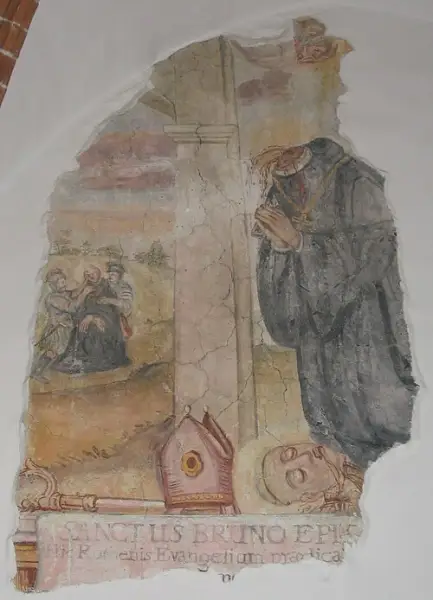
Word reached him in Poland that robbers had killed his friend Benedict and four others in 1003. Gathering what eyewitnesses could tell him, he composed a moving account of the Five Martyred Brothers — the work that, with the life of Adalbert, preserves so much of the political and ecclesiastical world of Central Europe at the millennium. Then, in autumn or at the close of 1008, he began the journey from which there was no returning: with eighteen companions he entered the lands of the Old Prussians to plant a mission, under both imperial and papal approval. Netimer, a local ruler, was converted, and the band pushed eastward, probably toward Yotvingia. Opposition met Bruno's evangelisation of that borderland, near the frontier of Kyivan Rus' and Lithuania; heeding none of the warnings, he was beheaded on 14 February 1009 — some accounts say 9 or 14 March — and Zebeden, Netimer's brother, hanged most of his companions. Duke Boleslaus the Brave ransomed the bodies and carried them into Poland; they have been supposed to rest at Przemyśl, though that is hardly probable, for Przemyśl stood under Orthodox Kyivan Rus' until 1018. The Annals of Magdeburg, Thietmar of Merseburg's Chronicle, the Annals of Quedlinburg, and a long line of written sources from the eleventh to the fifteenth century tell the story.
§ Mission to Prussia and death
The Second Apostle of the Prussians
Veneration as martyrs came to Bruno and his companions soon after their deaths, and Bruno was soon canonised by the measure of his own century, though no formal process ever confirmed the title. Rome's Camaldolese Order keeps his memory, and the Eastern Orthodox Church honours him too — a double recognition that suits a man who laboured exactly along the seam between Rome and Constantinople. His feast falls on 15 October. The name by which he is best known, Second Apostle of the Prussians, sets him in the direct line of Adalbert of Prague, whose martyrdom had helped to draw him to the mission in the first place. His writings are his most lasting monument: the Life of Adalbert of Prague and the Life of the Five Brothers open a rare window onto the politics, diplomacy and church relations of Central and Eastern Europe about the year 1000, and historians still work them over. His death carries an unexpected distinction in Lithuanian history, for the Quedlinburg Annals that reported it preserve the earliest known written mention of Lithuania, so that 1009 has been treated by Lithuanians as the written birthday of their nation's name. Braunsberg, it is said, took its name from him. Missionary and ascetic, he remains a model of the Gospel carried at the cost of life.
§ Mission to Prussia and death
Timeline
- 974
Born at Querfurt into a noble family, rumoured to be related to Emperor Otto III.
§ Early life
- 995
Appointed by the fifteen-year-old Otto III as one of his court chaplains.
§ Early life
- 1001
Entered the Benedictine monastery of Pereum near Ravenna and underwent strict ascetic training under Saint Romuald.
§ Early life
- 1003
Pope Sylvester II appointed Bruno, aged thirty-three, to head a mission among the pagan peoples of Eastern Europe.
§ Missionary life
- 12 Nov 1003
Monks of the Międzyrzecz house, Benedict and John among them, are slain by opponents of Prince Bolesław between 11 and 12 November
§ Missionary life
- Feb 1004
Left Rome and was consecrated archbishop in February by Archbishop Tagino of Magdeburg.
§ Missionary life
- 1004
Blocked from Poland by imperial conflict, worked in Hungary, failing to win Duke Ahtum of Banat to Rome before finishing his Life of Adalbert of Prague.
§ Missionary life
- 1004
Went on to Kiev, where Vladimir I authorised five months of work among the Pechenegs; he baptised about thirty adults and helped broker a peace treaty.
§ Missionary life
- 1008
In the autumn set out with eighteen companions for the Old Prussians, having consecrated a bishop for the Pechenegs and the first Bishop of Sweden.
§ Missionary life
- 14 Feb 1009
Beheaded on 14 February by Zebeden, brother of the convert Netimer, and most of his companions were hanged.
§ Mission to Prussia and death
- 1009
Duke Boleslaus the Brave bought the bodies of the martyrs and brought them to Poland.
§ Mission to Prussia and death
The Record
- Major works
- Life of Adalbert of Prague·Life of the Five Brothers (the Five Martyred Brothers)
- Patron of
- Honoured as the Second Apostle of the Prussians
- Symbols
- Bishop's vestments·Palm of martyrdom
- Canonization
- Never formally canonized; venerated as a martyr soon after his death in both the Catholic and Eastern Orthodox traditions
Prayer
Bibliography
Show 7 sources
- Meier, Gabriel (1908). "St. Bruno of Querfurt". In Herbermann, Charles (ed.). Catholic Encyclopedia. Vol. 3. New York: Robert Appleton Company.
- Šiūlys, Rimgaudas. "The Spirituality of St. Bruno of Querfurt", Lithuanian Historical Studies, 14, 2009, pp. 1–10
- Duckett, Eleanor Shipley. Death and Life in the Tenth Century, University of Michigan Press, 1967, p. 193
- Butler, Alban. Lives of the Saints, Christian Classics, 1995
- Maciejewski, Jacek (2010). Średniowieczny misjonarz a millenium Litwy Bruno z Kwerfurtu i jego ostatnia misja. Bydgoszcz.
- Baronas, D. "St Bruno of Querfurt: The Missionary Vocation", Lithuanian Historical Studies, 2009, t. 14, pp. 41–52
- Wood, Ian (2014). "The Latin Hagiography of Mission from Rimbert to Bruno of Querfurt". The Cyril and Methodius Mission and Europe. pp. 34–39.
Profile text adapted from the Wikipedia article, licensed CC BY-SA 4.0.
Pray with this saint every day
Save St. Bruno of Querfurt to your favorites, read the full profile, and get feast-day reminders in the Saints app.
Get the Saints AppFree on the App Store for iPhone and iPad