
May 925 – 11 October 965·Feast October 11
St. Bruno the Great
Archbishop of Cologne, Duke and Regent
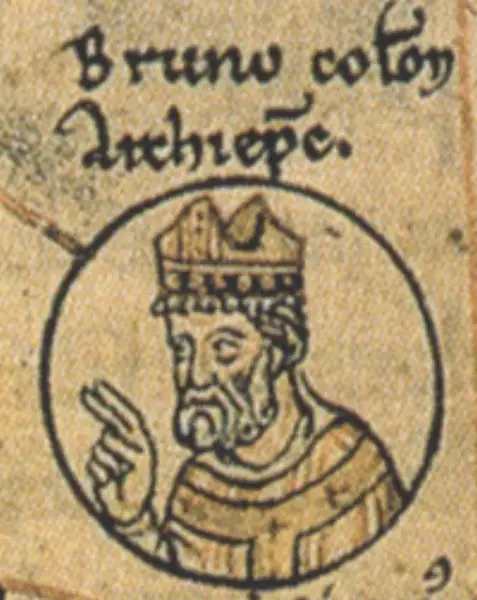
Overview
Bruno the Great, born in May 925, was archbishop of Cologne from 953 until his death and duke of Lotharingia from 954, the youngest brother of Emperor Otto I. Destined for the clergy while still a child, he was educated in Trier in the early 940s by Israel the Grammarian, the leading scholar of the day, and in 951 Otto named him archchaplain. When the see of Cologne fell vacant in 953 amid a rebellion led by Duke Conrad the Red, Otto installed Bruno in it, securing a loyal ally; once the revolt collapsed, Otto deposed Conrad and made Bruno duke of Lotharingia in his place. His biographer Ruotger styled him archduke, and the combined offices made him the most powerful man after the emperor, in Germany and beyond it. Louis IV of France having died in 954, and his mighty vassal Hugh the Great in 956, Bruno — wedded kin to both, and mother's brother to the heirs Lothair and Hugh Capet — governed West Francia as regent. From 962 he served as Otto's regent in Germany during the emperor's Italian absences. His court at Cologne was the foremost intellectual and artistic centre of its era in Germany, training the next generation of bishops, and under him the cathedral was enlarged until it was said to rival Old Saint Peter's in Rome. He founded the Benedictine monastery of St. Pantaleon outside Cologne, where he was buried after his death at Reims on 11 October 965. He was formally beatified in 1870 and canonized in 1895.
The Complete Life
A Prince Destined for the Church
Bruno first saw the light in May 925, last-born of King Henry the Fowler and Matilda of Ringelheim, and so grew up at the heart of the family then raising the Saxon monarchy over the East Frankish realm. His destiny was settled while he was small: he was set apart for the clergy, a typical expedient for a royal house that needed trusted bishops no less than trusted counts, and for a younger son it opened power without any rival claim to the throne. For his schooling he was given the best master available — in the opening years of the 940s he studied at Trier under Israel the Grammarian, the leading scholar of the day, a Breton whose learning was famous in an age when letters were thin. From such a teacher Bruno took the polish in Latin and theology that would one day set his court above every other in Germany. In 951 his elder brother Otto, king and in time emperor, gave him the archchaplaincy, the chief ecclesiastical charge of the royal chapel, bringing him into the daily handling of power. The appointment was trust and policy at once: Otto was gathering kinsmen and dependants into the strong places of the realm, and Bruno — lettered, able and beyond question loyal — stood ready for the greatest prize of all, the see of Cologne, which commanded much of the Rhineland together with a great stretch of Lotharingia.
§ Life
Archbishop and Duke
Crisis opened the door. In 953 Cologne's archbishopric fell vacant precisely when Duke Conrad the Red of Lotharingia — the emperor's own son-in-law — had risen in revolt against Otto. Placing Bruno in the empty see gave the king a powerful friend against Conrad at the hour of greatest need, since a large part of Lotharingia lay within the jurisdiction of the church of Cologne. Within a year the revolt had fallen apart; Otto stripped Conrad of the duchy and set Bruno over Lotharingia in his place. To this union of offices his biographer Ruotger gave the name archduke, a word minted for the occasion. It made Bruno, after Otto himself, the mightiest man of the age, within Germany and beyond its frontiers alike. He would prove nearly the last ruler of a united Lotharingia: in 959 he set two local lords, Godfrey and Frederick, over the marches of Lower and Upper Lotharingia, and after his death each was acknowledged as duke, the duchies coming together again only under Gothelo between 1033 and 1044. The settlement bears Bruno's own stamp of statecraft: strong enough to command, wise enough to devolve, and careful above all to secure the succession of his church rather than of any bloodline, for he left no heirs and his personal power went with him to the grave.
§ Life
Regent of Two Kingdoms
Bruno's writ soon ran on the western side of the frontier too. Louis IV of France died in 954, and Hugh the Great, the greatest of the French crown's vassals, in 956; Bruno, husband's kin to them both and mother's brother to their heirs — the boy-king Lothair and the future Hugh Capet — governed West Francia in their minority. It remains one of the curiosities of the tenth century that a German archbishop stood for a time as effective arbiter of France. From 962 onward he also held Otto's regency in Germany whenever the emperor was across the Alps in Italy, so that in the same years he stood at the head of two kingdoms at once. The work was thankless and largely invisible to later memory — it left no chronicle of victories — yet it held the Ottonian state together while the emperor pursued the imperial crown. Bruno governed, in short, as a steward rather than a sovereign, and it is characteristic of him that the sources record no itch in him to be anything else. His strength lay in a compound no rival could match: sacred office, family connexion and genuine administrative competence. The emperor could go south because Bruno could be left.
§ Life
Death at Reims
The closing years of Bruno's life were filled with the ordinary business of an extraordinary office: the regency of Germany through the emperor's Italian campaigns, the governing of Lotharingia by his margraves, and the endless round of building, patronage and reform at Cologne. His strength did not hold; he died at Reims on 11 October 965, still only in his fortieth year and at the summit of his power. Even the place of his death speaks: Reims, metropolitan church of the West Frankish kingdom whose regency he had wielded, and a city where his nephews' interests still needed a hand. His body was carried home to Cologne and laid in St Pantaleon, the monastery to the southwest of the city that he had himself built. The grave suited the man, whose memorial was no single deed but the Christian urban civilisation he had planted on the Rhine. Those who came after him in the see of Cologne would not hold the duchy too, yet the standing he created proved durable: the archbishops remained Cologne's secular as well as spiritual rulers down to the battle of Worringen, three hundred years on. Within a generation the family empire he had served faded, and the divided duchies went their own ways; but the church of Cologne — enlarged, endowed and schooled by Bruno — kept the place he had won for it as a powerhouse of the German church.
§ Life
A Cult of the Kulturkampf
Bruno's road to formal sainthood ran slowly, and its final stretch was openly political. St Pantaleon kept his memory through the whole Middle Ages, though the portrait his biographer Ruotger draws is of a moral exemplar rather than a worker of wonders, which held back any widespread popular cult. A brief miracle cult flickered at his tomb in the twelfth century and died away. Formal recognition had to wait for the nineteenth century: beatification came in 1870, and in 1871 Archbishop Paul Melchers raised his feast of 11 October to the rank of a double. His tomb had been opened once in 1747 and again in 1892, and canonisation followed in 1895. Jonathan Wright, the historian, reads this promotion of the cult against the background of the Kulturkampf — the contest between the Prussian-dominated German state and the Catholic Church — that is, as an effort to guard the Catholic identity of Cologne as the city was drawn into a Protestant-ruled German Empire. A Saxon prince who had governed duchy and church in one person made a fitting banner for a church asserting itself against a Protestant state. Politics aside, the outcome stands: a tenth-century archduke entered the roll of the saints at the end of the nineteenth, and both the Roman Catholic and the Eastern Orthodox Church keep his feast on 11 October.
§ Canonisation
The Maker of Medieval Cologne
Bruno's standing in Cologne came close to royalty. From Otto he and his successors in the see received privileges that belonged properly to kings — leave to raise fortifications and establish markets, to mint coin, and to gather and retain certain taxes: the special levies on Jews in exchange for royal protection, dues on market trade, and the tolls of Rhine traffic. Though later archbishops would not also be dukes, they remained the city's temporal as well as spiritual lords until Worringen, three centuries on. His court at Cologne was the chief centre of letters and art of its day in Germany, well ahead of his brother Otto's — that court was mostly on the move and given to war — and it drew scholars of the stamp of Ratherius and Liutprand of Cremona. There, too, much of the coming generation of German churchmen was trained: Everaclus of Liège, Gerard of Toul, Wikfrid of Verdun and Theoderic of Metz among them. His mark on the fabric of the city was enormous. He built himself a palace; he enlarged the cathedral until men said it rivalled Old Saint Peter's at Rome, a building that burned in 1248 to make way for the present church; he drew the strip between the old Roman wall and the Rhine inside the fortifications; and he raised churches to Saint Martin of Tours and Saint Andrew, with the Benedictine house of St Pantaleon to the southwest. In 964 he brought the relics of St. Patroclus from Troyes and laid them in St Patrokli Dom at Soest, where Patroclus is honoured to this day.
§ Legacy
Timeline
- May 925
Born in May, youngest son of King Henry the Fowler and Matilda of Ringelheim.
§ Life
- 942
Received his schooling at Trier in the early 940s under Israel the Grammarian, the age's leading scholar.
§ Life
- 951
Appointed archchaplain by his brother King Otto I.
§ Life
- 953
Named archbishop of Cologne, giving Otto a powerful ally against the rebellious Duke Conrad the Red.
§ Life
- 954
With the rebellion collapsed, Otto deposed Conrad and appointed Bruno duke of Lotharingia.
§ Life
- 956
On the death of Hugh the Great, joined the regency of West Francia for his nephews Lothair and Hugh Capet.
§ Life
- 959
Appointed the local nobles Godfrey and Frederick as margraves of Lower and Upper Lotharingia.
§ Life
- 962
Began serving as Otto's regent in Germany during the emperor's absences in Italy.
§ Life
- 964
Translated the relics of St. Patroclus from Troyes and buried them at St Patrokli Dom in Soest.
§ Legacy
- 11 Oct 965
Died at Reims on 11 October; his body was laid to rest at St Pantaleon, the monastery he had built just outside Cologne.
§ Life
- 1747
His tomb at St Pantaleon was opened for inspection.
§ Canonisation
- 1870
Formally beatified after centuries of local veneration.
§ Canonisation
- 1871
Archbishop Paul Melchers raised his feast of 11 October to the rank of a double.
§ Canonisation
- 1892
His tomb was opened a second time.
§ Canonisation
- 1895
Canonized, in a promotion historians link to the defense of Cologne's Catholic identity during the Kulturkampf.
§ Canonisation
The Record
- Major works
- Founded the Benedictine monastery of St. Pantaleon, Cologne·Founded the church of Saint Martin of Tours within the new city walls·Founded the church of Saint Andrew outside the northern wall of Cologne
- Symbols
- Archbishop's vestments·Ducal insignia
- Canonization
- Beatified in 1870; canonized in 1895; venerated at St. Pantaleon throughout the Middle Ages
Prayer
Bibliography
Show 7 sources
- Forse, James H. "Religious Drama and Ecclesiastical Reform in the Tenth Century", Early Theatre, Vol. 5, No. 2 (2002), p. 48.
- Lapidge, Michael (1993). Anglo-Latin Literature 900–1066. The Hambledon Press. ISBN 1-85285-012-4.
- Mayr-Harting, Henry (2007). Church and Cosmos in Early Ottonian Germany: The View from Cologne. Oxford University Press.
- "Latin Saints of the Orthodox Patriarchate of Rome", orthodoxengland.org.uk
- Reuter, Timothy. Germany in the early Middle Ages (1991, Longman)
- Riché, Pierre. The Carolingians: a family who forged Europe (1993, University of Pennsylvania Press)
- Lutz, Cora E. Schoolmasters of the Tenth Century. Archon Books, 1977.
Profile text adapted from the Wikipedia article, licensed CC BY-SA 4.0.
Pray with this saint every day
Save St. Bruno the Great to your favorites, read the full profile, and get feast-day reminders in the Saints app.
Get the Saints AppFree on the App Store for iPhone and iPad