
c. 400 – c. 480·Feast April 6
St. Brychan
Patriarch King of Brycheiniog and Father of Saints
Overview
Brychan ap Anlach was a legendary fifth-century king of Brycheiniog, the Welsh kingdom later called Brecknockshire or Breconshire in Mid Wales, and the traditional father of one of the great 'Holy Families of Britain'. Celtic hagiography makes him a son of the Irish prince Anlach Goronog mac Cormach and of Marchel, heiress of the Welsh kingdom of Garthmadrun; on his father's death he took possession of that kingdom and gave it his own name, Brycheiniog. Welsh pedigree-makers carried his mother's line back to one Annun the Black, styled king of the Greeks — a claim those sources never properly explain, and one often set beside the richer Irish legends of an Agnoman, or Agnon, of the Greeks. His name is likely a Welsh form of the Irish Broccán, and he also appears as Brocanus, Braccan, Brachan, Brecin and Breccan. Tradition gives him three wives — Gwladys, Prawst ferch Tydwal and Banhadlwedd ferch Banadi — and a very numerous family: the number of his children is reckoned anywhere from twelve to sixty-three, twenty-four being the commonest figure. His sons and daughters, among them Cynog, Keyne, Endelienta, Dwynwen, Nectan and Morwenna, are said to have gone out from Brecon to preach in Cornwall and North Devon, where churches and villages from St Keyne to Morwenstow took their names from them. The Life of St Cadoc pictures him taking up arms against Arthur, Cai and Bedwyr after King Gwynllyw abducted his daughter Gwladys from Talgarth. He is given a feast day on 6 April.
The Complete Life
An Irish Prince's Heir in Wales
Brychan ap Anlach of Brycheiniog stands in the twilight where record gives way to legend. Celtic hagiography gives him an Irish birth, as son of Prince Anlach Goronog mac Cormach — grandson of King Cormach mac Urb — and of Marchel verch Tewdrig ap Teithfal, through whom the Welsh kingdom of Garthmadrun came into the family's hands. At Anlach's death Brychan came into Garthmadrun and, taking it as his own, gave the realm his name: Brycheiniog, so that mid Wales bears the man's mark to this day. Irish and Greek strands are both claimed for his blood. Welsh pedigree-makers carried his mother's line back to one Annun the Black, styled king of the Greeks — a claim those sources never properly explain, and one often set beside the richer Irish legends of an Agnoman, or Agnon, of the Greeks. His very name carries the double inheritance: Brychan is Welsh in form, but it may render the Irish Broccán, and Latin sources style him Brocanus; he appears besides as Braccan, Brachan, Brecin and Breccan. One Drichan, of whom nothing else survives, had charge of his education. The childhood that can be recovered is thus a set of genealogical assertions — Irish father, Welsh mother, Greek forebear — each staking a portion of his identity.
§ Life
A Saint Without a Cult of His Own
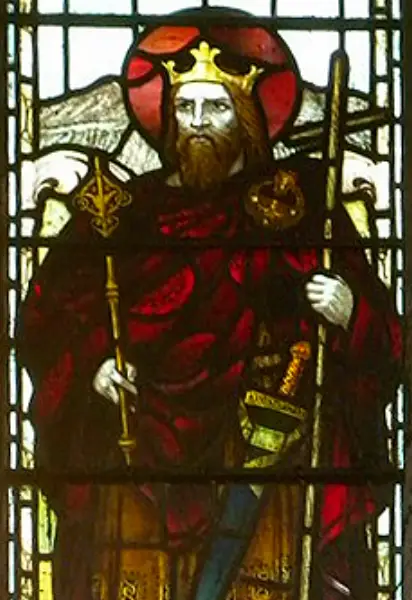
Brychan's standing among the saints is oddly oblique. Now and then he is written of as an undocumented saint, yet the older literature does not name him a saint at all: it calls him a patriarch, and no church bears his dedication — a strange silence around so famous a man. His holiness, in the tradition's own reckoning, was generative: he is recalled not for foundations or wonders but for offspring, and through them for the Christianising of a whole countryside. All the same a feast has been assigned him on 6 April, and devotion to him is alive in Wales and in Cornwall, the two lands his family is held to have evangelised. Images are rare and uncertain. Glass of the fifteenth century in the parish church of St Neot, Cornwall, is said to show him enthroned and crowned with eleven children in his arms; a standard modern guide, however, reads the figure as God with Souls in his lap, a verdict that would strip him of this one portrait too. The ambiguity suits a man whose fame rests almost wholly on other people's piety. His cult, so far as he has one, is scattered through the dedications of his children, whose churches cover Cornwall and North Devon: to find Brychan one must go to St Keyne or Morwenstow, St Endellion or St Mabyn, and read the patriarch in his posterity.
§ Portraiture and veneration
The Holy Family of Britain
Christian tradition allows Brychan three wives — Gwladys, Prawst ferch Tydwal and Banhadlwedd ferch Banadi — and a very numerous family. Manuscripts of William Worcester, John Leland and Nicholas Roscarrock, among others, name these women. How many children he had no two sources agree: the counts run from twelve to sixty-three, twenty-four being the commonest figure, and two principal lists stand beside each other, one Welsh and one Cornish, with little agreement between them. Most of the children, it is said, went out from Brecon to preach in Cornwall and North Devon, where they are venerated now. The Welsh sources — the Cognacio Brychan, De Situ Brecheniauc and the Jesus College MS 20 genealogies — give sons such as Cynog, Rhain Dremrudd, Clydwyn, Arthen, Dingad, Berwyn and Rhydog, and daughters including Meleri, Hunydd, Gwladys, Ceinwen, Dwynwen, Endelienta and Tudful. The Book of Leinster offers an Irish list of sons born to him by Dína, a daughter of the Saxon king, while Breton tradition adds a further wife, Menedoc, whom it makes a daughter of Constantine, king of the Scots. Of the holy children who settled in Cornwall, many left their names on churches and villages: Adwen at Advent, Cleder at St Clether, Endelient at St Endellion, Keyne at St Keyne, Mabon at St Mabyn, Menfre at St Minver, Morwenna at Morwenstow, Wenna at St Wenn, Yse at St Issey, and others. The roll almost certainly swelled with time, as secular families and saints alike sought descent from one of the Holy Families of Britain.
§ Children of Brychan
Timeline
- 400
Born around this year; Welsh tradition gives Talgarth, while hagiography places his birth in Ireland to Prince Anlach and Marchel.
§ Introduction
- 480
Died around this year at about eighty years of age, having inherited Garthmadrun through his mother and renamed it Brycheiniog.
§ Introduction
- 1100
Lifris's Life of St. Cadoc, written near this date, shows Brychan fighting Arthur, Cai and Bedwyr after Gwynllyw abducts his daughter Gwladys.
§ Life
- 1400
Fifteenth-century stained glass at St Neot in Cornwall is said to depict Brychan seated and crowned, holding eleven children in his arms.
§ Portraiture and veneration
The Record
- Patron of
- Venerated in Wales and Cornwall
- Symbols
- Depicted seated and crowned, holding children in his arms
- Canonization
- Pre-congregation; venerated traditionally in Wales and Cornwall, though the older literature calls him a patriarch rather than a saint
Prayer
Bibliography
Show 9 sources
- Morgan, Richard & Powell, R. F. Peter. A Study of Breconshire Place-Names. Llanrwst Wells: Gwasg Carreg Gwalch, 1999.
- Guy, Benjamin (2023). "Manaw of the Britons: The Pre-Viking Kings of the Isle of Man", in Isle of Man Studies, vol. 18, pp. 145–161.
- "EBK: King Brychan Brycheiniog of Brycheiniog", earlybritishkings.com
- Koch, John T. Celtic Culture: a historical encyclopedia. Santa Barbara: ABC-Clio, 2006, p. 301.
- Thornton, David E. "Brychan Brycheiniog (fl. c. 500)", Oxford Dictionary of National Biography.
- Emmanuel, Hywel David (1959). "Brychan", Dictionary of Welsh Biography. National Library of Wales.
- Orme, Nicholas (2000). The Saints of Cornwall. Oxford: Oxford University Press, p. 77.
- Ford, David Nash (2001). "Children of Brychan Brycheiniog", Early British Kingdoms, Nash Ford Publishing.
- Wade-Evans, A. W. "The Brychan documents", Y Cymmrodor 19 (1906): 18–50.
Profile text adapted from the Wikipedia article, licensed CC BY-SA 4.0.
Pray with this saint every day
Save St. Brychan to your favorites, read the full profile, and get feast-day reminders in the Saints app.
Get the Saints AppFree on the App Store for iPhone and iPad