
6th century (died 7 April)·Feast April 7
St. Brynach
Welsh Abbot of Nevern in Pembrokeshire
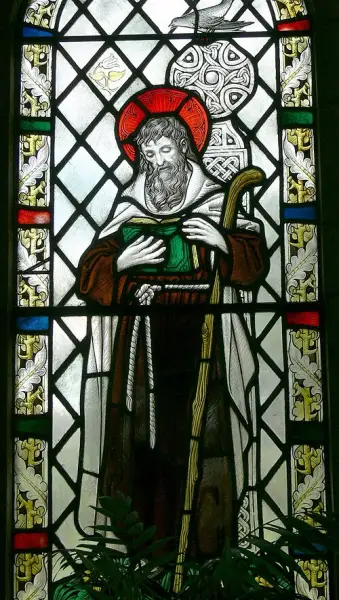
Overview
Saint Brynach was a Welsh holy man of the sixth century, an abbot long linked with Pembrokeshire, where a number of churches bear his dedication. His life, put into writing in the twelfth century, relates that early in the 500s he journeyed — from a home it does not name — to Rome and to Brittany before making for Milford Haven. In that corner of Wales he raised several small oratories: by the Cleddau, the Gwaun and the Caman, and beneath Mynydd Carningli, the 'Mountain of the Angels', where his greatest foundation stood. That monastery occupied the ground of the present village of Nevern, Nanhyfer in Welsh, on soil granted him by Clether, the local lord, who thereupon withdrew to Cornwall. For a time Maelgwn, king of Gwynedd, pressed and plagued the saint, until miracles moved the king to make peace with him. His Life draws him as a rather wild young man turned strictly virtuous after his conversion, and recounts his adventures — among them amorous and ghostly meetings — with a streak of humour seldom found in hagiographers. He died on 7 April, kept as his feast ever since, at Nevern, where his church beside the River Nevern is his abiding monument; the Norman church of St Brynach occupies the site of his sixth-century clas, a notable ecclesiastical centre. Welsh tradition calls him Brynach Wyddel, the Irishman, and his name may answer to the Irish Bernach. Dedications to him gather thick in Pembrokeshire and Carmarthenshire and beyond, in a spread that mirrors the Ogham stones of south Wales.
The Complete Life
A Wild Youth and a Journey to Rome
Nearly all that is known of Brynach's beginnings rests on a twelfth-century life, which says that early in the 500s he made a journey — starting point unspecified — to Rome and to Brittany, before pushing on to Milford Haven. The silence about his origins has invited centuries of conjecture, weighed below, but the Life is franker about the man himself. It draws him as a rather wild young man turned strictly virtuous by his conversion, and the tale of his adventures — among them amorous and ghostly meetings — carries a streak of humour seldom found in writers of saints' lives. That note of comedy, rare in medieval hagiography, hints at a tradition that preserved something of the man, or at least of the country that remembered him. The journey to Rome sets him among the many Celtic saints of the Age of the Saints said to have gone on pilgrimage to the apostles' tombs before settling to work at home, and the call at Brittany belongs to the same world, in which the sea-lanes of the Celtic lands bore monks and pilgrims as readily as traders or raiders. His landing at Milford Haven, the great natural harbour of Pembrokeshire, marks the point where the pilgrim turns founder, and the unruly youth of the adventures turns into the abbot of Nevern whose memory the Welsh church has kept each 7 April ever since.
§ Life
Oratories by the Rivers and the Mountain of the Angels
The work Brynach did in Pembrokeshire was of the eremitical, monastic sort. By the Cleddau, the Gwaun and the Caman he raised several small oratories, and beneath Mynydd Carningli — the Mountain of the Angels — he planted his greatest foundation. The monastery stood on the ground of the present Nevern, Nanhyfer in Welsh, a little inland from the north Pembrokeshire coast. Clether, the local lord, granted the soil and then withdrew to Cornwall: an exchange typical of the Age of the Saints, in which Welsh and Cornish noblemen endowed the new monasteries and sometimes traded their own lands for the religious life. Nor did the settlement go unopposed — for a time Maelgwn, king of Gwynedd, among the most formidable rulers of sixth-century Wales, pressed and plagued the saint, until his miracles moved the king to make peace. The story keeps alive the memory of a genuine tension between the new monastic houses and the older royal power, settled in the telling by holiness rather than arms. Saint Brynach died on 7 April, the day kept as his feast. His church beside the River Nevern is his abiding monument, and the Norman church of St Brynach occupies the site of his sixth-century clas, a notable ecclesiastical centre, so that the community he planted has stood on the same ground for fifteen centuries.
§ Life
The Irishman of Nevern
Welsh tradition calls him Brynach Wyddel, the Irishman, and his name may answer to the Irish Bernach. From this possible etymology has come speculation that he came out of Ireland: Iolo Morganwg, followed by Sabine Baring-Gould, identified him with the chieftain Fernach who crossed to Wales from Ireland in company with the young Brychan of Brycheiniog. Egerton Phillimore rejected the identification, and though a Brennach Wyddel o'r Gogledd — Brennach the Irishman of the North — stands in the Welsh Triads, Rachel Bromwich doubted that the saint was meant. Uncertain as his origin is, his trace upon the landscape is plain. In Pembrokeshire, churches at Nevern, Dinas Cross, Llanfyrnach, Henry's Moat and Pontfaen carry his dedication; Carmarthenshire has Llanboidy and a chapel at Llanddarog; and further dedications are scattered through Glamorgan, Brecknockshire and Monmouthshire. Their spread matches that of the Ogham stones in south Wales, and so defines a distinct Irish-influenced province of the Age of the Saints — a corner of Britain in the fifth and sixth centuries where Irish settlement, Irish speech and Irish monasticism set an enduring Christian mark. His feast is kept on 7 April in the Eastern Orthodox Church, the Roman Catholic Church and the Anglican Communion, and he is reckoned a patron of spring.
§ Dedications
Timeline
- 500
Sometime in the early sixth century travelled to Rome and Brittany, and then on to Milford Haven.
§ Life
- 500
Raised small oratories by the Cleddau, the Gwaun and the Caman, and beneath Mynydd Carningli, the 'Mountain of the Angels'.
§ Life
- 500
Founded his chief monastery at Nevern (Nanhyfer), on soil granted by Clether, the local lord, who withdrew to Cornwall.
§ Life
- 500
Plagued for a time by Maelgwn, king of Gwynedd, until his miracles moved the king to make peace with him.
§ Life
- 7 Apr 550
Died at Nevern in the sixth century; his feast is kept on the same day.
§ Life
- 1150
A 12th-century account of Brynach's life, later edited by A. W. Wade-Evans, recorded his journey and foundations.
§ Life
The Record
- Major works
- Monastery at Nevern (Nanhyfer), his most famous foundation·Oratories near the rivers Cleddau, Gwaun and Caman
- Patron of
- Patron of spring
- Symbols
- Monk or abbot with a cuckoo·The Nevern Cross
- Canonization
- Pre-congregation; venerated in the Eastern Orthodox Church, Roman Catholic Church and Anglican Communion
Prayer
Bibliography
Show 7 sources
- "Life of St. Brynach", Vitae Sanctorum Britanniae et Genealogiae, ed. A. W. Wade-Evans. Cardiff: University of Wales Press, 1944.
- "Ancient & Modern", St Brynach's Church, Nevern.
- Emanuel, H. D. "Brynach, saint (fl. late 5th century - early 6th century)", Dictionary of Welsh Biography, 1959.
- Bowen, E. G. (1977). Saints, Seaways and Settlements in the Celtic Lands. Cardiff: University of Wales Press, p. 105.
- Baring-Gould, Sabine & Fisher, John (1907). Lives of the British Saints.
- Bromwich, Rachel (2006). Trioedd Ynys Prydein: The Triads of the Island of Britain, 3rd ed.
- Phillimore, Egerton (1906). Notes in: George Owen's "The Description of Pembrokeshire" (1603).
Profile text adapted from the Wikipedia article, licensed CC BY-SA 4.0.
Pray with this saint every day
Save St. Brynach to your favorites, read the full profile, and get feast-day reminders in the Saints app.
Get the Saints AppFree on the App Store for iPhone and iPad