
5th–6th century·Feast December 8
St. Budoc
Abbot and Bishop of Dol, Saved from the Waters
Overview
Budoc of Dol, also spelled Budeaux or Beuzec, was a Breton monk, abbot and bishop of Dol, honoured as a saint in Brittany and in Devon alike. Legend makes him a grandson of the mythical Count Even of Brest, Viscount of Léon. His mother, Princess Azenor, falsely accused by a jealous stepmother, so enraged her husband, the King of Goëlo, that he ordered the pregnant woman thrown into the sea in a cask; calling on Saint Brigid, she drifted five months and came ashore upon Ireland, where her child was born. A villager fetched the abbot of Beau Port near Waterford, the baby was baptised the next day, and there Budoc grew up, his mother serving the monastery as washer-woman. His name is popularly read as 'saved from the waters', from the Breton beuziñ, to drown — an etymology Baring-Gould dismisses as fanciful. He studied at Ardmore, a house said to have been founded by Declán, and became monk and then abbot there. Departing Ireland in a stone boat, he came ashore at Porspoder near Brest, and later reached Dol, succeeding Samson of Dol and Magloire as bishop and ruling twenty-six years according to the tenth-century vita of Magloire and the Chronicle of Dol. He is also said to have crossed Plymouth Sound and landed at Budshead Creek, in what is now St Budeaux, Plymouth, where his labours point to an early church. His relics rest at Plourin in Finistère, whose patron he is, together with Plymouth's. Devon keeps his feast on 8 December, Brittany on 9 December.
The Complete Life
The Child in the Cask
Budoc's birth belongs to legend, not record. He is said to have been a grandson of the mythical Count Even of Brest, Viscount of Léon. His mother, Princess Azenor, was slandered as unfaithful by a jealous stepmother; the lie maddened her husband, the King of Goëlo, who sentenced the pregnant woman to be cast into the sea within a cask — a tower of the Château de Brest still carries her name. Azenor called upon Saint Brigid, and the cask drifted five months. Soon after her child was delivered, the vessel was thrown up on the coast of Ireland, and the tale, the Oxford Dictionary of Saints observes, has a Greek-mythic ring. A villager who came upon mother and infant went for the abbot of Beau Port, by Waterford, and the infant received baptism the following day; Azenor entered the monastery's service as washer-woman, and there Budoc was brought up. The legend does not leave the slander unpunished: the stepmother, falling ill, recanted her lies upon her deathbed, and Azenor's husband sailed after her; reunited in Ireland, husband and wife were reconciled, though both died before they could sail home to Brittany. A Cornouaille tradition, alternatively, makes Azenor herself the foundress of a religious house at Cap Sizun. As for the name: Budoc, or Beuzec, is popularly read as 'saved from the waters', from the Breton beuziñ, to drown — a derivation Baring-Gould wrote off as fanciful — while old Celtic boudi carries the sense of victory and profit.
§ Legend
Monk of Ardmore, Abbot of the Breton Coast
Strip away the marvels and a monastic career remains. In his youth Budoc studied at Ardmore, a monastery held to have been planted in the early fifth century by Declán of Ardmore; there he took the habit and in time rose to be its abbot. The vita of the monk Winwaloe styles him a teacher dwelling on the island of Laurea, and the hagiographer G. H. Doble held that he was a once-celebrated abbot whose principal house stood on the Breton shore. Baring-Gould, on his reading of the same material, supposed that the princess Azenor had fled Armorica with her young son amid dynastic strife; touching first at Cornwall, they went on to Ireland, where the boy embraced the monastic life, and only later made their way back to Brittany, coming ashore at Porspoder near Brest. The reconstructions part company on direction and detail, yet agree on the essentials: a man schooled in the Irish monastic tradition who carried that training across the water to Brittany. His eventual leaving of Ireland was itself a little legend, for he is said to have put to sea in a stone trough and come ashore at Porspoder — a vessel as impossible as the cask that had carried him in infancy, and preaching the same sermon: that the sea meant to drown him delivered him instead. Out of those crossings came the abbot whom the churches of two countries would afterwards honour.
§ Life
Bishop of Dol
At some undated point Budoc reached Dol, where he was set over the local church as bishop, perhaps in connexion with a monastery said to have been planted there by Samson of Dol, whose successor in the see he is believed to have been. Later tradition has him succeed both Samson of Dol and Magloire, and the tenth-century vita of Magloire together with the eleventh-century Chronicle of Dol give him twenty-six years of governance. Baring-Gould, with his habitual caution, keeps the Abbot Budoc and the successor of Bishop Magloire at Dol as two distinct persons whom devotion afterwards fused; the reader may take the division or the fusion as he pleases. Nothing disputed attaches to the fact itself: a bishop of Dol bearing the name was remembered with honour in a see that stood among the leading churches of Brittany, within the Kingdom of Domnonée, where Budoc is said to have died in the sixth century. His episcopate belongs to that great age of Breton monastic bishoprics in which abbots became bishops and bishops ruled from monasteries, the offices divided by lines as fluid as the seas the saints sailed. The stones of his cathedral church have long since gone under later building, yet the cult that grew up around his name — at Dol, at Plourin, and across the Channel in Devon — outlasted them all.
§ Life
The Saint of Two Shores
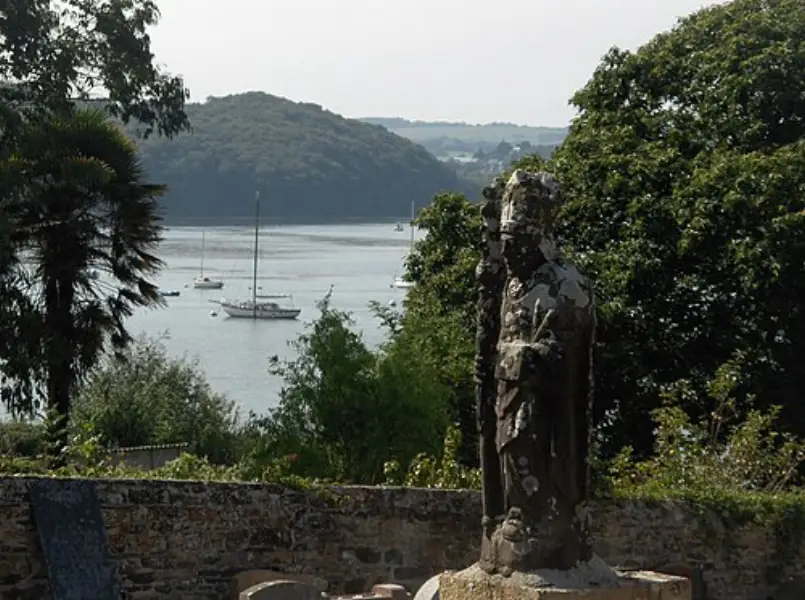
Both shores of the Channel keep Budoc's memory. Tradition sends him across Plymouth Sound in search of an inlet on the Tamar's Devon bank, where he came ashore at Budshead Creek in what is now St Budeaux, a district of Plymouth; his presumed labours there point to an early church in Plymouth, though the name cannot be traced in Devon before the sixteenth century. An ancient church at Budock in Cornwall is also said to have received his dedication, and one at Oxford once did. In Brittany his cult centres on Plourin in Finistère, where his relics lie and where he is the local patron; at Porspoder two windows of stained glass in the chancel of the Saint-Budoc Church carry scenes from the story of his life. Plymouth in England claims him as patron too. His feast was first kept on 8 December, the date Devon retains, while Brittany has moved it to 9 December. He is honoured in the Catholic Church, the Anglican Communion and Eastern Orthodoxy, and the troparion in his honour greets a hierarch loaded with temporal and spiritual honours in Armagh and in Dol who toiled to win souls for Christ — a fair summing-up of a life divided among Ireland, Brittany and the English south-west.
§ Budoc in Southwest England
In Their Own Words
Thou wast miraculously preserved from the ocean's fury and, being sustained by the hand of God, thou didst devote thyself to his service, O Hierarch Budoc. Being showered with both temporal and spiritual honours both in Armagh and in Dol, thou didst labour to win souls for Christ, therefore we implore thine aid, begging Christ our God that he will save our souls.
The Record
- Major works
- Early church foundation at St Budeaux, Plymouth (by tradition)·Church at Budock in Cornwall, said to have been dedicated by him
- Patron of
- Patron saint of Plourin, Finistère, France·Patron saint of Plymouth, England
- Symbols
- Cask or barrel adrift at sea·Bishop's vestments·Stone boat
- Canonization
- Pre-congregation; venerated since his death as a saint in Brittany in France and in Devon in England
Prayer
Bibliography
Show 5 sources
- "Budoc", Oxford Dictionary of Saints
- Baring-Gould, Sabine. "S. Budoc, Abbot and Confessor", The Lives of the British Saints, C. J. Clark, 1907, p. 329.
- Doble, G. H. (1964). The Saints of Cornwall: part 3. Truro: Dean and Chapter, pp. 3–14.
- Loukianoff, Yannick. "Saint-Budoc Church", Patrimoine D'Irois.
- "Budoc", Prosopography of Anglo-Saxon England.
Profile text adapted from the Wikipedia article, licensed CC BY-SA 4.0.
Pray with this saint every day
Save St. Budoc to your favorites, read the full profile, and get feast-day reminders in the Saints app.
Get the Saints AppFree on the App Store for iPhone and iPad