
unknown – 753·Feast October 14
St. Burchard of Würzburg
Anglo-Saxon Missionary and First Bishop of Würzburg
Overview
Burchard of Würzburg, called Burkard or Burkhard in German, was an Anglo-Saxon Benedictine monk, possibly of noble family and schooled at Malmesbury Abbey, who became the first Bishop of Würzburg. Leaving England after the death of his parents, he joined the missionary labours of Boniface, who may have been a relative, after 732. He spent a period at the Abbey of St. Peter in Fritzlar, which Boniface had founded, before going out as a missionary into Thuringia. When Boniface organised the new bishoprics of middle Germany he set Burchard over Würzburg, an appointment endorsed by Carloman, the Frankish mayor of the palace, and endowed by him. His consecration cannot have been later than the summer of 741, since that autumn he is recorded officiating as a bishop at Willibald of Eichstädt's consecration. Pope Zachary gave his confirmation to the young bishopric in 743. Burchard sat in the first German council of 742, attended the general Frankish council of 747, and the year after travelled to Rome as Boniface's envoy to report its results to the pope. In 750, together with Fulrad of Saint-Denis, he laid before Zachary the celebrated question of Pepin, the answer to which was held to sanction the Carolingian seizure of the throne. In 751 he resigned his see in favour of the monk Megingoz and retired to solitude, dedicating the Abbey of St. Andrew in Würzburg in 752 and translating the relics of Saint Kilian and his companions Totnan and Colman to the cathedral on 8 July of that year. He died in 753.
The Complete Life
A Monk of Malmesbury
Burchard was an Englishman, and the Germany he evangelised was the fruit of an English monastic culture that sent its sons across the sea in the eighth century as steadily as it received pilgrims. He was a Benedictine monk, possibly born into nobility, and he received his schooling at Malmesbury Abbey, the great house in Wessex associated with Aldhelm and with the scholar Maildub, whose name appears in the calendar of Anglo-Saxon saints. Of the circumstances of his crossing the record is brief but telling: he departed England once his parents had died, freed thereby from filial duty from filial obligation, and joined Boniface, the apostle of the Germans, in his missionary labours, at some point after the year 732. The tradition adds a family note that is hard to verify but easy to believe in this circle of West Saxon churchmen: Boniface may have been a relative of his. His first station in the mission field was the Abbey of St. Peter at Fritzlar, which Boniface had founded on the site of a sacred oak the missionary had felled, and there Burchard lived for a time in the young community of monks gathered from England. It was a school of perseverance and of organisation, and from it Burchard was sent out to work as a missioner in Thuringia, the country east of the river that would later form part of his diocese.
§ Life
First Bishop of Würzburg
The second stage of Burchard's vocation came when Boniface undertook the organisation of bishoprics across middle Germany. The mission had reached the point at which scattered conversions needed settled pastors, and Boniface, now armed with papal and Frankish authority, set men over the new sees drawn from his own company. To Würzburg, on the river Main, he appointed Burchard. As was customary in that arrangement of church and state, the appointment was approved by Carloman, the mayor of the palace who governed the eastern Frankish realm, and Carloman endowed the new diocese with a number of benefits, giving the bishopric its temporal footing. The date of Burchard's consecration is fixed within narrow limits: it must have fallen no later than the summer of 741, for in the autumn of that same year he is found acting in episcopal office at the consecration of Willibald of Eichstädt, another of Boniface's Anglo-Saxon collaborators. The new bishop ruled the see for a decade. Pope Zachary confirmed the young bishopric in 743, and Burchard's standing among the German churchmen of the day is shown by his presence at the first German council in 742 and at the general Council of the Franks of 747, the assemblies through which the church of the new provinces gave itself canonical order.
§ Life
Envoy to Rome for Pepin's Question
Burchard's service extended beyond his diocese into the diplomacy that bound the young German church to Rome and the Frankish throne. In the year after the Council of the Franks he travelled to Rome as an envoy from Boniface, bearing to Pope Zachary an account of what the council had decided, a mission that made the bishop of Würzburg one of the channels through which the reforming legislation of the age reached papal confirmation. Two years later he was called to a far heavier errand. In 750, in company with Fulrad, abbot of Saint-Denis, he laid before the same Pope Zachary the famous question of Pepin, the mayor of the palace who effectively ruled the Frankish kingdom while the last Merovingian king sat powerless on the throne. The question asked, in substance, whether the man who held the power or the man who held the title should be king, and the answer returned from Rome was taken to legitimate the transfer of royal power to the Carolingian house. Thus a monk of Malmesbury, become bishop of Würzburg, stood at one of the hinge moments of European history, carrying between the Franks and the papacy the correspondence that prepared the coronation of Pepin and, with it, the alliance of the new royal house with the Holy See. The mission shows the trust in which Burchard was held on every side, by Boniface, by the Frankish court, and by Rome itself.
§ Life
Resignation, Relics and Rest
The closing act of Burchard's life was a renunciation. In 751, after ten years on the episcopal bench, he resigned the see of Würzburg in favour of Megingoz, a Benedictine monk of St. Peter's Abbey in Fritzlar, the very house where Burchard had first lived on arriving in Germany, and he withdrew from governance into a life of solitude. Retirement did not mean idleness. In 752 he dedicated the Abbey of St. Andrew in Würzburg, a foundation that would later take his own name as St. Burchard's Abbey, giving the city a second religious house alongside the cathedral community. That same year, on the eighth of July, he performed the ceremony for which his city has remembered him most gratefully: he translated the relics of Saint Kilian, the Irish apostle of the region, together with those of Saints Totnan and Colman, into Würzburg Cathedral, a church then under the patronage of St. Kilian. The elevation gathered the missionary past of Franconia into the church Burchard served, joining the Irish martyr of an earlier generation to the Anglo-Saxon bishop of the new one. Having settled the affairs of his see and honoured the saints of his adopted city, Burchard died in 753. His grave would become a centre of devotion in its turn, and the community he founded would keep his memory through the centuries that followed.
§ Life
Veneration in Würzburg
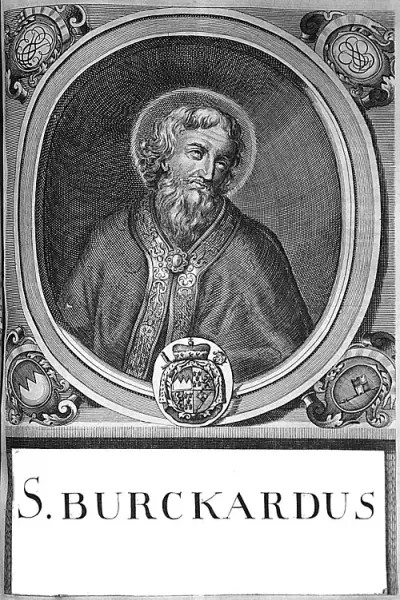
The cult of Burchard grew steadily after his death. In 986, more than two centuries after he was buried, his relics were translated to the Abbey of St. Andrew, the house he had dedicated in 752, which by then bore his name; the translation was the formal sign that the first bishop of Würzburg was honoured as a saint of the local church. His feast day is kept on 14 October in both the Roman Catholic and the Eastern Orthodox churches, and the city he served remembers him in stone: a statue of Saint Burchard stands on Würzburg's Alte Mainbrücke, the old bridge over the Main, in the company of the other saints of the city's history, and an engraving by Johann Salver preserves an early image of him. The literature of his life has accumulated steadily, from the medieval vitae edited and studied in modern critical editions to the entries in the great German biographical dictionaries, in the Catholic Encyclopedia and its Protestant counterpart, and in Religion Past and Present. His historical standing is secure in outline: an English Benedictine formed at Malmesbury, a collaborator of Boniface, first bishop of Würzburg, envoy of the council to Rome, bearer of Pepin's question, and finally a monk again in the abbey that keeps his name, the bridge between the Irish mission of Kilian and the Carolingian church that grew up over it.
§ Veneration
Timeline
- 732
After his parents' death he leaves England and joins Boniface's missionary labours, living at the Abbey of St. Peter in Fritzlar before missioning in Thuringia.
§ Life
- 741
Consecrated first Bishop of Würzburg, an appointment approved and endowed by Carloman, mayor of the palace; he officiates at Willibald's consecration that autumn.
§ Life
- 742
Attends the first German council.
§ Life
- 743
Pope Zachary confirms the new bishopric of Würzburg.
§ Life
- 747
Attends the general Frankish council of 747.
§ Life
- 748
As Boniface's envoy to Rome, he presents the results of the council to Pope Zachary.
§ Life
- 750
With Fulrad of Saint-Denis he brings Pepin's famous question to Pope Zachary, opening the way to Carolingian royal power.
§ Life
- 751
Resigns the see of Würzburg in favour of Megingoz, a Benedictine of St. Peter's in Fritzlar, and retires to a life of solitude.
§ Life
- 752
Dedicates the Abbey of St. Andrew in Würzburg, later renamed St. Burchard's Abbey
§ Life
- 8 Jul 752
Translates the relics of Saints Kilian, Totnan and Colman to Würzburg Cathedral, then dedicated to St Kilian
§ Life
- 753
Dies at Würzburg.
§ Life
- 986
His relics are translated to the Abbey of St. Andrew.
§ Veneration
The Record
- Major works
- Founded the Abbey of St. Andrew in Würzburg (later St. Burchard's Abbey)
- Symbols
- Bishop's regalia
- Canonization
- Pre-congregation; venerated in the Roman Catholic and Eastern Orthodox churches
Prayer
Bibliography
Show 9 sources
- Kirsch, Johann Peter. "St. Burchard of Würzburg." The Catholic Encyclopedia, Vol. 3. New York: Robert Appleton Company, 1908.
- Monks of Ramsgate. "Burchard". Book of Saints, 1921. CatholicSaints.Info, 8 September 2012.
- Noble, Thomas F. X. "Review of 'Die Lebensbeschreibungen Bischof Burchards von Würzburg: Vita Antiquior - Vita Posterior - Vita Metrica'." The Catholic Historical Review, vol. 94 no. 1, 2008, p. 134–135. Project MUSE, doi:10.1353/cat.2008.0046.
- Borrelli, Antonio. "San Burcardo di Würzburg", Santi e Beati, October 31, 2002.
- Butler, Alban. "Saint Burckard, First Bishop of Wurtzburg, Confessor". Lives of the Fathers, Martyrs, and Principal Saints, 1866. CatholicSaints.Info, 14 October 2013.
- Hartmann, Wilfried. "Burchard of Würzburg", Religion Past and Present, Brill, 2006, ISBN 9789004146662.
- Herbermann, Charles, ed. (1913). "St. Burchard of Würzburg". Catholic Encyclopedia. New York: Robert Appleton Company.
- Bautz, Friedrich Wilhelm: Burchard. In: Biographisch-Bibliographisches Kirchenlexikon (BBKL). Band 1, Bautz, Hamm 1975, ISBN 3-88309-013-1, Sp. 816–817.
- Wendehorst, Alfred: Burchard (Nr. 14). In: Lexikon des Mittelalters. Band 2, Artemis & Winkler, München/Zürich 1983, ISBN 3-7608-8902-6, Sp. 951.
Profile text adapted from the Wikipedia article, licensed CC BY-SA 4.0.
Pray with this saint every day
Save St. Burchard of Würzburg to your favorites, read the full profile, and get feast-day reminders in the Saints app.
Get the Saints AppFree on the App Store for iPhone and iPad