
c. 595 – between 643 and 675·Feast April 3
St. Burgundofara
Merovingian Abbess and Founder of Faremoutiers
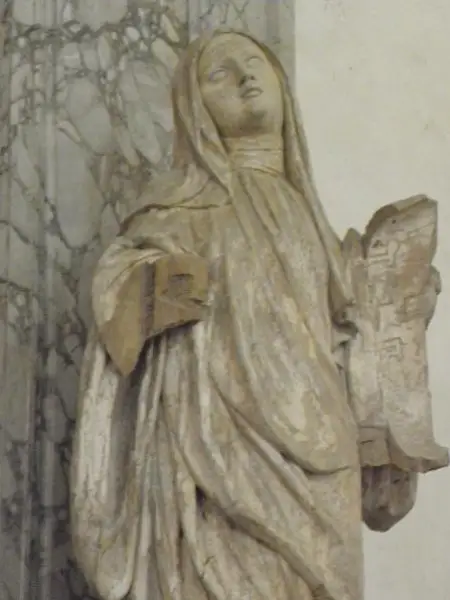
Overview
Burgundofara, also called Fara and known in French as Sainte Fare, was a virgin, abbess and saint of the Merovingian age. Born around 595 near Meaux to Agneric, a high official at the court of King Theodebert II, and his wife Leodegonda, she belonged to a family remarkable for holiness: her brothers included Saints Chagnold and Burgundofaro and the abbot Waldebert. When Columbanus, exiled from Luxeuil, was received in her father's house in 610, he blessed the family and consecrated the child to the religious life. Her father resisted, arranged a marriage, and threatened her life; a fever and an eye affliction struck her down, from which Columbanus healed her, and Saint Eustathius finally intervened to secure her release. In 614 she made her monastic profession, and shortly afterwards, with her father's grant of land and Eustasius's support, she founded the monastery of Faremoutiers, a double house that grew into one of the most distinguished religious foundations of Gaul. There she ruled as abbess for forty years over nuns and monks, among them the Anglo-Saxon princess Earcongotha and two East Anglian royals who succeeded her as abbesses. She died after a lingering illness between 643 and 675 and was buried near the altar of her church. Her last will, which preserved her lands for her monastery, is a unique surviving window onto the wealth of a Frankish woman of the seventh century. She is the patron saint of Cinisi in Sicily and of eye ailments.
The Complete Life
A Courtier's Daughter near Meaux
Burgundofara was born around the year 595 into the highest level of Frankish provincial society, at an estate near Meaux, not far from Paris. Her father, Agneric, held the rank of a principal official at the court of King Theodebert II, and her mother, Leodegonda, presided over a household that would produce an extraordinary harvest of saints and churchmen. Of her four siblings, Chagnold became a monk under Columbanus at Luxeuil Abbey and is honoured as a saint; Burgundofaro served as royal chancellor before becoming bishop of Meaux; Waldebert, who held the counties of Guines, Ponthieu and Saint-Pol before ruling as abbot of Luxeuil in Burgundy; and Agnetrada, also called Agnetrudis, completes the list. Into this circle came, in 610, the most consequential visitor the house ever received. Columbanus, the Irish missionary founder of Luxeuil, had been driven out of that monastery, and the family welcomed him to their home at Meaux while he was in exile. He blessed the whole household, and in blessing the child Burgundofara he consecrated her to God. Her hagiographer, Jonas of Bobbio, who probably knew her personally, recorded the scene, and the medieval scholar Jo Ann McNamara has drawn on his account to illuminate the whole generation of noblewomen who took the veil. Different sources place her consecration in infancy, at ten, or at fifteen years of age, a divergence Alban Butler noted long ago.
§ Life
Consecration against a Father's Will
The consecration of 610 set the girl on a collision course with her father. Agneric preferred that his daughter marry, and in Jonas of Bobbio's account of Columbanus's life he opposed her vocation and arranged a husband for her, despite what the blessing had implied. Her body registered the conflict: she fell ill with a fever and a disorder of the eyes, and lay in that condition until Columbanus came again to his friend's house. The missionary told Agneric plainly that if he released his daughter from the betrothal she would recover, and he healed her then and there. Her father promised, she regained her health, and the promise was broken. Burgundofara fled the house and claimed sanctuary in a church at Soissons. She was found, and Agneric dispatched her brothers Burgundofaro and Chagnold in pursuit, with the message that she faced death if she did not return. Her answer, preserved by Butler, has carried her defiance down the centuries: she asked whether they thought she feared death, since to lose her life for virtue and for fidelity to her promise to God would be a great happiness. The affair was settled by the intervention of Saint Eustathius, Columbanus's successor at Luxeuil, who convinced Agneric to relent. In 614, a year or two before her monastery was founded, she received the vows of a nun. McNamara has read the episode as part of a family strategy: with an heiress's consecration to point to, Agneric held an unanswerable excuse against any royal command that she marry one of the king's followers.
§ Life
The Foundation at Faremoutiers
Her father's concession took the form of land, and on that grant, with the support of Eustasius, Burgundofara founded a monastery at Faremoutiers, among the first houses to rise under the direct influence of Columbanus and in time one of the most distinguished in France. The house was a double monastery, housing nuns and monks within one foundation, though not on equal terms: the monks occupied menial positions, many of them former serfs given to the community to perform its manual labour, and the priests held little weight there. A church dedicated to the Virgin Mary and to Saints Peter and Paul was built near the monastery. To instruct his sister in the monastic observance, Eustasius appointed her own brothers, Chagnold and Waldebert, and McNamara suggests that she introduced either Waldebert's mixed rule or a version adapted like that of Donatus of Besançon. Her example drew the wives and daughters of the Frankish nobility in numbers, and the community came to include women from beyond the Frankish world: Earcongotha, the Anglo-Saxon princess whom Eorcenberht of Kent had fathered, and two members of the East Anglian royal house, Saethryth and Aethelburh of Barking, both of whom later ruled the monastery as its abbesses. The foundation became, in the phrase of her biographers, a centre of fervent spiritual life, and she herself lived and served there as abbess for forty years.
§ Life
The Rule of an Abbess
The spiritual life Burgundofara shaped at Faremoutiers can be glimpsed through the research of Jo Ann McNamara into Jonas's vita. Jonas himself gave no details of the house's foundation or its daily observance, but the traces he left show an austere and intensely interior regime. Three times daily the abbess heard her nuns' confessions, although, as McNamara notes, she apparently commanded no sacramental power of absolution; the penitential rhythm was hers, the absolving word another's. The Eucharist seems to have been a comparatively rare and solemn event in the house, and Burgundofara herself administered it, perhaps from a reserved stock, whenever one of the sisters was dying, so that the final communion was given by the mother of the community directly. Ascetic marks of the Columbanian tradition appeared at table: wine and milk were forbidden to the sisters, at least through the seasons of Lent and Advent. Around the abbess stood the aristocratic sisterhood she had drawn from the courts of Francia and the royal houses of the Anglo-Saxon kingdoms, women who had exchanged inheritance for the cloister. Medieval scholars have returned to her story again and again for what it shows of how noblewomen of that age managed their wealth and property upon taking the veil; Edward James observes that her testament, drawn up after an illness from which she nearly died, offers a rare glimpse, and the sole one to survive, into the wellsprings of a seventh-century Frankish woman's wealth.
§ Life
Testament and Death
Burgundofara's last years were marked by the painful lingering illness from which she died. Faced with mortality, she acted to secure her life's work against her own kin: she drew up a testament to keep her kin from laying hold of her lands after her death. Every property she held but one she devoted to her monastery, a disposition customary in that period for women who had inherited wealth from their parents, and the one exception, a share in a villa at Louvres, she left to her siblings, the price of their agreement not to disturb her bequest. The arrangement reveals a shrewd realism beneath the sanctity: she knew exactly what pressure her brothers and sisters could bring, and she bought peace for her house with a measured concession. She died between 643 and 675, sources differing on the year, and was laid to rest close by the altar of the monastic church, with her brother Burgundofaro, now bishop of Meaux, standing by. A few decades later Majolus, abbot of the monastery at Meaux, took her relics up from the ground and exposed them for the veneration of the faithful, the formal beginning of her cult. Portions of those relics rest today in the parish church at Faremoutiers and at Champeaux, where a statue of the saint keeps her memory.
§ Death and legacy
Miracles and a Cult Across the Sea
Alban Butler recorded that a great number of miracles had been wrought through her intercession, and one of them is documented with unusual care. Charlotte de Bret, born in 1595, the daughter of a Paris financial officer, entered the convent at Faremoutiers as a nun in 1609. She had lost her left eye at the age of seven; in 1617 she lost the right as well and became blind. Paris specialists declared her sight beyond recovery, and the remedies given to deaden her pain extinguished all feeling in her eyes and the nerves around them. In 1622, when the saint's relics were taken up from their shrine, de Bret kissed a bone and laid it against both eyes. She felt pain for the first time in more than four years, though her lids were immovably closed; a humour distilled from them, and she begged for the relic to touch her eyes twice more. At the third touch her sight came back, perfect. Her surgeons and physicians confirmed the cure, and John de la Chastre, bishop of Meaux, took affidavits and declared the blindness healed; the abbess Frances de la Chastre together with her community issued a certificate that also recorded the cures of two other nuns, of palsy and rheumatism. Devotion to Burgundofara spread through France, Sicily, Italy and other countries. She is the patron saint of Cinisi in Sicily, and of eye afflictions, and her cult crossed the Atlantic with Sicilian emigrants: in 2024 the Societa Santa Fara di Cinisi of Sterling Heights, Michigan, a society devoted to Italian heritage, marked its centenary with a Mass, a procession and the veneration of her relics, brought from Cinisi; her statue has stood in Sterling Heights' Holy Family church, built by Italian immigrants in 1909, for over a century.
§ Death and legacy
Timeline
- 595
Born near Meaux to Agneric, a high official at King Theodebert II's court, and Leodegonda.
§ Life
- 610
The exiled Columbanus is received in her family's home at Meaux, blesses the household and consecrates Burgundofara to the religious life.
§ Life
- 614
After an arranged marriage, illness, flight to a church in Soissons and her father's death threats, Eustathius intervenes and she receives vows as a nun.
§ Life
- 616
A year or two after her vows, she uses land granted by her father, with Eustasius's support, to found the double monastery of Faremoutiers.
§ Life
- 643
Dies after a painful lingering illness some time between this year and 675 (some sources say 655), and is buried near the altar with her brother Burgundofaro present.
§ Death and legacy
- 1622
The blind nun Charlotte de Bret kisses a relic of the saint and has her sight restored, a cure confirmed by her physicians and by the bishop of Meaux.
§ Death and legacy
- 2024
The Societa Santa Fara di Cinisi in Sterling Heights, Michigan celebrates its centenary with a Mass, procession and veneration of her relics.
§ Death and legacy
In Their Own Words
Do you think I am afraid of death? To lose my life for the sake of virtue, and fidelity to the promise I have made to God, would be a great happiness
The Record
- Major works
- Founded the double monastery of Faremoutiers
- Patron of
- Cinisi, Sicily·Eye ailments
- Canonization
- Pre-congregation; venerated in the Roman Catholic and Eastern Orthodox churches
Prayer
Bibliography
Show 7 sources
- Baring-Gould, Sabine (1877). The Lives of the Saints. Vol. 15. London: John Hodges.
- James, Edward (2020). "Elite Women in the Merovingian Period". In Effros, Bonnie; Moreira, Isabel (eds.). The Oxford Handbook of the Merovingian World. Oxford University Press. pp. 238–254. ISBN 9780197510803.
- Lambert of Ardres (2001). The History of the Counts of Guines and Lords of Ardres. Translated by Shopkow, Leah. University of Pennsylvania Press. ISBN 978-0-8122-1996-8.
- McNamara, Jo Ann (1996). "Burgundofara, Abbess of Faremoutiers". In McNamara, Jo Ann; Halborg, John E.; Whatley, E. Gordon (eds.). Sainted Women of the Dark Ages. Duke University Press. pp. 155–175. ISBN 0-8223-1200-X.
- Butler, Alban (1866). "December 7: St. Fara, Virgin and Abbess". The Lives of the Saints. Vol. 12. Dublin: James Duffy.
- Burchi, Pietro (10 September 2001). "Saint Fara (Burgundofara)". Santi Beati (in Italian).
- "Fara (or Burgundofara), Saint". McClintock and Strong Biblical Cyclopedia Online. New York: Haper and Brothers, 1880.
Profile text adapted from the Wikipedia article, licensed CC BY-SA 4.0.
Pray with this saint every day
Save St. Burgundofara to your favorites, read the full profile, and get feast-day reminders in the Saints app.
Get the Saints AppFree on the App Store for iPhone and iPad