
6th century·Feast June 4
St. Buriana
Irish Hermit Missionary of Cornish Cornwall
Overview
Buriana was a sixth-century Irish saint who lived as a hermit at St Buryan, near Penzance in Cornwall. The medieval records give her name in many spellings, among them Berriona, Beriana, Bruinseach, Buryan, Beryan and Berion, and the nineteenth-century scholar Sabine Baring-Gould identified her with the Irish saint Bruinsech. The tradition describes her as the daughter of an Irish king, while the Exeter Calendar of Martyrology makes her the daughter of a Munster chieftain. Leaving Ireland, she crossed the sea in a coracle, the small skin boat of the Celtic voyager monks, to bring the Christian faith to the people of Cornwall. One legend connected with her tells of the healing of the paralysed son of King Geraint of Dumnonia, the British ruler of the far south-west. She exercised her ministry from a chapel that stood on the ground now occupied by the parish church of St Buryan, which remains her principal shrine and patronage. Her feast is entered in the Exeter Martyrology on 1 May, the Church of England keeps it on the same day, and the Roman calendar of saints assigns it to 4 June; the parish church itself celebrates her on the Sunday nearest 13 May, following the old Julian May Day.
The Complete Life
An Irish King's Daughter
The life of Buriana has come down in fragments, and the fragments disagree agreeably among themselves. She was a saint of the sixth century, and the tradition is at one in calling her Irish: she was born in Ireland, and her mission lay across the sea. Beyond that the sources diverge on her origin. One strand of the legend makes her the daughter of an Irish king, a pedigree that belongs to the common stock of Celtic hagiography, in which holiness so often springs from a royal house. The Exeter Calendar of Martyrology, a more sober witness, describes her instead as the daughter of a Munster chieftain, placing her family in the south of the island. Her very name flickers in the records: she appears as Berriona, Beriana, Bruinseach, Buryan, Beryan and Berion, a variety that reflects the passage of an Irish name through Cornish, Latin and English mouths. Sabine Baring-Gould, the great collector of the West Country saints, argued that she was one person with the Irish saint Bruinseach, an identification that ties the Cornish hermit back to her native land. Nothing certain is recorded of her childhood or her family beyond these notices, and the historian must be content with the picture of a noble-born Irishwoman who turned from inheritance to pilgrimage.
§ Life
Crossing to Cornwall
What Buriana is remembered for is the voyage. Like many of the Irish saints of the age, she crossed the sea in a coracle, the hide-covered currach in which Celtic monks and missionaries set out over the ocean with no assurance of landfall except their confidence in God. Her purpose, the tradition states plainly, was missionary: she came to convert the local people of Cornwall to Christianity, joining that great company of Irish voyagers, among them piranis and Breaca and countless nameless others, whose landings are woven into the topography of the western peninsulas. Her settlement was at St Buryan, a parish near Penzance that carries her name, and there she lived as a hermit. Her work was anchored in one place: she ministered from a chapel that occupied the very ground on which the parish church of St Buryan now stands, so that the congregation that gathers there today stands, in a literal sense, within the walls of her mission field. A legend of her Cornish years tells that she cured the paralysed son of King Geraint of Dumnonia, the British king whose realm covered the far south-west; the story belongs to the familiar pattern by which a saint's holiness is shown forth in healing granted to a ruler's household. Around that chapel and that healing grew the devotion that still attaches to her name.
§ Life
The Shrine at St Buryan
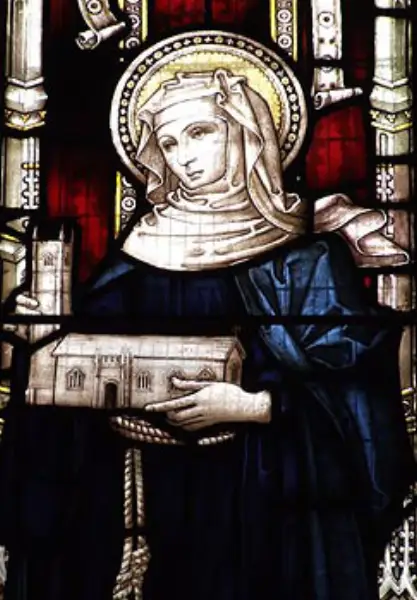
Buriana's afterlife is written into the landscape. The parish church of St Buryan is her primary patronage and her major shrine, a church that keeps her feast with a loyalty older than any rubric. The official feast recorded in the Exeter Martyrology falls on 1 May, the day the Church of England also observes, while the Roman calendar of saints assigns her to 4 June. The parish itself, however, celebrates its patron on the Sunday falling nearest to 13 May, keeping to the old Julian-calendar May Day, a piece of seasonal arithmetic by which the community holds to the feast of its fathers against the corrections of the reformers. She is venerated in the Eastern Orthodox Church, the Anglican Church and the Roman Catholic Church alike, one of the many Celtic saints whose cult crosses the divisions of later centuries. The scholarly record on her is slender but real: Patrick Moran's study of Irish saints in Great Britain, Peter Berresford Ellis on the Cornish saints, B. L. Olson's note on the tenth-century list of Cornish parochial saints in a Vatican codex, and the parish's own accounts all bear witness to her. In stained glass at St Buryan's she is still depicted, a king's daughter from over the sea who made a Cornish parish her lasting home.
§ Veneration
The Record
- Patron of
- St Buryan's Church, Cornwall
- Canonization
- Pre-congregation; venerated in the Eastern Orthodox, Anglican and Roman Catholic churches
Prayer
Bibliography
Show 5 sources
- Moran, Rev. Patrick F. (1879). Irish Saints in Great Britain. p. 17.
- Ellis, P. B. (1992). The Cornish Saints. Penryn: Tor Mark Press, p. 6.
- Olson, B. L. (1996). "Note: The tenth-century List of Cornish parochial saints' names in Codex Vaticanus Reg. Lat. 191". Parergon 13 (2): 179–181. doi:10.1353/pgn.1996.0016.
- "St Buryan Parish Church TR19 6BA | St Buriana". www.stburyanchurch.org.uk. Retrieved 4 September 2023.
- Ford, David Nash (2006). "St Buriana". earlybritishkingdoms.com. Early British Kingdoms. Retrieved 2 May 2022.
Profile text adapted from the Wikipedia article, licensed CC BY-SA 4.0.
Pray with this saint every day
Save St. Buriana to your favorites, read the full profile, and get feast-day reminders in the Saints app.
Get the Saints AppFree on the App Store for iPhone and iPad