
1003? – September 27, 1046·Feast September 24
St. Bystrík
Bishop of Nitra and Martyr of the Vatha Rising
Overview
Bystrík was a bishop of Nitra, in the Kingdom of Hungary, who died a martyr in the pagan rising of 1046. His birthplace and date are unrecorded, though he seems to have come from an aristocratic family of Slavic or Hungarian stock whose Christianity went back to the Cyril-Methodian mission, before Great Moravia fell in 907, and he was likely born near Nitra around the turn of the eleventh century. He is believed to have studied at the school of St. Hypolita at Zobor Abbey, whose community produced the saints Astrik, Prokop, Svorad, Benedict and Maurus. King Stephen I of Hungary, the first Christian king, appointed him bishop of Nitra around 1034 as part of the wider conversion of the Hungarian clans. In September 1046 the pagan revolt led by Vatha swept the country, and Bystrík, together with bishops Gerard Sagredo and Buldus, was travelling toward Buda for the coronation of the future Andrew I when the mob attacked. Stoned on September 24, he fled across the Danube by boat with bishop Beneta but was run through with a sword on the Pest bank; he lingered three days and died on September 27. Canonized by King Ladislaus I in 1083, he is honoured in Hungary together with Gerard and Buldus, and his depictions, always episcopal and often bearing sword and boat, are found in roughly two dozen places across Slovakia and Hungary and in Slovak communities abroad.
The Complete Life
A Noble Child of the Moravian Mission
The early life of Bystrík is known only in outline, and even the outline is partly conjecture. The exact place and time of his birth have not been preserved; he seems, however, to have belonged to an aristocratic family, probably of Slavic or of Hungarian stock, whose ancestors had been baptised in the mission of Cyril and Methodius at a time when that mission still flourished in Great Moravia, that is, before the empire's collapse in 907. The likely setting of his childhood is the country around Nitra, one of the oldest centres of Christianity in the region, and the likely date is around the close of the tenth century and the opening of the eleventh. For his schooling the tradition points to the school of St. Hypolita attached to Zobor Abbey above Nitra, an institution whose pupils and masters formed an remarkable generation: from Zobor at this period came Astrik, Prokop, Svorad, Benedict and Maurus, men who carried the faith into the newly organised Hungarian kingdom. To be educated among the disciples of Cyril and Saint Gorazd was to inherit both the Slavonic liturgical tradition and the Latin learning that was then entering the kingdom, and this double inheritance shaped the churchman Bystrík became. The infobox of later tradition hazarded the year 1003 for his birth, a date that fits the general probabilities of his career but cannot be verified from any early source.
§ Bystrík's bishopric
Bishop under the First Christian King
Bystrík's episcopal vocation unfolded under King Stephen I, the first king of Hungary, who reigned while the Hungarian clans were being gathered into the Christian fold. Stephen's programme was to plant bishoprics across his kingdom and staff them with men of learning and zeal, and around the year 1034 he raised Bystrík to the see of Nitra, an ancient seat in the west of the kingdom, in territory that is present-day Slovakia. The diocese of Nitra holds his memory as one of its early bishops, though the documentary evidence for his rule there is late: the first surviving historical sources that demonstrate his connection with Nitra are the Annales ecclesiastici regni Hungariae of Melchior Inchofer, written as late as 1644. Later historiography treats his historicity as uncertain, while allowing that he may well have been a real bishop who served King Stephen around 1034. What the tradition does preserve is the circle in which he moved: the churchmen trained at Zobor were the instruments of the kingdom's Christianisation, and Bystrík belonged to that company. His years as bishop fell in the last decade of Stephen's long reign, a period when the Christian settlement of Hungary, imposed from above on a people whose old religion still lived beneath the surface, was about to be tested in the most violent way.
§ Bystrík's bishopric
Martyrdom by the Danube
The rising that killed Bystrík broke out in 1046. Vatha, a leader of the pagan party among the Hungarians, headed a revolt against the Christian order, and the disturbances spread to the centre of the kingdom. Bystrík was travelling toward Buda, together with bishop Gerard Sagredo of Csanád and bishop Buldus, in order to be present at the coronation of the future Andrew I, when the mob found them near the Danube, in the area of present-day Budapest. On September 24 the attackers began to stone the bishops. Buldus was killed outright. Bystrík and bishop Beneta managed to escape across the river by boat, but on the Pest bank the pagans caught up with them, and Bystrík was run through with a sword before the arriving forces of Andrew I could rescue the fugitives. Wounded unto death, he survived for three days and died on September 27, 1046. The thirteenth-century legend of St. Gerard, the earliest witness to his story, describes how bishops Buldus and Bystrík rescued bishop Benett from the hands of the insurgents, a detail that the later Hungarian chronicles carried forward. His death, with that of his companions, closed the revolt's assault on the Hungarian episcopate and opened the age of their cult.
§ Martyrdom
Canonized at Szabolcs
The formal canonisation of Bystrík belongs to the reign of King Ladislaus I of Hungary, who in 1083 raised to the altar, in a single ceremony at Szabolcs, the martyrs of the 1046 rising together with other heroes of the young Hungarian church. The same act recognised the sanctity of Gerard Sagredo and of the royal house of Stephen. For Bystrík it fixed his liturgical commemoration on September 24, the day of the stoning at the Danube, rather than September 27, the day he actually died. In Hungary this date has a shared character: September 24 is the date on which Hungary keeps St. Gerard Sagredo together with his fellow martyrs Bystrík and Buldus, so that the three bishops who set out together for the coronation are honoured together in death. The canonisation of 1083, coming barely a generation after the events, anchored the memory of the pagan rising in the devotional life of the kingdom and turned a political catastrophe into a testimony of faith. It also gave the diocese of Nitra a patron from its own early history, a bishop who had served the first Christian king and suffered under the reaction against his work.
§ Canonisation
Cult across Slovakia and Hungary
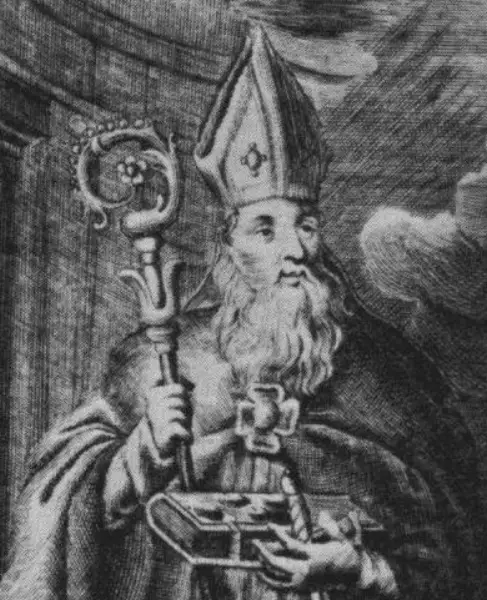
Reverence for Saint Bystrík has never been widespread, yet it has proved durable and geographically broad. The oldest surviving depiction of the saint comes from the baroque era: a copperplate by Hoffman published in 1692 in the Jesuit work of Gabriel Hevenesi, the Ungaricae Sanctitatis Indicia. Today some two dozen depictions of him are known, scattered through Slovakia and Hungary and among Slovaks settled as far away as Australia, Canada, Italy, Poland and the United States. He appears in frescoes, on glass, on bells, and on paintings executed on wood and on fabric. Iconographically he is shown as a bishop with a book and the full array of episcopal insignia, cope, mitre, crosier, gloves and ring; in his left hand, beside the book, he often carries the sword that is the emblem of his death, and sometimes the boat in which he crossed the Danube. The documentary record is thinner than the artistic one: beyond the records of the Nitra bishopric his name appears in the Vatican Apostolic Archive, in the Chronicon Pictum of the fourteenth century, in the Buda, Dubnic and Munich chronicles, in the German chronicle of Henry of Mügeln, and in the chronicles of Johannes de Thurocz and Antonio Bonfini. Devotion has taken architectural form only recently: the first church devoted to him was consecrated at Nemce near Banská Bystrica on September 15, 2006, another church honours him at Hajná Nová Ves, and Saint Bystrík's House stands at Čičmany.
§ Veneration
Timeline
- 1003
Born near Nitra around the turn of the eleventh century into an aristocratic family Christianised in the Cyril-Methodian mission.
§ Bystrík's bishopric
- 1034
Appointed Bishop of Nitra by King Stephen I of Hungary.
§ Bystrík's bishopric
- 24 Sep 1046
On September 24, Vatha's pagan mob stones the bishops travelling to the coronation of Andrew I; Buldus dies at once.
§ Martyrdom
- 27 Sep 1046
Struck down with a sword at the Danube's Pest bank as he fled by boat; he dies three days later, on September 27.
§ Martyrdom
- 1083
Canonized at Szabolcs during the reign of King Ladislaus I of Hungary.
§ Canonisation
- 1692
The oldest known depiction of the saint appears in Gabriel Hevenesi's Ungaricae Sanctitatis Indicia as Hoffman's copperplate.
§ Veneration
- 15 Sep 2006
On September 15 the first church devoted to Saint Bystrík is consecrated at Nemce near Banská Bystrica, Slovakia.
§ Veneration
The Record
- Symbols
- Sword·Boat·Episcopal book·Cope·Mitre·Crosier
- Canonization
- Canonized in 1083 at Szabolcs during the reign of King Ladislaus I of Hungary
Prayer
Bibliography
Show 7 sources
- Bugan, Bystrík: Bishop Bystrík in Slovak history. In: Bobak, J. et al.: Historical Proceedings no. 15, 1/2005. Martin, Slovakia: Matica slovenská, 2005, p. 13–25.
- Bugan, Bystrík: Saint Bystrík. Bratislava: Lúč, 2007, p. 204.
- Pâté, Julius et al. Lexicon of Catholic priestly figures of Slovakia. Bratislava: Lúč, 2000, p. 172–174.
- Zrubec, Laco: Personalities of our past. Bratislava: Slovak Pedagogical Publishing House, 1991, p. 83–85.
- Hevenesi, Gábor (1692). Ungaricae Sanctitatis Indicia. pp. 82–84.
- "Saint Bystrík" (PDF). Hungarian Saints. Hungarian Catholic Mission. Retrieved 8 January 2013.
- Bugan, Bystrik: Svätý Bystrík. Bratislava: Lúč, 2007, ISBN 978-80-7114-660-5 (English summary).
Profile text adapted from the Wikipedia article, licensed CC BY-SA 4.0.
Pray with this saint every day
Save St. Bystrík to your favorites, read the full profile, and get feast-day reminders in the Saints app.
Get the Saints AppFree on the App Store for iPhone and iPad