
c. 497 – 580·Feast September 25
St. Cadoc
Wise Abbot of Llancarfan and Founder of Churches
Overview
Cadoc, also spelled Cadog, was a fifth and sixth century Welsh abbot of Llancarfan, near Cowbridge in Glamorgan, a monastery famed in the age of the Celtic church for its learning; there Illtud began his religious life as Cadoc's pupil. He is credited with founding many churches in Cornwall, Brittany, Dyfed and Scotland. His father, Gwynllyw the Bearded, ruled among the lesser kings of Wales, counted Saint Petroc as a brother, and lived as a robber chieftain; he eloped over the mountains with Princess Gwladys, daughter of King Brychan of Brycheiniog, in a raid in which two hundred of his three hundred followers perished. Born around 497 into these royal houses, Cadoc was, by tradition, baptised and taught by the hermit Meuthi, and after an incident in which his father stole the cow of the Irish monk Tathyw of Caerwent, the boy was given into the monk's care and educated at his monastery in Caerwent. When he came of age he would not command his father's war band, choosing instead to fight for Christ, and raised his first monastery, Llancarfan, in the Vale of Glamorgan, studied three years in Ireland and under Bachan, a teacher of rhetoric from Italy, built a stone monastery in Scotland around 528 at Kilmadock, and settled on an island in the Etel river in Brittany, now L'Ile de Cado, where he founded an oratory and a monastery. Known to the Welsh as Cattwg Ddoeth, the Wise, he left a large collection of maxims preserved in the Myvyrian Archaiology. He died, by tradition, in 580.
The Complete Life
A Child of Two Royal Houses
Cadoc began life amid violence and wonder in equal measure. His father, Gwynllyw the Bearded, numbered among the lesser Welsh kings, counted Saint Petroc as a brother, and lived by robbery. Wishing to marry Princess Gwladys, daughter of King Brychan of Brycheiniog, a neighbouring ruler, he sent envoys to her father's court at Brecon and was refused. The pair eloped, fleeing over the mountains in a raid in which two hundred of Gwynllyw's three hundred followers are said to have died. From that tempestuous union Cadoc was born in Monmouthshire around 497, heir to two royal lines, Gwynllwg on his father's side and Brycheiniog on his mother's. Legend lavished portents on him before and at his birth: strange lights shone in his parents' house, the cellars filled miraculously with food, and an angel proclaimed the birth and called the hermit Meuthi to be the child's baptiser and teacher; a holy well gushed forth for the font and thereafter, the story runs, ran with wine and milk. He is thought to have received at the font the name Cathmail, or Cadfael. Soon after the birth Gwynllyw rode out on a celebratory raid with a new band of warriors and among his plunder took the cow of an Irish monk, St. Tathyw of Caerwent, probably the Tathan remembered as an early abbot of Caerwent whose dedications stand around Llantwit Major. Tathyw feared no king and came to demand his beast back; moved by impulse or by grace, Gwynllyw handed over his son instead, and Cadoc went to be educated at the monk's monastery in Caerwent, learning Latin, the beginnings of letters, and, most decisively, the worth of the monastic and priestly life.
§ Biography
The White Boar and the Refusal of Arms
The turn in Cadoc's life came, the Vita recounts, on a day in the Cardiff district of Glamorgan. Fleeing an armed swineherd from a hostile tribe, he ran through the woods in search of cover and came face to face with a boar grown white with age. The animal, disturbed, made three fierce bounds towards him, and then, at the moment of death, miraculously vanished. Cadoc read the deliverance as a sign from heaven and marked the place with three tree branches. The valley belonged to his uncle, King Pawl of Penychen, who made the land over to his nephew, and there in time rose the great church college and monastery of Llancarfan. The choice of vocation carried a heavier refusal with it: in adulthood Cadoc declined to take command of his father's army, preferring, in the phrase of his biographers, to fight for Christ rather than for a kingdom of this world. His formation continued outward from Wales. From Llancarfan he went to Ireland, where he studied and taught for three years; returning to his own country he attached himself to Bachan, also called Pachan, a teacher of rhetoric from Italy, under whom he polished the learning that would make his house a school for others, Illtud among them, passing his earliest religious years in Cadoc's school. A tradition also sends him on pilgrimage to Rome, though the more certain chapter of his travels is the time he spent in Brittany, where his name is still written across some thirty Breton place-names.
§ Biography
The Church of the Stags
The monastery of Llancarfan, set in the Vale of Glamorgan not far from the Bristol Channel and known in one tradition as the Church of the Stags, was the centre of Cadoc's spiritual labour. The traditions about its foundation diverge. According to Huddleston, the majority of Welsh writers place the foundation in the days of St. Germanus's visit to Britain, in 447 and name St. Dubricius as its first principal, with Cadoc succeeding him on his elevation to the episcopate; Huddleston himself observes that Constantius of Lyons's Life of St. Germanus, written about fifty years after the saint's death, says nothing of any such school in Britain or of Germanus's presence in Wales. The alternate tradition gives the foundation to Cadoc himself toward the close of the fifth century. What the stories agree upon is the character of the place: a site that at first seemed impossible, an almost inaccessible marsh, which the abbot and his monks drained and cultivated until it ranked among the most celebrated and inviting religious houses of South Wales, its plan embracing a monastery, a college and a hospital. When Cadoc returned from his three years in Ireland he found the buildings in ruins and, furious, drove the monks back to manual labour, hauling timber out of the woods for the rebuilding; two stags then emerged from the trees to labour beside them, which is why the stream past the monastery is still called the Nant Carfan, the Stag Brook. Rev. Rees notes that the house stood not exactly at Llancarfan but at a spot within it known as Llanfeithin. His sister Maches, killed by robbers stealing her finest ram, was commemorated by a church Tathan built on the spot after the murderers confessed to him.
§ Llancarfan
Monasteries in Scotland and Brittany
Cadoc's missionary reach extended far beyond Glamorgan. Around 528, once his father was dead, tradition credits him with raising a stone monastery in Scotland, most likely at Kilmadock, the place that carries his name, north-west of Stirling where the Annant Burn meets the Teith a couple of miles above Doune. Beside the old Kilmadock church and graveyard, now ruinous, stands Hermit's Croft, believed to be where he passed seven years of residence. Seven churches raised locally under his patronage afterwards passed to the authority of Inchmahome Priory, and the monastery itself is reported to have stood below Mount Bannauc, usually identified with the hill south-west of Stirling that sends the Bannockburn down its slope; some have proposed that its site lies beneath the modern town of St Ninians, two kilometres to Stirling's south. His Scottish disciples bore the name Gille Dog, the servants of Cadog, which lives on in the surnames Dog, Doig, Dock and Doak, and a further tradition adds a monastery at Cambuslang. In Brittany the saint's work rooted itself on an island of the Etel river, today the Ile de Cado, on which he raised an oratory, established a monastery and gave his strength to preaching the Gospel. His chapels survive at Belz and Locoal-Mendon in Morbihan and at Gouesnac'h in Finistere, where sufferers invoke him against deafness, and roughly thirty Breton place-names grew from his cult. Cornwall and Dyfed, too, hold numerous churches set up under his patronage, a field of foundations that made him among the most widely travelled of the Welsh saints.
§ Scotland
Beneventum and the Cloud
The manner and place of Cadoc's death are the most debated parts of his legend. His epithet Doeth, Welsh for wise, led some writers to confuse him with a St. Sophias, wisdom in Greek, a bishop of Beneventum in Italy; on that account he is sometimes placed at his death in Bannaventa, the Weedon lying five kilometres east of Daventry in Northamptonshire. The Vita's closing episode takes up and transfigures the confusion: Cadoc is wafted away in a cloud from Britannia to Beneventum, where a certain prior receives warning that a western Briton will arrive and receive the new name Sophias; under that name Cadoc rules as abbot, then bishop, then martyr. Over his tomb, the narrative continues, there rose a magna basilica which no visiting Briton was permitted to enter, and a wholly invented Pope Alexander is drafted into the tale. Tatlock, weighing these stories, remarked that moderns innocent enough to squeeze the last farthing of historical truth out of such a yarn had tried to locate the Beneventana civitas somewhere in Britain, and pointed instead to the circular Lombard church at Benevento dedicated to Saint Sophias, a scarce name among the saints, concluding that some Welsh traveller to the town had found there a name or a story to licence the pleasing fiction that Cadoc had come there and was Sophias. Behind the legend stands a real death, traditionally set in 580 and traditionally dated to 21 September. A further tangle shadows the record: this Cadoc, grandson of Brychan Brycheiniog, may be one with, or may have been confused with, Cadoc son of Brychan, whose churches stand at Llanspyddid by Brecon and at Llangadog in Carmarthenshire, and with a onetime chapel in Kidwelly parish, and whom Serenus de Cressy recorded as dying in 490, buried in France and commemorated on 24 January.
§ Other legends
Entry in the Roman Martyrology
Cadoc's standing in the Church's official books is modest but secure. The 2004 edition of the Roman Martyrology lists him among the saints whose deaths tradition sets on 21 September, under the Latin name Cadoci, with an entry that names him the abbot of the monastery at Llancarfan in South Wales and records the many houses raised to his honour in Cornwall and Brittany. He does not, however, figure in the current Roman Catholic national calendar kept for Wales, so that his commemoration lives chiefly in local and traditional observance. The calendar question has its own history. Since 21 September is the feast of the Apostle Saint Matthew, the church of Cardiff has traditionally kept St. Cadoc's Day on 25 September, a date that has become his general feast; the French Ile de Saint-Cado keeps its great pardon on the third Sunday of September; and elsewhere his older traditional feast day is 24 January, the date associated in some lists with the other Cadoc of the Brecon churches. He is venerated in the Catholic Church, in the Eastern Orthodox Church, whose calendars keep him on 24 January and 25 September by the old and new reckonings, and in Anglicanism, a triple inheritance fitting a saint whose foundations were planted in Wales, Scotland, Cornwall and Brittany alike.
§ Liturgical celebration
Cadoc, Arthur and the Holy Grail
Cadoc's Norman era Vita, written by Lifris of Llancarfan shortly before 1086, has an importance beyond Wales, for it is one of the seven saints' lives that speak of Arthur apart from Geoffrey of Monmouth's Historia Regum Britanniae, and so forms part of the evidence in the case for Arthur's historicity. The Vita draws Arthur as great and bold, yet headstrong. Lifris tells that Cadoc sheltered a man who had slain three of Arthur's warriors, and that Arthur received from Cadoc a herd of cattle by way of compensation; the beasts were handed over, yet no sooner did Arthur take them than they turned into bundles of ferns. Like wonders occur in the mediaeval lives of Carannog, Padern and Goeznovius, where miracles confronting worldly power serve the cause of the church's freedom. The kings Maelgwn of Gwynedd and Rhain Dremrudd of Brycheiniog also figure in the Vita, and St. Cadoc's Church at Caerleon, though a Norman fabric much rebuilt, rests upon the footings of the Roman legion's headquarters and may memorialise an early cell of his, in a town likewise associated with Arthur. In the later Arthurian Welsh Triads Cadoc, with Illtud and Peredur, is named as one of three knights who became keepers of the Holy Grail. A miraculous healing spot linked with him kept its power until the days of King Hiuguel, Hywel ab Edwin, who died around 1041 to 1044, when, through some malevolent influence, the spot was lost. Known as Cattwg Ddoeth, the Wise, Cadoc left a large collection of maxims and moral sayings preserved in the third volume of the Myvyrian Archaiology, while the legendary genealogy printed in Rees's Lives of the Cambro British Saints traces his line through the emperors of Rome to Maximianus and the British soldiers who followed him.
§ Cadoc and Arthur
Timeline
- 490
Establishes the Llancarfan monastery in the final decades of the fifth century, one tradition says, on land granted by his uncle King Pawl.
§ Llancarfan
- 497
Born in Monmouthshire around 497; an angel announces his birth and the hermit Meuthi baptises him at a well that afterwards flowed with wine and milk.
§ Biography
- 528
After his father's death, erects a stone monastery in Scotland, most likely at Kilmadock near Stirling.
§ Scotland
- 21 Sep 580
Dies, by tradition carried off in a cloud to Beneventum according to the closing episode of his Vita.
§ Other legends
- 1041
A miraculous healing spot associated with Cadoc is lost through malevolent influence in the time of King Hywel, who died around 1041 to 1044.
§ Other legends
- 1086
Lifris of Llancarfan writes the Vita Cadoci shortly before 1086 to honour the house and confirm its endowments.
§ Biography
- 1086
Llancarfan Abbey does not survive the Norman intrusion into South Wales and is dissolved about 1086.
§ Biography
In Their Own Words
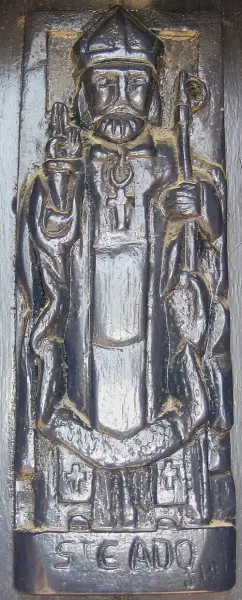
In the monastery at Llancarfan in South Wales, Saint Cadoc the Abbot, under whose name many monasteries in Cornwall and Brittany were established.
The Record
- Major works
- Llancarfan Abbey in the Vale of Glamorgan·Monastery at Cambuslang, Scotland·Stone monastery at Kilmadock, Scotland·Oratory and monastery on L'Ile de Cado, Brittany·Collections of maxims and moral sayings preserved in the Myvyrian Archaiology
- Patron of
- Glamorgan·Llancarfan·Famine victims·Deafness·Glandular disorders
- Symbols
- Bishop throwing a spear·Crown at feet·Stag·Pig·Mouse
- Canonization
- Pre-congregation; listed in the 2004 Roman Martyrology under 21 September, venerated in the Catholic, Eastern Orthodox and Anglican churches
Prayer
Bibliography
Show 11 sources
- Martyrologium Romanum, 2004, Vatican Press (Typis Vaticanis), page 529.
- Tatlock, J. S. P. (1939). "The Dates of the Arthurian Saints' Legends", Speculum 14.3 (July 1939), pp. 345–365.
- Strayner, Joseph R., ed. Dictionary of the Middle Ages. New York: Charles Scribner's Sons, 1983, p. 6.
- Hutchinson-Hall, John. Orthodox Saints of the British Isles. Vol I. St. Eadfrith Press, 2013, p. 75.
- Huddleston, Gilbert. "Llancarvan." The Catholic Encyclopedia. Vol. 9. New York: Robert Appleton Company, 1910.
- Chandlery, Peter. "Welsh Monastic Foundations." The Catholic Encyclopedia. Vol. 15. New York: Robert Appleton Company, 1912.
- Rees, Rice (1836). An Essay on the Welsh Saints Or the Primitive Christians.
- Rees, Rev. William Jenkins (1853). Lives of the Cambro British Saints, p. 378.
- Hando, F. J. (1958). Out and About in Monmouthshire. Newport: R. H. Johns.
- Bartrum, Peter C. "Bachan" in A Welsh Classical Dictionary: People in History and Legend up to about A. D. 1000, p. 38. National Library of Wales, 1993.
- Butler, Alban. Butler's Lives of the Saints, Volume 11, page 44. Paul Burns, 1995. ISBN 0860122603.
Profile text adapted from the Wikipedia article, licensed CC BY-SA 4.0.
Pray with this saint every day
Save St. Cadoc to your favorites, read the full profile, and get feast-day reminders in the Saints app.
Get the Saints AppFree on the App Store for iPhone and iPad