
died 1st century·Feast May 15
St. Caecilius
First Bishop of Elvira and Apostle of Granada
Overview
Caecilius — rendered Cecil, Cecilius or San Cecilio in Spanish — is honored as the patron saint of Granada in southern Spain. According to tradition he was a Christian missionary active in the first century, within the Apostolic Age. After first serving as an itinerant bishop in the region of Roussillon, he carried the Gospel to the town of Iliberri, also called Iliberis, the ancient settlement known successively as Elvira and Granada, and there he became its first bishop. On this account he is regarded as the founder of the archdiocese of Granada, traditionally said to have been established around the year 64. The Glosas Emilianenses likewise name Caecilius as Elvira's first bishop. Tradition credits him with several didactic treatises and holds that he was burned to death for the faith under the emperor Nero. He belongs to the Seven Apostolic Men, seven clerics said to have been ordained at Rome by Saints Peter and Paul and dispatched to evangelize Spain, together with Hesychius, Ctesiphon, Torquatus, Euphrasius, Indaletius and Secundius — a legend that probably took shape in the seventh century. Granada's Sacromonte neighborhood keeps his fiesta each first of February, and the abbey there claims his relics, though the lead books found with them were condemned as forgeries.
The Complete Life
A Missionary of the Apostolic Age
Almost everything known of Caecilius comes to us through tradition rather than documented history, and the tradition itself is solemn: it places him among the Christian missionaries of the first century, laboring while the Apostles themselves were still living memory. His field of work before reaching Hispania lay in Roussillon, the region straddling the eastern Pyrenees, where tradition says he exercised ministry as an itinerant bishop — a pastor without a fixed throne, moving from place to place as the needs of scattered congregations demanded. Itinerancy of this kind belonged to the earliest pattern of church order, when the message was carried along the roads of the empire by bishops who owned nothing but the office entrusted to them. Spanish piety incorporated him into the larger narrative of the Seven Apostolic Men, siete varones apostólicos, the seven clerics said to have received ordination at Rome from the hands of Saints Peter and Paul before being sent out to evangelize Spain. In that company he stands beside Hesychius, Ctesiphon, Torquatus, Euphrasius, Indaletius and Secundius, a band of brothers dispatched to the far western edge of the Mediterranean world. Scholars judge that this composite legend probably arose in the seventh century, centuries after the events it narrates, yet it preserved a genuine memory: the faith of Hispania was old, apostolic in claim, and proud of its founders.
§ Life
Evangelist of Iliberri and Founder of a See
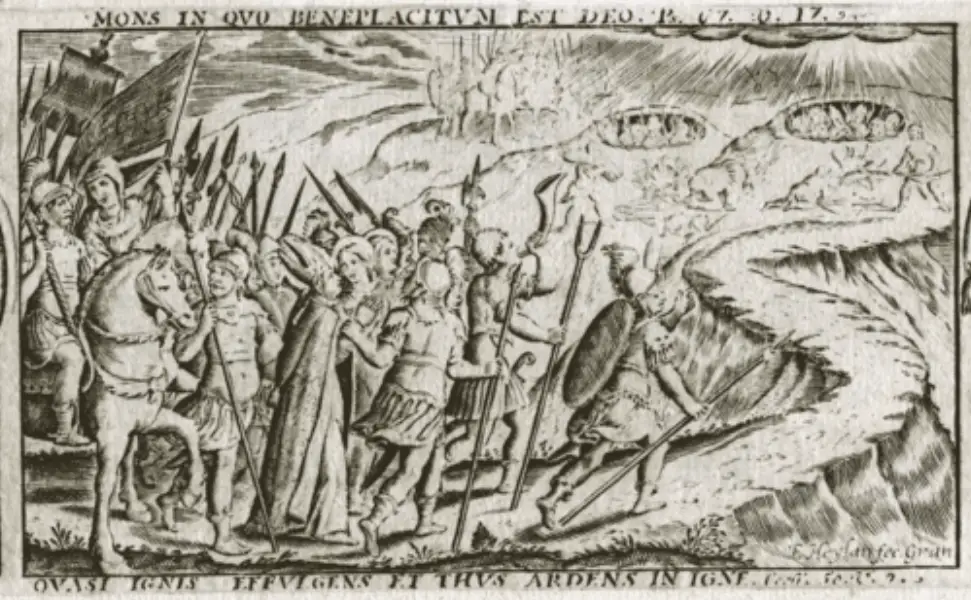
From Roussillon the tradition sends Caecilius to the town of Iliberri, also called Iliberis, the community known in later centuries as Elvira and identified with Granada. There he preached and, in time, was established as the town's first bishop — the inaugural shepherd of a see whose successor, the archdiocese of Granada, traditionally dates its foundation to around the year 64. That dating, falling within the reign of Nero and within living memory of the Crucifixion, makes Elvira one of the most anciently founded local churches of the Iberian peninsula. The claim found independent if late confirmation in the Glosas Emilianenses, the celebrated medieval glosses, which likewise record Caecilius as Elvira's first bishop. Beyond his pastoral charge, tradition states that he wrote a number of didactic treatises — works of instruction intended to teach the faith — though no text survives under his name. The tradition of his death completes the mission: he is held to have been burned to death during Nero's reign, joining the roster of those who died in the persecution that also claimed Saints Peter and Paul. Bishop and martyr together, he gave Iliberri both its first shepherd and its first witness of blood, and the city of Granada has never forgotten the double gift.
§ Life
Granada's Patron and the Sacromonte
Caecilius' afterlife in devotion is inseparable from the city that claims him. Each first of February the Granada neighborhood of Sacromonte celebrates the Fiesta de San Cecilio, when large crowds gather to honor the city's first bishop and patron. The fiesta, together with the abbey that anchors it, has long served as the chief instrument for preserving, propagating and disseminating his legend — a legend Granada deliberately deployed in the seventeenth century, when the city sought to reshape the story of its own past, supplanting the recent Moorish era with accounts of far older Christian origins. The legend assigns the catacombs of Sacromonte as the site of the saint's martyrdom, and the abbey displays what are said to be his relics alongside the bones and ashes of eleven other saints, and the oven in which tradition held they had been burned. The same find produced the Lead Books of Sacromonte, inscribed plaques and volumes discovered with the relics, which the Holy Office later dismissed as forgeries. That judgment did not unsettle the popular devotion: the fiesta endures, the patronage endures, and Caecilius remains the figure through whom Granada tells itself the story of its own beginnings — a reminder that saints live as much in the memory of cities as in the records of historians.
§ Veneration
Timeline
- 60
Tradition places his missionary labors and his itinerant episcopal ministry around Roussillon during the Apostolic Age.
§ Life
- 64
Evangelizes Iliberri (Elvira/Granada) and becomes its first bishop, founding the see later known as the archdiocese of Granada.
§ Life
- 68
Put to death by burning during the reign of Nero, according to tradition.
§ Life
- 600
The legend of the Seven Apostolic Men, the seven clerics sent from Rome to Spain, probably originates in this century.
§ Life
- 1600
Granada invokes Caecilius' legend to redefine its historic identity, replacing its Moorish past with accounts of early Christian origins.
§ Veneration
The Record
- Major works
- Didactic treatises (per tradition)
- Patron of
- Patron of Granada, Spain
- Symbols
- Episcopal attire
- Canonization
- Pre-congregation; venerated from antiquity as a bishop and martyr of the Apostolic Age
Prayer
Bibliography
Show 5 sources
- Schäfer, Joachim. "Cäcilius von Illiberis", Ökumenischen Heiligenlexikon
- Fidel Fita y Colomé (1913). "Granada". In Herbermann, Charles (ed.). Catholic Encyclopedia. New York: Robert Appleton Company.
- "San Torcuato y los 7 Varones Apostólicos". Aciprensa.
- "Santoral del Dia 1 de Febrero - Cecilio".
- Odden, Per Einar. "Den hellige Cecilius av Granada", Den katolske kirke
Profile text adapted from the Wikipedia article, licensed CC BY-SA 4.0.
Pray with this saint every day
Save St. Caecilius to your favorites, read the full profile, and get feast-day reminders in the Saints app.
Get the Saints AppFree on the App Store for iPhone and iPad