
1st century·Feast March 30
St. Caesar of Dyrrhachium
Apostle of the Seventy and First Bishop of Dyrrhachium
Overview
Saint Caesar of Dyrrhachium belongs to the company of the Seventy Disciples, the wider circle of Jesus' early emissaries described in the Gospel of Luke, whose number is given as seventy or seventy-two depending on the manuscript. Eastern Christian traditions honor these figures as the seventy apostles, and Caesar's name stands among them. According to the tradition received by the churches, he was ordained by Paul the Apostle and established as the first bishop of Dyrrhachium, a port city of Epirus on the Adriatic, identifiable with modern Durrës in Albania. His name also appears in the New Testament itself, since Paul's letter to the Philippians greets the saints at Philippi on behalf of the believers in Caesar's household, in the verse 4:22. As a pioneering bishop on the Illyrian coast, Caesar occupies a place at the very head of Albanian Christianity. He was succeeded in the see of Dyrrhachium by Saint Astius, an Albanian martyr who is still honored with a church dedicated to him in Durrës. The Church commemorates Caesar on March 30 together with the apostles Sosthenes, Apollos, Cephas and Epaphroditus, and again on December 8 with those same apostles and Onesiphorus.
The Complete Life
One of the Seventy
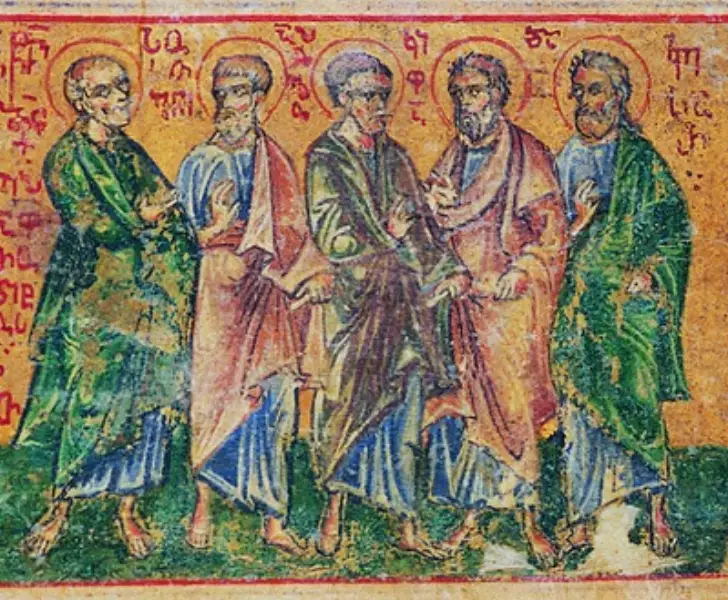
Everything the Church securely remembers about Saint Caesar's origins comes to us through his place among the Seventy Disciples. These were the wider band of followers, beyond the Twelve, whom Jesus sent out ahead of him, and whom Luke's Gospel records; ancient copies of the text differ over whether they numbered seventy or seventy-two. Eastern Christian traditions speak of them as the seventy apostles, and Caesar's Greek name, Kaisar Dyrrachiou, appears in their ranks. Nothing in the sources tells us where he was born or what work he followed before his calling, and hagiography has wisely declined to fill the silence with legend. What the tradition does affirm is his presence in the Lord's own missionary band, a claim that places him within living memory of the ministry of Jesus. In Byzantine iconography he is shown among the frescoed company of Epaphroditus, Sosthenes, Apollos, Cephas and Caesar, humble disciples whom the world little noticed but whom the churches have never forgotten. For the faithful of Albania, this obscure apostolic origin is itself a treasure: their nation's Christian history begins not with a later missionary from some imperial center, but with a disciple counted among those sent by Christ himself. Caesar's later career as a bishop confirms the pattern seen across the early Church, in which workers trained in the Lord's own school of preaching were then appointed to govern the new congregations of the Mediterranean world.
§ Life
Bishop of an Adriatic See
Caesar's apostolic work took him westward along the great road that linked the Aegean to the Adriatic. Dyrrhachium, the Greek city the Romans knew as the terminus of the Via Egnatia, stood in Epirus on the coast of what is today Albania, and it was here that his ministry bore its lasting fruit. The tradition of the churches holds that Paul the Apostle himself ordained Caesar to be the first bishop of the city, making him the founding shepherd of a see that would carry the faith into Illyricum. The connection with Paul is not left to conjecture alone. In his letter to the Philippians, written from imprisonment, the apostle passes on the greetings of the believers connected with Caesar, in the verse 4:22, a small textual witness that has been read as pointing to this disciple. Governing a mixed Greek and Illyrian population in a busy port, Caesar would have faced the ordinary trials of a first-century bishop: pagan neighbors, itinerant teachers and the slow work of forming a community in the apostles' doctrine. The succession at Dyrrhachium shows that he did not labor in vain. After him the see passed to Saint Astius, an Albanian who sealed his witness with martyrdom and whose memory is still kept in Durrës, where a church bears his name. From Caesar to Astius the line of Albanian Christianity runs unbroken back to the apostolic age.
§ Legacy
Remembered with the Apostles
The churches have kept Saint Caesar's memory in their calendars with a striking constancy. The liturgical commemoration on March 30 joins him to Apostles Sosthenes, Apollos, Cephas and Epaphroditus, disciples whose names are drawn from the Pauline letters, and a second commemoration on December 8 gathers the same company together with Onesiphorus. This pairing of dates reflects the Eastern manner of honoring groups of apostles whose individual histories have been lost but whose collective witness endures. Caesar's veneration is wide rather than narrow: the Eastern Orthodox Church, the Roman Catholic Church, the Oriental Orthodox Churches, the Anglican Communion and the Lutheran Church all number him among the saints, a rare breadth that testifies to the antiquity of his cult. For modern Albania his significance is national as well as religious. Dyrrhachium is today Durrës, the country's principal port, and Albanian church historians, including the Archbishop of Tirana, Durrës and All Albania, Anastasios, have traced the nation's Christian story back through Astius to Caesar and to Paul himself. The Orthodox Church in America keeps his feast in its menaion, and the Prologue of Ohrid preserves the memory of the choosing of the seventy holy apostles among whom he is counted. Byzantine frescoes continue to depict him in apostolic dress beside his companions. A saint of whom so little is recorded, and who is honored so widely, reminds the Church that her foundations were laid by many hands whose names the Gospels barely mention.
§ Legacy
The Record
- Canonization
- Pre-congregation; venerated among the Seventy Disciples by ancient tradition in the Eastern Orthodox, Roman Catholic, Oriental Orthodox, Anglican and Lutheran churches.
Prayer
Bibliography
Show 4 sources
- "The Church of Albania" – The Historical – Spiritual Tradition and Art – from the Apostolic Years to Date, by the Archbishop of Tirana, Durrës and All Albania, Anastasios
- Apostle Caesar of the Seventy, Orthodox Church in America (OCA)
- The Holy Apostles Sosthenes, Apollos, Tychicus, Epaphroditus, Onesiphorus, Cephas and Caesar, Prologue of Ohrid
- The Choosing of the Seventy Holy Apostles
Profile text adapted from the Wikipedia article, licensed CC BY-SA 4.0.
Pray with this saint every day
Save St. Caesar of Dyrrhachium to your favorites, read the full profile, and get feast-day reminders in the Saints app.
Get the Saints AppFree on the App Store for iPhone and iPad