
468/470 – 27 August 542·Feast August 27
St. Caesarius of Arles
Merovingian Monk-Archbishop, Preacher and Lawgiver of Gaul
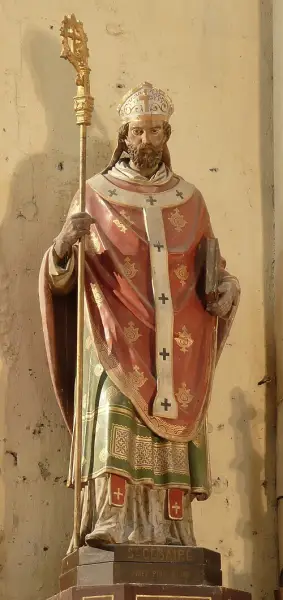
Overview
Saint Caesarius of Arles, a monk and bishop born at Chalon-sur-Saône to Romano-Burgundian parents just before the Western Empire collapsed, stood out as the foremost churchman Merovingian Gaul produced in his generation. Deeply pious from his youth, and estranged from his family because of it, he left their house at seventeen, studied briefly under a bishop named Sylvester, and then entered Lérins, the island monastery that was then a powerhouse of ascetic renewal in the Gallic church. Put in charge of its stores as cellarer, he scandalized the community by denying rations to monks he considered too comfortable; removed from office and harming himself with fasting, he was packed off to Arles on the pretext of needing treatment. There he found that Bishop Aeonius was a relative from his hometown, who raised him to the diaconate and priesthood and placed him over an Arles monastery. Chosen as Aeonius's successor, he became bishop in 502, aged around thirty-three. His long episcopate unfolded amid the contest of Visigothic, Ostrogothic and Frankish rulers over southern Gaul: he bought back war captives on an immense scale, disposing even of church plate to do so, and defended the ransoming of barbarians too, since they were equally capable of belonging to the City of God. Denounced once and exiled to Bordeaux, accused again and jailed, he won his release from Theodoric at Ravenna and afterward governed undisturbed. He chaired the councils of Agde (506) and Orange (529), compiled the earliest Western monastic rule designed for women, and left more than 250 sermons.
The Complete Life
A Burgundian Youth in a Dying Empire
Caesarius first saw the light at modern Chalon-sur-Saône, child of a household mixing Roman and Burgundian blood as the Western Empire drew toward its close. Germanic sovereigns were already the effective rulers of Burgundy at that moment, whatever forms of Roman administration lingered on paper. A sister, Caesaria, shared his home; she would one day govern the convent he established and receive from him the Rule for Virgins he addressed to her. Piety set the boy against his own people early. Where his parents were conventional, he was consumed by an intensity of religious feeling that kept him at odds with them for most of his teenage years. At seventeen he walked out of the house, attaching himself for a while to Bishop Sylvester as a student, and then made his way out to Lérins, an island house that had become a genuine engine-room for the church of Roman Gaul. Formed there as a monk, he gave his days to Scripture, reading it and living it, hoping to raise the tone and order of Christian life and to care for the destitute. He absorbed everything the community taught him with unusual speed, and was soon named cellarer, keeper of its provisions. There his austerity misfired: deciding that the brethren were not severe enough, he cut their rations and made himself hated, so that Abbot Porcarius stripped him of the charge. He then began to refuse food altogether, until the abbot stepped in a second time and shipped him off to Arles under the cover of seeking medical help.
§ Life
From Lérins to the Throne of Arles
The journey nominally undertaken for his health decided his whole future. Landing in the city, the Vita Caesarii tells us, he learned to his complete astonishment that Arles' bishop, Aeonius, hailed from Chalon and belonged to his own family — concivis pariter et propinquus, townsman and kinsman together. The older man promoted his young relative first to deacon and afterward to priest, and for a three-year stretch Caesarius headed a monastery in the city, a foundation that has since vanished without trace. When Aeonius died, the clergy, the citizen body and the local authorities moved — on the late bishop's own recommendation — to place Caesarius in the empty chair. Klingshirn, writing with modern skepticism, holds that the election may in fact have been sharply contested and that substantial local resistance may have existed; a cleric named Iohannes, present in the Arles episcopal lists, may even have been the successful candidate. Whatever the politics, Caesarius received episcopal consecration in 502 at roughly thirty-three. In office he combined fearlessness with freedom from worldly ambition, yet showed real skill at accommodating people gently. He worked hard to bring laypeople into the liturgy and welcomed questions on anything his preaching had left obscure; he told his flock to read the Bible at home and handle the word of God with the reverence they gave the sacraments. Care for the destitute and the sick made him famous far beyond Gaul: ransoming prisoners was a regular act of his episcopate, and he went so far as to part with the church's ornaments to redeem them.
§ Life
Ransomer of Captives Between Three Kingdoms
The stage on which this bishop played his part was dominated by a single drama: the struggle of Visigothic, Ostrogothic and Frankish monarchies over who would hold the south of Gaul. That struggle kept him ransoming the war's casualties year after year. The fighting of 507–508 — Burgundians and Franks against Visigoths and Ostrogoths — left the district's common people destitute, without food, and exposed to slavery, banishment and death. Caesarius rescued and bought back large numbers of the rural population, but the way he went about it drew criticism, for among those he redeemed were many barbarians and declared foes of the city. His answer to the criticism has rung down the centuries: barbarians were human beings, and being human they had it within them to belong to the City of God. The politics of such a position were dangerous. A notary, Licinianus, reported him to Alaric II as a man plotting to hand the city over to the Burgundians, and he was banished to Bordeaux until his innocence emerged and he was quickly allowed home; he then pleaded for the life of the very man who had slandered him. Around 512, with Theodoric's forces closing around Arles, a second accusation of treachery landed him in prison. A meeting with the Ostrogothic sovereign at Ravenna the following year cleared the air at once, and from that point his remaining years as bishop were tranquil.
§ Life
Disciple of Augustine at the Edge of the Cloister
Three masters formed this bishop: Augustine of Hippo, Julianus Pomerius and John Cassian. Through them he belongs to the closing generation of Gallic churchmen who labored to weave wide-ranging ascetic practice into the fabric of Western Christianity. Augustine's books stamped his understanding of the human community, inside cloisters and out, and his skill in the pulpit grew from long study of the bishop of Hippo's example; Klingshirn names him Augustine's faithful standard-bearer in the early medieval period. Pomerius, himself fired by Augustine, demanded that bishops and clerics live as monks rather than aristocrats — no lavish dinners, no estate-building, no worldly letters — and pressed them to surrender their wealth and live and dress plainly. Caesarius' preaching shows the same practical cast throughout. Alongside ordinary vice he had to fight surviving superstition — augury, and the pagan festivities of the calends — and his Old Testament homilies, lacking any critical apparatus, lingered on the passages' typical meanings. Learning, he taught, was never meant to terminate in the learner: whoever refuses to pass on what he has received falls short of God's design. He therefore wanted the illiterate to pay others to read aloud to them after church, and encouraged sacred reading everywhere, at church and at home, by day and by night, in solitude and in family. The Christian People were for him God's new elect, and he pictured men drawn from every corner of the earth into one believing, peaceable and affectionate fellowship — a vision that tracks Augustine's populus christianus closely.
§ Writings and teachings
Father of Canons and Rules
Few bishops of the sixth century shaped medieval institutions as lastingly as Caesarius did. The most significant local council he chaired was Orange in 529, whose teaching on grace and human freedom modern church historians have praised warmly; what it rejected was the account of grace then dominant in the Gallic south, substituting a moderated Augustinianism. Because these doctrines mattered to laypeople no less than to clerics, distinguished laymen — illustres ac magnifici viri — were summoned to subscribe, and eight of them, with at least twelve bishops, did so. His treatise De Gratia et Libero Arbitrio, directed against the semi-Pelagians, won approval from Pope Felix IV, who circulated it, and Boniface II confirmed the Orange legislation; the scholar Louis Thomassin argued that he was the earliest Western bishop to be granted the pallium. His 512 Regula virginum broke new ground as the initial Western rule drafted solely for women: it argued for lifelong enclosure from the day of entry, fixed hours for prayer, restrained fine clothing and decorative excess, and named its virgins the Church's jewels, guarded by God from ravening spiritual wolves. His sister and later his niece governed the house he raised outside Arles. His sermons, more than 250 of which survive, circulated throughout the Latin West, feeding German monasteries, surfacing in Old English verse, and informing Gatianus of Tours and, much later, Aquinas. William Daly judged that in many respects he anticipated the medieval idea of Christendom, foreseeing a society ever expanding, embracing and uniting the world.
§ Council of Orange, 529
Timeline
- 470
Born at Chalon-sur-Saône into a Romano-Burgundian household during the Western Empire's final years.
§ Life
- 502
Following Aeonius's death he is chosen for the see, and is consecrated bishop while still only in his early thirties.
§ Life
- Sep 506
He chairs the Council of Agde in Languedoc, where thirty-five bishops gather to treat chiefly of discipline.
§ Life
- 508
In the famine and violence after the 507–508 siege he redeems country people threatened with slavery, banishment and death.
§ Life
- 512
Accused again as Theodoric invests Arles, he is jailed; in the same period he issues the Regula virginum, pioneering Western legislation for women religious.
§ A Rule for women
- 513
Meeting the Ostrogothic king at Ravenna, he dissolves the suspicion against him, and governs in peace for the rest of his life.
§ Life
- 525
His niece Caesaria the Younger takes charge of the women's monastery, succeeding his sister.
§ A Rule for women
- 529
Chairing Orange, he settles a hundred years of argument over grace and works that had run on since Augustine died.
§ Council of Orange, 529
- 27 Aug 542
He dies in Arles, Francia, on 27 August, having kept direction of the monastery within his family to the end.
§ Life
In Their Own Words
This also do we believe, in accordance with the Catholic faith, that after grace received through baptism, all the baptized are able and ought, with the aid and co-operation of Christ, to fulfil all duties needful for salvation, provided they are willing to labour faithfully. But that some men have been predestinated to evil by divine power, we not only do not believe, but if there be those who are willing to believe so evil a thing, we say to them with all abhorrence anathema.
And therefore I ask you, oh sacred virgins and souls dedicated to God, who with you lamps shining await with clear conscience the coming of the Lord, that, because you know that I labored to establish a monastery for you, you with your prayers might ask that I be made a companion on your journey; and that, when you shall enter joyfully into the kingdom with the wise and holy virgins, you might obtain by your plea that I not remain outside with the foolish ones.
The Record
- Major works
- More than 250 surviving sermons (ed. German Morin, Corpus Christianorum Series Latina 103–104)·Regula ad Virgines — Rule for Virgins (512)·Regula ad Monachos — Rule for Monks·De Gratia et Libero Arbitrio, against the semi-Pelagians, circulated with papal approval by Felix IV·Testament and letters·Vita Caesarii, written by Bishop Cyprian of Toulon with others
- Canonization
- Pre-congregation; honored as a saint from his death in 542 in both the Catholic and the Eastern Orthodox churches.
Prayer
Bibliography
Show 7 sources
- Klingshirn, William E. Caesarius of Arles: The Making of a Christian Community in Late Antique Gaul. Cambridge University Press, 1994.
- Klingshirn, William E. Caesarius of Arles: Life, Testament, Letters. Liverpool: Liverpool University Press, 1994 (Translated Texts for Historians, vol. 19).
- Shahan, Thomas. "St. Caesarius of Arles." The Catholic Encyclopedia, Vol. 3. New York: Robert Appleton Company, 1908.
- Wace, Henry; Piercy, William C., eds. "Caesarius, bishop of Arles." Dictionary of Christian Biography and Literature to the End of the Sixth Century, 3rd ed. London: John Murray, 1911.
- Daly, William M. "Caesarius of Arles, a Precursor of Medieval Christendom." Traditio 26 (1970): 1–28.
- Life of Caesarius of Arles (Vita Caesarii Arelatensis), by Bishop Cyprian of Toulon and others, ed. Bruno Krusch, Monumenta Germaniae Historica, vol. 3, Hannover: Hahn 1896, pp. 433–501.
- Caesarius of Arles, Sermons, ed. German Morin, Corpus Christianorum Series Latina 103–104, Turnhout: Brepols 1953; English translation by Magdeleine Mueller, 3 vols., Catholic University of America Press 1956–73.
Profile text adapted from the Wikipedia article, licensed CC BY-SA 4.0.
Pray with this saint every day
Save St. Caesarius of Arles to your favorites, read the full profile, and get feast-day reminders in the Saints app.
Get the Saints AppFree on the App Store for iPhone and iPad