
c. 331 – 368·Feast March 9
St. Caesarius of Nazianzus
Fourth-Century Physician and Saintly Brother of Gregory the Theologian
Overview
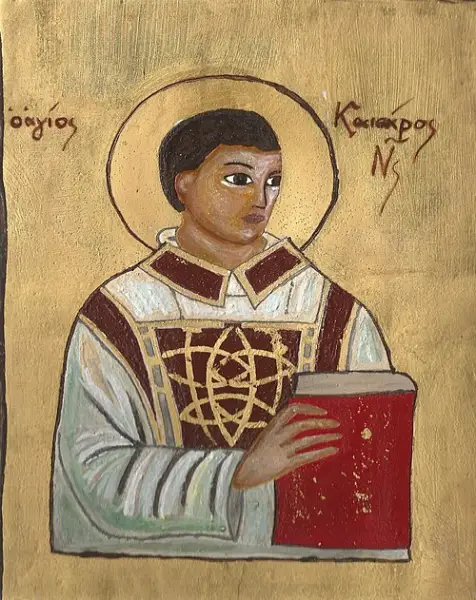
Saint Caesarius of Nazianzus, born around 331 at Arianzus, the family estate outside Nazianzus in Cappadocia, came into the world as the younger child of Gregory the Elder, who would govern that town as its bishop, and his pious wife Nonna; his elder brother was Gregory the Theologian. His gifts led him not to the altar but to secular learning. After preparatory studies, probably at Caesarea Mazaca in Cappadocia, he attended the elite schools of Alexandria in Egypt, where geometry, astronomy and above all medicine held his devotion, and in that last discipline he outshone every fellow student. Around 355 he settled in Constantinople, already building a name for medical brilliance; when his brother passed through around 358, Caesarius surrendered a lucrative and honorable post so as to travel home in his company, though the capital soon drew him back. Rising to prominence at the Byzantine court, he practiced medicine under Constantius II and then, to his family's sorrow, under Julian the Apostate, whose attempts to draw him into briefly revived paganism failed. Leaving court rather than compromise, he returned to Constantinople after Julian died in 363, and under Valens accepted the post of quaestor of Bithynia. He survived the earthquake that struck Nicaea on 11 October 368 but succumbed shortly afterward to the plague that followed, only recently baptized. Gregory directed his plundered estate's remains to the poor, and buried him at Nazianzus with a famous oration.
The Complete Life
Son of Nazianzus
Caesarius entered the world around the year 331 at Arianzus, the family's villa near the small Cappadocian town of Nazianzus, a site identified with modern Sivrihisar in Turkey's Eskişehir Province. His household was already remarkable. His father, Gregory the Elder, would become bishop of Nazianzus, and his mother, Nonna, was a woman of deep piety whose prayers, the family believed, had drawn her husband to Christianity. The most famous member of the household was his elder brother Gregory, later celebrated as Gregory the Theologian, one of the Cappadocian Fathers. The two boys grew up in an atmosphere of learning and devotion, but their gifts pointed in different directions. While Gregory was drawn toward rhetoric and the religious life, Caesarius showed brilliance in the exact sciences. His education followed the classical ladder of the fourth century: he probably studied first at Caesarea Mazaca in Cappadocia, in preparation for the elite schools of Alexandria in Egypt, then the intellectual capital of the Mediterranean. In Alexandria his favorite studies were geometry, astronomy and above all medicine, and in that last discipline he surpassed all his fellow students. Biographer John McGuckin notes that, close as the two were, their temperaments diverged sharply: lively and sociable, Caesarius felt thoroughly at ease in society, whereas his brother preferred to keep the world at arm's length. The two nevertheless complemented one another, with Caesarius encouraging Gregory's literary and rhetorical interests and Gregory relying on his younger brother to guide him through trouble.
§ Biography
Physician at Two Courts
Around 355 Caesarius moved to the imperial capital, Constantinople, and by the time he arrived he was already laying the foundations of a great reputation for medical skill. Three years later, around 358, his brother Gregory appeared there, homeward bound from his studies in Athens, and Caesarius made a choice that revealed the depth of his attachment to his family: he sacrificed a remunerative and honorable post in order to return to Cappadocia with Gregory. The pull of the capital, however, proved irresistible. He came back to Constantinople and rose to become an eminent physician at the Byzantine court, first under Constantius II and then, much to the regret of his family, under Julian, the emperor who abandoned Christianity and attempted to restore paganism. Julian's court placed Caesarius under direct pressure. The apostate emperor made efforts to win him over to the old religion, and Caesarius, who prized his faith above the emperor's goodwill, in the end withdrew from court rather than yield. His conscientious retreat did not end his public career. After Julian's death in 363 he returned to Constantinople, and under the Emperor Valens he accepted the office of quaestor of Bithynia, a position that carried substantial treasury and tax-collection responsibilities for the province. It was a life of high professional success lived at the intersection of medicine, money and imperial politics, and it made Caesarius one of the few saints of the era whose sanctity was forged in the antechambers of power rather than the desert.
§ Biography
Earthquake, Baptism and Plague
The closing chapter of Caesarius's life was crowded into a single autumn. On 11 October 368 an earthquake shook Nicaea, the Bithynian city where he was then serving as quaestor, and Caesarius escaped with his life. Surviving the disaster, he received an urgent letter in which his brother begged him to resign his office and retire into the religious life. Whatever Caesarius intended, events overtook him. The earthquake was followed by a widespread plague, and he was suddenly killed by it, shortly after having received baptism. Like many Christians of the period, he had deferred the sacrament until late in life, a common practice among those who feared post-baptismal sin, so that the washing he had long postponed arrived only at the threshold of death. His passing unleashed disorder: servants and creditors swiftly plundered the sizeable property he left, and little survived the scramble. Gregory demanded that whatever residue remained go to the poor and to surviving family members, and the household complied. The body was brought home to Nazianzus for burial, and there Gregory preached the funeral eulogy before their parents. Gregory's sermon, known as "On His Brother: St. Caesarius," portrays him as a model Christian and ascetic, a judgment that generosity of grief may have heightened, It remains the principal source for the details we possess about him and prepared the way for the Church's eventual recognition of his sanctity.
§ Biography
A Saint Remembered
Caesarius's afterlife in the Church rests largely on his brother's eloquence. The funeral oration Gregory preached at Nazianzus presented the court physician as a model of Christian virtue, and from that text the churches of both East and West drew the memory of a saint, honored in the Eastern Orthodox and Roman Catholic traditions with a feast on 9 March. Later scholarship has had to sift the legend from the record. The claim that this Caesarius was identical with the Prefect of Constantinople who was thrown into prison by Procopius in 365 is based solely on a conjecture of Jacques Godefroy (1587–1652), who edited the Theodosian Code at Lyon in 1665, and lacks any firm historical foundation. The four Dialogues, comprising 197 questions with answers and long credited to Caesarius, printed in Migne's Patrologia Graeca XXXVIII at columns 851–1190, almost certainly did not come from his hand: their character, subject matter and chronological slips all point elsewhere, and scholars treat them as inauthentic. Even his literary afterimage is uncertain in that respect. Yet his character has continued to fascinate: he serves as the main character and narrator of Gods and Legions, Michael Curtis Ford's historical novel of 2002, which charts the ascent and downfall of Julian the Apostate through the eyes of the confidant the novelist imagines him to have been. The physician who would not trade his faith for an emperor's favor remains a quiet witness to conscience at court.
§ Biography
Timeline
- 331
Caesarius is born at Arianzus, the estate close to Nazianzus, a child of Gregory the Elder and Nonna.
§ Biography
- 355
Caesarius comes to Constantinople, where he is already acquiring a reputation for medical skill.
§ Biography
- 358
His brother Gregory, homeward bound from Athens, appears in the capital; Caesarius gives up a remunerative post to return home with him.
§ Biography
- 363
After Julian's death, Caesarius returns to Constantinople.
§ Biography
- 11 Oct 368
He escapes the earthquake at Nicaea, receives baptism, and dies in the ensuing plague; Gregory buries him at Nazianzus.
§ Biography
The Record
- Major works
- Funeral oration "On His Brother: St. Caesarius", pronounced by Gregory of Nazianzus (the four Dialogues of 197 questions traditionally ascribed to Caesarius are regarded as spurious)
- Canonization
- Pre-congregation; recognized as a saint in the Eastern Orthodox and Roman Catholic churches, with his cult grounded in his brother Gregory's funeral oration.
Prayer
Bibliography
Show 6 sources
- McGuckin, John A. St. Gregory of Nazianzus: An Intellectual Biography. Crestwood, NY: St. Vladimir's Seminary Press, 2001. ISBN 0-88141-222-8
- Migne, J.P. (General Editor). Cursus Completus Patrologiae Graecae. 167 volumes. Paris: 1857–1866.
- Weber, Nicholas. "St. Caesarius of Nazianzus." The Catholic Encyclopedia, Vol. 3. New York: Robert Appleton Company, 1908.
- Guiley, Rosemary (2001). The Encyclopedia of Saints. Infobase Publishing. ISBN 978-1-4381-3026-2.
- Monks of Ramsgate. "Caesarius of Nazianzum." Book of Saints, 1921. CatholicSaints.Info.
- Herbermann, Charles, ed. (1913). "Caesarius of Nazianzus." Catholic Encyclopedia. New York: Robert Appleton Company.
Profile text adapted from the Wikipedia article, licensed CC BY-SA 4.0.
Pray with this saint every day
Save St. Caesarius of Nazianzus to your favorites, read the full profile, and get feast-day reminders in the Saints app.
Get the Saints AppFree on the App Store for iPhone and iPad