
died 107 (c. 3rd century by some accounts)·Feast November 1
St. Caesarius of Terracina
African Deacon and Martyr Who Conquered the Cult of the Caesars
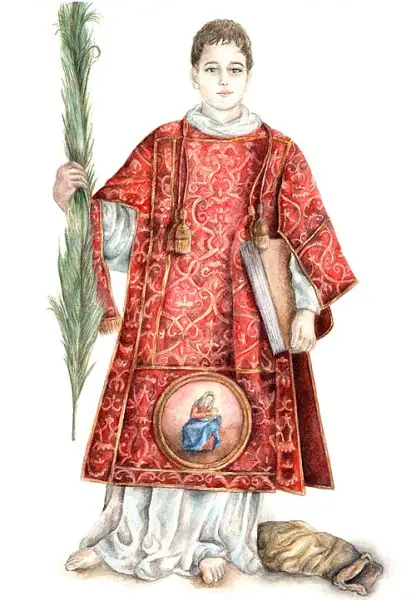
Overview
Saint Caesarius of Terracina, known in Italian as San Cesario the Deacon, was an African deacon put to death for his faith at Terracina, the harbor town between Rome and Naples. His Passion sets the drama under the pagan emperor Trajan, who reigned from 98 to 117. A member of the ancient and illustrious Julia family, Caesarius reached Terracina after a shipwreck and preached the Gospel to the city's poor. There he encountered a grim annual rite held each first of January, in which a young man, indulged for eight months in every pleasure, was forced to ride a horse from the clifftop and plunge to his death on the rocks below as an offering to Apollo for the empire's welfare. The deacon publicly denounced the practice; Apollo's priest Firminus had him arrested and hauled before Leontius, the Roman consul of Campania. Refusing sacrifice to the sun god, he prayed and the temple of Apollo collapsed, killing Firminus. After twenty-two months in prison he was brought to judgment; the light that answered his prayer converted the consul Leontius, who sought baptism and died on 30 October. On 1 November in the year 107, the governor Luxurius sewed Caesarius and the local priest Julian into a sack and hurled them from the cliff called Pisco Montano into the sea. The sea returned their bodies for burial near Terracina. Later ages made him the Christian successor to the imperial cult of Julius Caesar and Augustus, and he is invoked against drowning, floods and for the success of caesarean sections.
The Complete Life
An African Deacon on Italian Shores
Caesarius served as a deacon of Africa, one of that continent's many churchmen whose names traveled with the Mediterranean world of the early empire. The sources available to us say little of his youth, but they do preserve a claim about his lineage: he belonged to the ancient and illustrious Julia family, the stock that produced Julius Caesar himself, an irony his later cult would exploit with great deliberateness. His path to Italy was dramatic. Having survived a shipwreck, he came ashore at Terracina, a harbor town positioned between Rome and Naples, and there he found his mission: preaching the Gospel to the poor of the city. What he found there, too, was a religious horror. Under the pagan emperor Trajan, who ruled from 98 to 117, each year on the first of January the city held a rite intended to guarantee the empire's health and salvation. A youth was selected and indulged with material delights, his every desire granted for eight months; then he was made to mount a richly harnessed horse, ride to the summit of the city's cliff and cast himself, together with the unwilling animal, into the void, to be broken on the rocks and drowned in honor of Apollo, a propitiatory offering for the state and its emperors. The deacon from Africa, arriving poor and shipwrecked among a poor population, saw the rite for what it was and refused to avert his eyes. His condemnation of it would cost him everything.
§ Life
A Voice Against Human Sacrifice
Caesarius's ministry at Terracina took the form of prophetic protest. Standing before a ritual in which the empire's prosperity was purchased with a young man's life, he cried out against a power that persuaded by tortures and grew fat on shed blood. The words could not go unanswered. Firminus, the priest of Apollo, had the deacon arrested and brought before Leontius, the Roman consul of Campania, the provincial authority who would decide his fate. Interrogated, Caesarius was ordered to sacrifice to the pagan god of sun and light, the standard test applied to Christians who fell into official hands. He declined. What followed belongs to the register of the Passio rather than to sober annals: at the deacon's prayer, the temple of Apollo in the city's Forum collapsed, and the pagan Firminus was killed in the ruin. The gesture answered power with power, and it sealed the confrontation. Caesarius was locked up in jail, and there he remained for twenty-two months, a long confinement that itself became part of his testimony. When his case finally came to the Forum, he requested leave to pray, and while he prayed a radiant light poured down on him. Consul Leontius, seeing it, was won over on the spot, asked for baptism, and died soon afterward, on 30 October. Even the judge, the story insists, could not resist what he saw.
§ Life
The Sack and the Sea
The end came on the first of November in the year 107. Luxurius, the governor of the city, condemned Caesarius to the poena cullei, the ancient Roman punishment reserved for the gravest crimes: he was tied up together with Julian, a local presbyter who shared his fate, in a sack and flung into the sea from a cliff known as Pisco Montano. The manner of death was meant to be a degradation, denying the victims burial and erasing them from human memory. The Passion records that Caesarius did not die silent: before the execution he prophesied the governor's own end, death from the bite of a poisonous viper. The sea, in the story's telling, refused to keep them. On that same day the bodies of Caesarius and Julian were thrown back onto the shore, and a servant of God named Eusebius buried them near the town of Terracina. In this way, the narrative concludes, the deacon completed his martyrdom, the sea that was meant to erase him becoming the instrument of his remembrance. That paradox has followed the saint ever since, for the Church would come to invoke him precisely against drowning and river floods, and even for the safety of mothers in childbirth, the deliverance through water turned into a sign of deliverance itself. Terracina's cathedral, dedicated jointly to Saints Peter and Caesarius, still anchors his memory in the town where he died.
§ Life
The Saint Who Replaced Caesar
No martyr's afterlife is stranger or more politically astute than Caesarius's. Because his name means devoted to Caesar, and because it echoed the Caesareum and Augusteum, the rooms set aside in Roman public buildings for the worship of the emperors, the Church chose him deliberately to consecrate to Christ the places that had belonged to the pagan Caesars. Devotion to the deified rulers of Rome was notoriously hard to root out, rooted as it was in Roman national pride; a Christian martyr who bore the emperor's own name offered a tolerable substitute, and so the cult of the Caesars was quietly supplanted rather than destroyed. On the medieval Palatine, a ceremonial space rarely occupied by the emperor himself, one single saint was installed to undergird the imperial majesty: Caesarius. His passio, scholars note, revolves around the salus, the health and prosperity of the empire, suggesting by its very themes that the state's well-being rested on firmer Christian foundations than on its pagan past. The relics sealed the triumph. In the fourth century the Emperor Valentinian I's daughter was healed at the Terracina shrine, and he transferred the relics to Rome, housing them first in a Palatine church and later at a newly built San Cesareo in Palatio beside the Appian Way; Valentinian III named the imperial chapel for him. Fragments later reached Glastonbury, Exeter and Lincoln in England, and today rest from Pittsburgh to Manila, from Lucca to Rio de Janeiro, while a modern icon tours the basilicas of the world.
§ Cult: Caesarius as an imperial saint
Timeline
- 30 Oct 107
Converted at the deacon's trial, the consul Leontius seeks baptism and dies a short time later
§ Life
- 1 Nov 107
Governor Luxurius seals Caesarius and the presbyter Julian in a sack and hurls them into the sea from the Pisco Montano cliff
§ Life
- 1 Nov 107
The same day, the servant of God Eusebius recovers the martyrs' bodies and buries them near Terracina
§ Life
- 1110
A Passionale made for Saint Augustine's Monastery in Canterbury includes his Passion with an initial showing the martyrdom
§ Art: precious manuscripts
- 1463
A Paris manuscript of Vincent of Beauvais's Speculum Historiale illustrates the Passio with scenes of Caesarius and Julian
§ Art: precious manuscripts
- 1465
A Book of Hours made in Langres includes a miniature portrait of Saint Caesarius, now in the Morgan Library
§ Art: precious manuscripts
- 30 Mar 2015
Terracina Cathedral's silver reliquary arm goes on show in the Vatican exhibition of sacred jewelry from Lazio
§ Relics
- 3 May 2023
Bishop Bernard Fellay consecrates the main altar of the Basilica of the Immaculate Conception in St. Marys, Kansas with a first-class relic
§ Relics
In Their Own Words
Alas for a state and emperors who persuade by tortures and are fattened on the outpouring of blood.
The Record
- Patron of
- Patron of Roman emperors·Invoked against drowning and river floods·Invoked for defense against lightning, earthquakes and meteorological calamities·Invoked for the good success of caesarean sections
- Symbols
- Palm of martyrdom·Gospel book·Sack (poena cullei)
- Canonization
- Pre-congregation; an early Christian martyr venerated from antiquity in the Eastern Orthodox and Roman Catholic churches.
Prayer
Bibliography
Show 7 sources
- Schreiber, Barbara. "St. Caesarius of Terracina." Encyclopædia Britannica.
- Prinzi, Angela. Il Dossier innologico e agiografico dei santi martiri di Terracina Cesario e Giuliano: Passio (BHG 284A), Miraculum e Laudatio (BHG S.N.). Studi e testi, 545, Vatican Library.
- Amore, Agostino. "Cesario e Giuliano, santi martiri di Terracina." Bibliotheca Sanctorum, III, Città del Vaticano 1963, coll. 1154-1155.
- Baring-Gould, Sabine. The Lives of the Saints, 1. J. Hodges, 1877.
- Maskarinec, Maya. City of Saints: Rebuilding Rome in the Early Middle Ages. University of Pennsylvania Press, 2018.
- Head, Thomas F. Medieval Hagiography: An Anthology. Psychology Press, 2001.
- De Smedt C., Van Hoof G., De Backer J. Acta sanctorum novembris, tomus I. Parisiis 1887.
Profile text adapted from the Wikipedia article, licensed CC BY-SA 4.0.
Pray with this saint every day
Save St. Caesarius of Terracina to your favorites, read the full profile, and get feast-day reminders in the Saints app.
Get the Saints AppFree on the App Store for iPhone and iPad