
6th century
St. Caffo
Sixth-Century Welsh Martyr of Anglesey
Overview
Saint Caffo was a sixth-century Christian of Anglesey, north Wales, honored as both saint and martyr. He was a son of Saint Caw, a king of northern Britain who forfeited his territories and brought his family to safety in Anglesey, where the ruler Maelgwn Gwynedd granted him land in Twrcelyn, the island's north-eastern district. Caffo's wider kin included his uncles Saints Iestyn and Cyngar, his sister Saint Cwyllog, and a numerous set of brothers whose tally varies between ten and twenty-one in different manuscripts — among them, in some accounts, Saint Gildas. Caffo attached himself to Saint Cybi, a Cornish-born Christian active in the middle decades of the sixth century and his cousin, who settled inside a disused Roman fort at the place now called Holyhead, whose Welsh name Caergybi means Cybi's fort. The medieval Life of Cybi, preserved in a manuscript of about 1200, first mentions Caffo on the day he went out to obtain fire from a smith: he came back with a glowing ember carried inside his clothing, which was unharmed. The companions later parted, whether through a quarrel or because Gildas had insulted Maelgwn, who then pressured Cybi to dismiss Caffo — both explanations appear in the sources. Making his way into southern Anglesey, Caffo was killed by shepherds from the district now called Newborough, perhaps in revenge for the insult offered their king. The place of his death became Llangaffo, named for him, with a parish church still bearing his dedication.
The Complete Life
A Prince's Son in a Foreign Island
Caffo belonged to one of the most remarkable saintly families of early medieval Britain. His father, Saint Caw, reigned as a king in northern Britain until he lost his lands and fled with his household to Anglesey, where Maelgwn Gwynedd, the dominant Welsh ruler of the age, settled them in Twrcelyn, the district occupying the island's north-east. The children of that marriage produced an astonishing harvest of sanctity. Caffo's uncles, Saints Iestyn and Cyngar, Caw's own brothers, gave their names to Anglesey churches; his sister, Saint Cwyllog, is commemorated at Llangwyllog; and his brothers were numerous enough that the manuscript sources disagree about how many there were, counting anywhere from ten to twenty-one. Some traditions place Saint Gildas, the great monastic scholar and scourge of British kings, among that brotherhood. The sources preserve no birth date and no death date for Caffo, and the historian must be content with the sixth century as his whole span. What they do preserve is the texture of a refugee aristocracy turned Christian: a dispossessed northern dynasty, planted on a Welsh island by a king's charity, whose sons and daughters became the founders and patrons of the parish churches that still dot Anglesey. In that world, sainthood ran in families, and Caffo's kinship with Cybi, himself a Cornish Christian established in the island's Roman ruins, gave him his place in the church's story.
§ Life and martyrdom
Companion of Cybi at the Roman Fort
Caffo's vocation was lived out in companionship. He attached himself to Saint Cybi, a cousin described as a Christian from Cornwall active around the middle of the sixth century, who made his base within a disused Roman fort at Holyhead, on Anglesey's western tip; the town's Welsh name, Caergybi, still proclaims whose fort it became. Cybi was one of the fixed stars of Welsh hagiography, and Caffo's memory survives chiefly inside his master's orbit. The evidence connecting the two men is a manuscript written around 1200 containing two accounts of Cybi's life, and it is silent about Caffo until a single arresting incident. Sent one day to fetch fire from a blacksmith, the young companion came back carrying a live, red-hot coal wrapped in his clothing — and the cloth was unmarked. The miracle, small and domestic as it is, carries the story's whole weight of meaning: the fire of holiness carried without harm, the servant entrusted with what burns. After that episode the partnership did not last. Cybi and Caffo parted, and the sources offer two explanations without choosing between them. One holds there was a disagreement between the two men themselves; the other lays the cause at another door — Caffo's brother Gildas had delivered an insult to Maelgwn Gwynedd, the very ruler who had given the family its land, and Maelgwn then compelled Cybi to send his kinsman away. Both versions sit side by side in the manuscript accounts, leaving the reader to weigh politics against temperament.
§ Life and martyrdom
Death Among the Shepherds
Dismissed or departed, Caffo turned south across the island, and it was there, in southern Anglesey, that his life ended at the hands of shepherds from the district now known as Newborough. The sources do not disguise the likely motive: the killing may have been an act of revenge for the insult his brother Gildas had paid to the local king. If the earlier account is right, the same words that cost Gildas standing at Maelgwn's court cost Caffo his life among the flocks of the south. It is a martyrdom of an unusual kind — no magistrate, no edict, no formal refusal to sacrifice, only a holy man killed by countrymen aroused against his family. The Church in Wales nonetheless numbers him among its martyrs, and the name of the place where he fell came to carry his own: Llangaffo, the llan or enclosure of Caffo. The Welsh word llan began by meaning an enclosure and widened to mean a church, so the very name of the village announces that a saint's community once stood where he died. Local tradition adds a further mark of that memory: the place also once bore the name Merthyr Caffo — merthyr is Welsh for martyr — hinting that a house of monks may once have stood there. Of the man himself — his voice, his preaching, his age at death — nothing survives. The shepherds, the coal and the name on the map are what history kept.
§ Commemoration
A Church That Keeps His Name
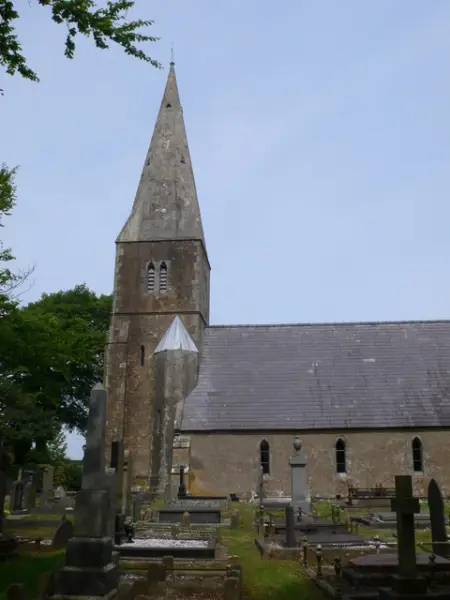
Caffo's afterlife is written into the geography of Anglesey. The area where he died became Llangaffo at some unrecorded date, and a church rose there in his honor; the Welsh element llan, originally an enclosure, came to mean a church, while -gaffo is simply the saint's name worn down by time. It is impossible to say when the name was first used or when the first building was raised, but the terminus is firm: in 1254 the church and its community appear in the Norwich Taxation, the national survey of church names and property, so the foundation was already old by then. Tradition holds that a monastery once occupied the site, remembered in the name Merthyr Caffo. The church of St Caffo still stands in the village and continues in use for worship by the Church in Wales, an unbroken dedication of more than seven and a half centuries. Folk memory added its own layer. Caffo was credited with a spring that bubbled nearby, known both as Crochan Caffo, the saint's cauldron, and as Ffynnon Caffo, his well; parents once brought fowls there for the attendant priest to eat, hoping to cure their children of peevishness; a farm near the site still bears the well's name, though the well itself has been lost. Caffo stands among the Anglesey saints whose names fill the island's parishes — Cwyllog, Eleth, Iestyn, Peulan, Tyfrydog — a local holiness never ratified by Rome but sustained by the people among whom it was lived.
§ Commemoration
Timeline
- 1200
A manuscript of about this date, containing two accounts of Cybi's life, records Caffo as his companion and tells of the fiery coal
§ Life and martyrdom
- 1254
The church and community of Llangaffo, named for the saint at his deathplace, are recorded in the Norwich Taxation
§ Commemoration
In Their Own Words
In Wales sanctity was locally conferred and none of the medieval Welsh saints appears to have been canonized by the Roman Catholic Church.
The Record
- Patron of
- Llangaffo, Anglesey
- Symbols
- Red-hot coal carried unharmed in his clothes
- Canonization
- Pre-congregation; never canonized by a pope — Welsh sanctity was locally conferred, as historian Jane Cartwright notes.
Prayer
Bibliography
Show 6 sources
- Baring-Gould, Sabine (1907). The Lives of the British Saints: The Saints of Wales and Cornwall and such Irish Saints as have dedications in Britain, volume 2. Honourable Society of Cymmrodorion.
- Lloyd, John Edward (2009). "Cybi (fl. 550), saint." Dictionary of Welsh Biography. National Library of Wales.
- Davies, John Reuben (2003). The Book of Llandaf and the Norman church in Wales. Boydell Press.
- Rees, W. J. (1853). Lives of the Cambro British Saints. Longman.
- Cartwright, Jane (Spring 2002). "Dead virgins: feminine sanctity in medieval Wales." Medium Aevum 71 (1).
- Jones, Geraint I. L. (2006). Anglesey Churches. Carreg Gwalch.
Profile text adapted from the Wikipedia article, licensed CC BY-SA 4.0.
Pray with this saint every day
Save St. Caffo to your favorites, read the full profile, and get feast-day reminders in the Saints app.
Get the Saints AppFree on the App Store for iPhone and iPad