
early 3rd century (traditionally 63 – 85)·Feast September 27
St. Caius of Milan
Early Bishop of Milan of the Pre-Ambrosian Church
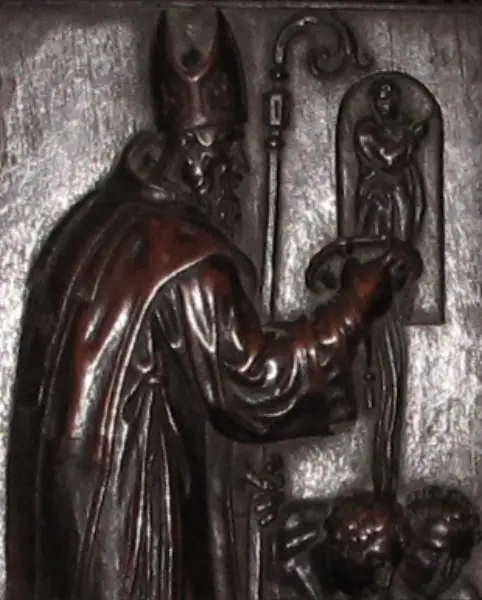
Overview
Caius, also spelled Gaius and in Italian Caio, was a bishop of Milan in the early third century, and the succession lists of that church make him the successor of Anathalon and the predecessor of Castritian. The Orthodox tradition carries him much further back, reckoning him the first bishop of Milan in the first century, and the traditional episcopal catalogue assigns him the years 63 to 85, between Anathalon and Castricianus. Of his life and his governance of the church almost nothing certain survives: he held the see while the Milanese congregation was still taking shape within the Roman Empire, he died on 26 September, and tradition says his body was laid in a cemetery adjoining the long-demolished Basilica Naboriana. His relics were later translated to the nearby Basilica of Sant'Ambrogio, where they rest among the treasures of the Ambrosian church. Medieval texts, notably the eleventh-century Historia Dataria, embroidered his memory with legendary details: that he was present in Rome at the martyrdom of the apostles Peter and Paul, and that he converted Saints Vitalis, Valeris, Gervasius and Protasius. He is honoured as a saint in both the Roman Catholic and the Eastern Orthodox Church, with his feast on 27 September.
The Complete Life
The Episcopate of Milan
The vocation of Caius was the government of one of the earliest sees of northern Italy. Modern critical scholarship places his episcopate in the early third century, in the succession of Anathalon and before Castritian, which makes him a bishop of the Milanese church in the decades before the persecutions of the mid-third century, governing a community that must have lived with the constant legal insecurity of Christianity under the Roman Empire. The Orthodox tradition, however, preserves a far older claim: that Caius was the first bishop of Milan in the first century, and the traditional episcopal catalogue of the archdiocese assigns him the years 63 to 85, immediately after Anathalon, whose dates are given as 53 to 63. The divergence is not a quarrel about the man but about the antiquity of the see, and Milan's later eagerness to trace itself to the apostolic age belongs to the same impulse. What the office itself demanded can be inferred from its setting: preaching, the care of the poor, the administration of baptism, the ordination of clergy, and the guarding of a flock that Roman law could at any moment expose to confiscation and death. That a bishop of this era should be remembered by name at all, with his death day preserved, is itself a mark of the veneration his church gave him.
§ Life
Death and Burial
Tradition gives 26 September as the day of Caius' death, his dies natalis or birth into heaven, and says his corpse was laid to rest in ground near the Basilica Naboriana. That basilica, dedicated to Saints Nabor and Felix, once stood in Milan but has since been demolished, so that the resting place first assigned to the bishop has itself passed away. The removal of his relics followed the common pattern of the Italian churches: at some later date his remains were translated into the nearby Basilica of Sant'Ambrogio, the great shrine that Ambrose raised over the bodies of Gervasius and Protasius, and there the relics of Caius rest among the saints of the Ambrosian church he preceded by more than a century. It is one of the ironies of Milanese ecclesiastical history that a bishop of whom almost nothing else is known should have ended beside the greatest of all his successors, so that pilgrims who come to Ambrose encounter, in the same sanctuary, the frail memorial of the obscure Caius. The medieval imagination was not satisfied with this obscurity, and the Historia Dataria supplied him with a martyr's-eyes biography: present in Rome at the killing of Peter and Paul, and himself the converter of Vitalis, Valeris, Gervasius and Protasius, the very martyrs Ambrose discovered. These details are to be considered legendary.
§ Life
Legacy and Veneration
Caius is honoured as a saint both in the Eastern Orthodox Church and in the Roman Catholic Church, and his feast day is kept on 27 September, the day following the recorded date of his death. His chief monument is the episcopal succession list of Milan, in which his name stands between Anathalon and Castritian, and which the diocese has carried through its entire subsequent history, from the ancient age through the Genoese period of exile to the modern line of archbishops. The Orthodox tradition's insistence on him as a first-century bishop, the immediate successor of the missionary age, expresses the conviction of the church of Milan that its origin lies with the apostles themselves, a conviction that later fed the medieval texts: the Historia Dataria of the eleventh century gave him a place at the martyrdom of Peter and Paul and credited him with the conversion of Vitalis, Valeris, Gervasius and Protasius. Modern scholarship treats these additions as legendary, and the historical Caius remains what the earliest record made of him: a name, a see, a death day, and a burial. For the historian of the church of Milan his value is precisely that bareness, for he witnesses to the continuity of the Milanese episcopate before the documentary horizon opens with the later bishops of the fourth century.
§ Life; Notes
The Record
- Major works
- Governed the church of Milan in the pre-Ambrosian period as successor of Anathalon
- Canonization
- Pre-congregation; honoured as a saint in the Roman Catholic Church and the Eastern Orthodox Church
Prayer
Bibliography
Show 3 sources
- Ruggeri, Fausto (1991). I Vescovi di Milano. Milano: NED. p. 7. ISBN 88-7023-154-2. (in Italian)
- "Latin Saints of the Orthodox Patriarchate of Rome". www.orthodoxengland.org.uk.
- Cazzani, Eugenio (1996). Vescovi e arcivescovi di Milano. Milano: Massimo. p. 10. ISBN 88-7030-891-X. (in Italian)
Profile text adapted from the Wikipedia article, licensed CC BY-SA 4.0.
Pray with this saint every day
Save St. Caius of Milan to your favorites, read the full profile, and get feast-day reminders in the Saints app.
Get the Saints AppFree on the App Store for iPhone and iPad