
6th century·Feast November 1
St. Callwen
Shadowy Welsh Virgin of the Brychan Line
Overview
Callwen is an early Welsh Christian saint reckoned among the numerous children and descendants of Brychan, the fifth- and sixth-century king whose family peopled the calendars of the Welsh church. Later genealogies disagree about her precise place in that lineage: one list of saints makes her a daughter of Brychan himself, which would render her a sister of Cynog, while other material treats her simply as one of his descendants. The tradition common to the sources is that she renounced marriage and gave her life to God and to the service of her neighbours, a choice that placed her among the consecrated virgins of the age of the Welsh saints. Her feast falls on 1 November, a day she shares with her sister Gwenfyl. Her historicity, however, is insecure. Early sources do not corroborate her as a saint, and both the form and the origin of her name are described as dubious; one twentieth-century scholar of Cardiganshire concluded that the name does not appear in any ancient list or calendar. Her memory has nonetheless left a mark on the landscape of Brecknockshire, where a chapel in the vale of Tawe bore her name, where a parish was erected in 1868, and where a new church dedicated to her was opened in 1893, surviving in local speech even after its formal rededication.
The Complete Life
A Daughter of Brychan
Callwen belongs to that great company of early Welsh saints whose genealogy is better remembered than their biography. The sources place her among the Brychan family, the far-reaching kindred of a fifth- and sixth-century Welsh ruler whose children and grandchildren account for dozens of dedications across Wales and the Marches. Within that family tree her position shifts from one account to another: a list of saints makes her a daughter of Brychan himself, which would make her a sister of Cynog, while other traditions are content to describe her more loosely as one of his descendants. What the tradition does state plainly is the shape of her life: she embraced the single state, refusing marriage in order to dedicate herself to God and to the service of her fellow men and women. That choice aligns her with the consecrated virgins of the early Celtic church, women whose witness was expressed not through institutions but through personal renunciation and works of charity. Her feast on 1 November is shared with her sister Gwenfyl, and the pairing is one of the few fixed points in an otherwise unstable record. Even her name invites caution: scholars describe both its form and its origin as dubious, and the early sources decline to corroborate her sainthood, leaving the historian with a tradition that is ancient in its setting yet late and uncertain in its attestation.
§ Life
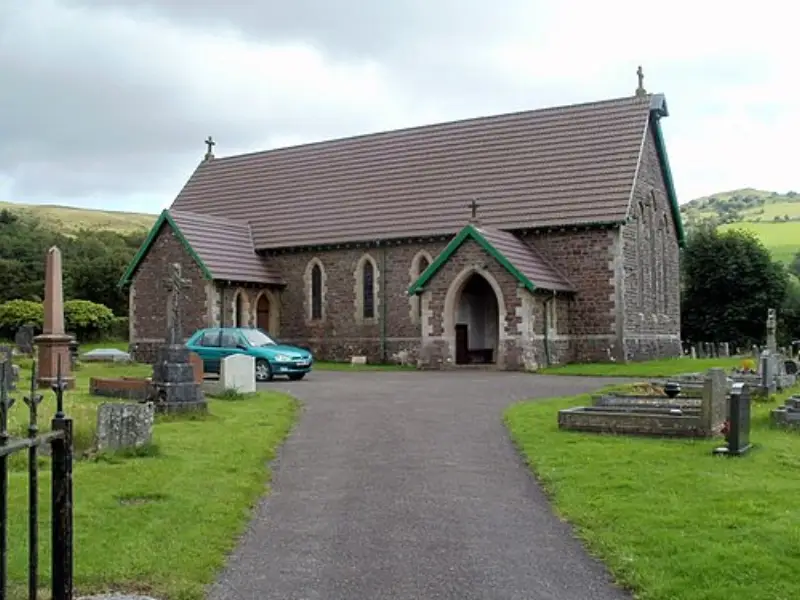
Callwen Church in the Vale of Tawe
Whatever the doubts about the woman, her name attached itself firmly to a corner of Brecknockshire. In the parish of Defynnog, in the vale of Tawe, stood a chapel that Theophilus Jones described in 1809 as bearing two names, one of which he took to be a corruption meaning Fairwood chapel, a description of the place as it first appeared. Rice Rees, writing in 1836, treated the dedication more simply: the chapel, he said, belonged to Saint Callwen. From an early date the building, known also as Capel Colwyn or St Colwen's, answered to Defynnog as its chapel of ease; about 1868 Glyntawe was separated and erected into a parish of its own. In 1893 a new church replaced the old one, the change certified by Basil Jones, bishop of St David's, together with the parish's patron, the widowed Ellen Elizabeth Gwyn, and the vicar, David Hughes. That church was formally rededicated to St John the Baptist in 1964–65, yet the people of the village of Callwen have never adopted the new title, and locally it remains Callwen Church. Doubt followed the name into Cardiganshire as well: John Thomas Evans, writing in 1914 on the church at Cellan, observed that the saint ascribed to it was poorly authenticated and absent from ancient lists, noting a spring called Ffynnon Callwen nearby while Sir Edward Anwyl doubted that Cellan and Callwen could be the same word at all.
§ Legacy
Timeline
- 1809
Theophilus Jones records the Tawe vale chapel as Cael Glyntawe or Capel Callwen, a corruption meaning Fairwood chapel
§ Legacy
- 1836
Rice Rees states that the chapel in the vale of Tawe was dedicated to Saint Callwen
§ Legacy
- 1868
Capel Colwyn ceases to serve as a chapel of ease to Defynnog as Glyntawe becomes a separate parish
§ Legacy
- 1 Jul 1893
A new Church of Saint Callwen replaces the older Glyntawe building under Basil Jones, bishop of St David's
§ Legacy
- 1914
John Thomas Evans writes that Callwen is poorly authenticated and absent from any ancient list or calendar
§ Legacy
- 1964
The Glyntawe church is rededicated to St John the Baptist, though villagers still call it Callwen Church
§ Legacy
In Their Own Words
sometimes called Cael Glyntawe and sometimes Capel Callwen, a corruption of Cellwen, Fairwood chapel, or the chapel in the fair wood, descriptive no doubt of its early appearance
The Record
- Patron of
- Glyntawe, Brecknockshire (by dedication)
- Symbols
- Shown with the virgin's palm in Welsh hagiographic tradition
- Canonization
- Pre-congregation Welsh saint of the Brychan family, whose historicity is itself doubted
Prayer
Bibliography
Show 8 sources
- Ball, John (18 March 2007), St John's Church, Callwen, Glyntawe, Breconshire, retrieved 7 April 2016
- Basil, William (29 August 1893), "Instrument", The London Gazette, retrieved 7 April 2016
- Evans, John Thomas (1914), The Church Plate of Cardiganshire, London
- Glyntawe and Callwen, Trecastle Community, retrieved 8 April 2016
- Jones, Theophilus (1809), A History of the County of Brecknock, W. & G. North, for the author
- Powell, R. F. Pete (1990–1992), "The place-names of Devynock hundred", Brycheiniog 24
- Rees, Rice (1836), An Essay on the Welsh Saints Or the Primitive Christians, Usually Considered to Have Been the Founders of the Churches in Wales, Longman, Rees, Orme, Brown, Green, and Longman
- Sheehan, Thomas W. (2001), Dictionary of Patron Saints' Names, Our Sunday Visitor Publishing, ISBN 978-0-87973-539-5
Profile text adapted from the Wikipedia article, licensed CC BY-SA 4.0.
Pray with this saint every day
Save St. Callwen to your favorites, read the full profile, and get feast-day reminders in the Saints app.
Get the Saints AppFree on the App Store for iPhone and iPad