
c. 466 – 561·Feast June 18
St. Calogerus the Anchorite
Sicilian Hermit Abbot of Monte Kronio
Overview
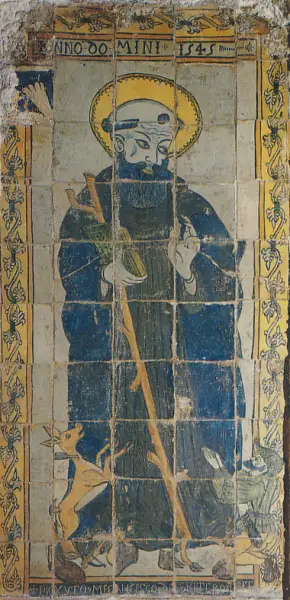
Calogerus the Anchorite, also called Calogerus of Sicily or Calogerus the Hermit, was a hermit-monk of the sixth century who became one of the most widely honoured saints of the island. Born around 466 at Chalcedon, he belongs by tradition to the company of easterners who fled North Africa when Arian persecution drove confessors of the Nicene faith from their homes: he escaped to Sicily in the company of Bishop Gregorius and Deacon Demetrius and worked in the area of Fragalata near Messina, where the three preached the Gospel and strengthened the Christians of the region. Calogerus is further held to have laboured as a missionary on Lipari among the Aeolian Islands before withdrawing to the solitary life for which he is named, settling in a grotto on Monte Kronio above Sciacca, where he died on 18 June in the year 561. The mountain is now called after him, as is another height near Palermo. Both the Orthodox and the Catholic churches keep his feast on 18 June. His cult is strongest at Agrigento, where he is honoured even above the city's official patron Gerland, and it extends through Porto Empedocle, Naro, Sciacca, Frazzanò, San Salvatore di Fitalia, Cesarò, Petralia Sottana and Campofranco. Icons show him as a bearded hermit of olive complexion in eastern hooded vestments.
The Complete Life
A Refugee from Arian Africa
Calogerus enters history as an exile. The tradition preserved by the Orthodox synaxaria groups him with Bishop Gregorius and Deacon Demetrius among those who lived toward the close of the fifth century and who were driven out of North Africa by adherents of the Arian heresy, the doctrine that denied the full divinity of the Son. The three confessors made their way across the sea and found refuge in Sicily, settling in the region of Fragalata near Messina. For a man born, as the traditional dates have it, around 466 at Chalcedon, the displacement would have been formative: the Mediterranean of his lifetime was a fractured Christian world, in which councils had defined the faith and kingdoms enforced versions of it, and ordinary believers found their lives reordered by arguments they had not chosen. Sicily itself, grain-rich and strategically placed, had changed hands among powers and would keep absorbing easterners for centuries to come; the island's Greek-speaking monastic culture, which survives in pockets to the present, owes much to precisely such arrivals. What the record gives of Calogerus's beginnings is spare — a birthplace, a date, a persecution, a flight — but the elements are consistent and they fit the age. The refugee who became one of Sicily's most beloved saints began as a man with reason to leave home.
§ Veneration
Gospel in Sicily and the Aeolian Islands
The work Calogerus and his companions undertook in exile was pastoral and missionary at once. Near Fragalata, close to Messina, the three men proclaimed the Christian faith and instructed believers in it — the Greek notices say expressly that they preached the Gospel and strengthened the Christians in the faith of Christ, phrases that suggest a community needing consolidation as much as conversion. Sicily's Christian population was long established by the late fifth century, but the disruption of migration and the pressure of doctrinal dispute left room for teachers who could organise and encourage. From the mainland Calogerus is also held to have carried the faith to Lipari, the principal of the Aeolian Islands, a volcanic archipelago whose population was small and whose position made it a natural stopping-point between Sicily and the mainland. Missionary work in such settings meant presence more than programme: a holy man arriving, living conspicuously, teaching those who gathered, and leaving behind a memory that hardened over generations into a cult. That is what happened on Lipari and, later, at Sciacca. The notice of his preaching is one sentence in the sources, but it explains everything else about him: the man who became Sicily's hermit began as Sicily's catechist, and the island's devotion to him grew from the seed of that first work among its people.
§ Veneration
The Grotto on Monte Kronio
Calogerus's last and most famous period was his retreat to Monte Kronio, the sulphurous height above Sciacca in western Sicily, where he lived as a hermit in a grotto and died on 18 June in 561, an old man of about ninety-five by the traditional reckoning. The anchorite's vocation he shared with the eastern monasticism of his origins: the flight to solitude, the cave dwelling, the long discipline of prayer alone. Sicily honoured such figures and kept their dwelling places; the grotto on the mountain preserved an icon of the saint dated 1545, a material witness to the continuity of his cult across a millennium. The mountain itself took his name, becoming in Sicilian Monte San Caluòru and in Italian Monte San Calogero, as did a second mountain near Palermo — an onomastic footprint that shows how deeply he entered the island's geography. The combination of holiness and hot springs at Sciacca gave the site a double attraction in popular religion, and the saint of the grotto became inseparable from the place. His death in peace, remembered on the day of its occurrence each year, closed a life that had moved across the entire Mediterranean: born at Chalcedon, driven from Africa, active at Messina and Lipari, and buried at last in the silence above the Sicilian coast.
§ Veneration
San Calogero of the Sicilians
The cult of San Calogero is among the most vigorous in Sicily, and its centre of gravity lies at Agrigento, where the sanctuary dedicated to him draws devotion exceeding even that paid to Gerland, the city's official patron saint. Around Agrigento the honour extends to Porto Empedocle and Naro, whose sanctuary is a notable monument of the cult, and beyond it to Sciacca, Frazzanò, San Salvatore di Fitalia, Cesarò, Petralia Sottana and Campofranco, several of which claim him formally as patron. He is commemorated on 18 June by the Orthodox Church, together with Gregorius and Demetrius, and on the same day by the Catholic Church, a rare symmetry that reflects his standing in both traditions. The name by which he is known is itself part of the legacy: Calogero derives from the Greek for monk, and the caloyers — Greek monks following the rule of Saint Basil — bear the same word, so that the saint's very name proclaims his monastic identity. In iconography he appears as a bearded hermit of olive complexion wearing eastern hooded vestments of Syriac type, a visual reminder that Sicily's beloved saint was an easterner by birth and a Basilian by vocation. His feast remains a day of procession and festivity in the towns that hold him dear.
§ Veneration
Timeline
- 466
Born at Chalcedon around this year
§ Introduction
- 18 Jun 561
Died as a hermit on Monte Kronio near Sciacca, aged about ninety-five
§ Introduction
The Record
- Patron of
- Naro, Campofranco, Petralia Sottana and San Salvatore di Fitalia in Sicily
- Symbols
- Bearded hermit of olive complexion·Eastern (Syriac) hooded vestments·Hermit's grotto on Monte Kronio
- Canonization
- Pre-congregation; venerated in the Catholic and Eastern Orthodox churches
Prayer
Bibliography
Show 1 sources
- "Τῇ αὐτῇ μέρᾳ, μνήμη τῶν ὁσίων πατέρων μῶν Γρηγορίου, Δημητρίου καί Καλογήρου, τῶν Ἀναχωρητῶν" [On this day, the commemoration of the Sainted Fathers Gregory, Demetrius, and Calogerus the Anchorites], Apostoliki Diakonia: Eorlogio, Church of Greece, retrieved 12 April 2017
Profile text adapted from the Wikipedia article, licensed CC BY-SA 4.0.
Pray with this saint every day
Save St. Calogerus the Anchorite to your favorites, read the full profile, and get feast-day reminders in the Saints app.
Get the Saints AppFree on the App Store for iPhone and iPad