
1550-1614·Feast July 14
St. Camillus de Lellis
Priest, Founder of the Camillians
Overview
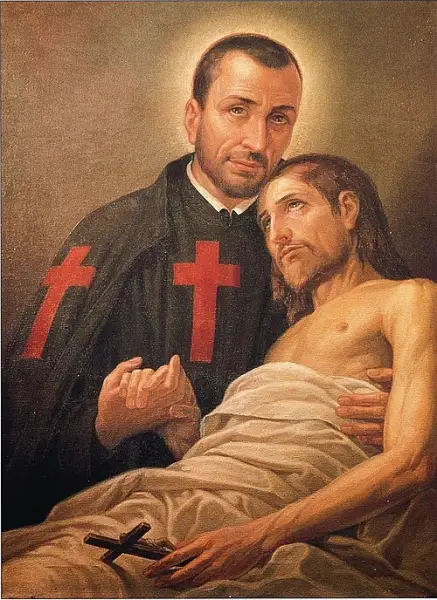
Camillus was born at Bucchianico in 1550 to a mother nearly sixty and a soldier father who was rarely home; orphaned young and ungovernable, he followed the armies of his father, contracted a leg wound that never healed, and by his mid-twenties had gambled away everything he owned. A stretch as a laborer at the Capuchin friary of Manfredonia brought the first crack of light: a friar's patient pleading led to a conversion in 1575, though the Capuchins rejected him for his incurable leg. Back in Rome he took work as a servant at San Giacomo degli Incurabili, rose to superintendent, and there saw how carelessly the sick of his age were treated. Under the direction of Philip Neri he studied for the priesthood, ordained at thirty-four in 1584, and gathered pious men around him to nurse patients with total devotion — eventually binding them by a fourth vow to serve the sick even at risk of their own lives. His brothers in the large red cross went onto plague ships, into famine and battlefields, and waited a quarter hour after death to be sure no one was buried alive. Pope Sixtus V approved the community in 1586 and Gregory XIV made it an order in 1591. Resigning as superior general in 1607, Camillus kept working until, dying in Rome in 1614, he had to crawl to the bedsides he could no longer walk to.
The Complete Life
Early Life
Camillus de Lellis first saw the light on 25 May 1550 at Bucchianico, a town of the Abruzzo then under the Kingdom of Naples; his mother was nearly sixty years old, and his father, a soldier, was seldom at home. Orphaned young and ungovernable, he followed the armies as his father had done, fighting with the Venetians against the Turks from 1566, and contracted a leg wound — a fist on the ankle — that never healed and would plague him for life. By his mid-twenties he had gambled away everything he owned, including, the story goes, the shirt off his back. It is one of the most unpromising beginnings of any saint's life in the calendar.
§ Early life
Conversion
A stretch as a laborer building the Capuchin friary at Manfredonia brought the first crack of light: a friar's patient pleading led to Camillus's conversion in 1575, though the Capuchins rejected him for the incurable leg that would keep him from their life. Back in Rome he took work as a servant at the hospital of San Giacomo degli Incurabili, the hospital of the incurables, and rose to superintendent. There he saw how carelessly the sick of his age were treated — by the hired hands who did the work no one else would — and the experience, joined to his own years as a patient, fixed the direction of his life. Under the direction of Philip Neri, his confessor, he studied for the priesthood, and was ordained at Pentecost 1584, aged thirty-four.
§ Early life
The Camillians
Camillus gathered pious men around him to nurse the sick with total devotion — first a few companions hired like himself, then a community, bound in 1591 by Gregory XIV into an order with a distinctive fourth vow: to serve the sick even at the danger of their own lives. His brothers, in a habit marked with a large red cross — the first such use of the red cross — went onto the plague ships forbidden to all others, into famine and battlefields; two of them died of plague nursing the crews of the galleys at Naples in 1588. Camillus's rules for the care of patients were a generation ahead of the practice of his time, insisting on cleanliness, gentleness, and the constant presence of the nurse; his brothers waited a quarter of an hour after apparent death, to be sure no one was buried alive. He resigned as superior general in 1607, and continued as a simple religious.
§ Expansion
Final Years and Death
Camillus's last years were a long illness: the leg wound, ulcers, and the failing strength of a body spent in the hospitals. He directed his order from his sickbed, and his brothers' care of him became the test of what he had taught them. He died in Rome on 14 July 1614, and was buried at the church of Santa Maria Maddalena, which Sixtus V had given his community and which remains the order's mother house. The crucifix from which, he said, came the words — why are you afraid; this is not your work but mine — became the order's emblem and motto.
§ Introduction
Canonization
Camillus was beatified by Pope Benedict XIV in 1742 and canonized by the same pope in 1746. In 1886 Leo XIII proclaimed him patron of hospitals and the sick, and Pius XI later named him co-patron of nurses with Saint John of God. His feast in the general calendar was 18 July from 1762 until 1969; he is now kept on 14 July, the day of his death. His assistance is also invoked against gambling — a patronage earned in his first thirty years.
§ Veneration
Legacy
Camillus de Lellis is, with John of God, the founder of the modern care of the sick. His order, the Ministers of the Infirm — the Camillians — still serve in hospitals on every continent; his red cross, worn on the habit, has been traced as an ancestor of the red cross emblem itself; and his fourth vow remains the most radical single sentence in the Church's care of the sick: to serve them even at the risk of one's life. For the medical professions he is the heavenly patron, and his biography — the gambler and soldier become the nurse of the dying — is the standing proof that sanctity can begin anywhere. In this corpus he stands beside Damien of Molokai in the Church's long answer to the plague and the hospital.
§ Founder
Timeline
- 25 May 1550
Born at Bucchianico, in the Kingdom of Naples, to a soldier father and a mother nearly sixty years old.
§ Early life
- 1562
His mother Camilla Compelli de Laureto dies, leaving the boy to grow up neglected among relatives.
§ Early life
- 1566
At sixteen he joins his father in the Venetian army and fights in the war against the Turks.
§ Early life
- 1575
His regiment is disbanded; after gambling away his possessions he undergoes a religious conversion at the Capuchin friary of Manfredonia.
§ Early life
- 1584
Ordained priest at Pentecost, aged thirty-four, by Thomas Goldwell, the last surviving Catholic bishop of Great Britain.
§ Early life
- 1585
His friends hire a large house in Rome where he gathers companions and teaches them the basics of nursing care.
§ Founder
- 1586
Pope Sixtus V gives his group formal recognition as a congregation and assigns them the Church of St. Mary Magdalene in Rome.
§ Founder
- 1588
Invited to Naples, he founds a new house with twelve companions; two brothers die of plague while nursing infected galleys.
§ Expansion
- 1591
Pope Gregory XIV elevates the community to an order equal to the mendicant orders; it adopts a fourth vow to serve the sick at the risk of life.
§ Expansion
- 1594
Leads his religious to Milan, where they care for the sick of the Ca' Granda, the city's main hospital.
§ Expansion
- 1601
At the Battle of Canizza their supply tent burns, but a red-cross habit survives, taken as divine approval of their emblem.
§ Expansion
- 1607
Resigns as Superior General of the Order, continuing to serve it as Vicar General.
§ Expansion
- 1613
Attends the Order's General Chapter, then tours its Italian hospitals with the newly elected Superior General, falling ill during the journey.
§ Expansion
- 14 Jul 1614
Dies in Rome and is entombed at the Church of St. Mary Magdalene.
§ Expansion
- 1742
Beatified in Rome by Pope Benedict XIV.
§ Veneration
- 1746
Canonized by Pope Benedict XIV four years after his beatification.
§ Veneration
- 1886
Pope Leo XIII names him heavenly patron of hospitals and of the sick everywhere.
§ Veneration
- 1930
Pope Pius XI names him co-patron, with Saint John of God, of nurses and nursing associations.
§ Veneration
In Their Own Words
Why are you afraid? Do you not realize that this is not your work but mine?
The Record
- Major works
- Founder of the Order of Clerks Regular, Ministers of the Infirm (Camillians, M.I.)
- Patron of
- The sick·Hospitals·Nurses·Physicians·Invoked against gambling
- Symbols
- Red cross on the habit·Crucifix
- Canonization
- Beatified by Pope Benedict XIV in 1742 and canonized by him in 1746; proclaimed patron of hospitals and the sick by Pope Leo XIII in 1886 and co-patron of nurses with St. John of God by Pope Pius XI in 1930
Prayer
Bibliography
Show 12 sources
- ↑ Martindale, C.C. (1946). Life of Saint Camillus . New York: Sheed and Ward. p. 4. {{ cite book }} : CS1 maint: date and year ( link )
- 1 2 3 4 Campbell, Thomas. "St. Camillus de Lellis." The Catholic Encyclopedia Vol. 3. New York: Robert Appleton Company, 1908. 5 May 2018
- 1 2 Sicari, Antonio. Ritratti de Santi , Jaca
- 1 2 3 "Saint Camillus de Lellis" . Franciscan Media . 2016-07-18. Archived from the original on 2020-07-20 . Retrieved 2020-07-06 .
- 1 2 "St. Camillus de Lellis" . olrl.org . Retrieved 2020-07-06 .
- 1 2 3 "St. Camillus de Lellis, Confessor", Butler, Alban. The Lives of the Saints 1866 This article incorporates text from this source, which is in the public domain .
- ↑ Website of the Camillian Fathers
- ↑ "The Community" . 2011-10-22. Archived from the original on 2011-10-22 . Retrieved 2020-07-06 .
- 1 2 McKeown, Jonah. "St. Camillus de Lellis: Patron saint of hospitals, nurses, and the sick", Catholic News Agency, April 18, 2020
- ↑ General Roman Calendar of 1960
- ↑ Husenbeth, Frederick Charles. Emblems of the Saints , Longman, Green, Longman, and Roberts, 1860 p. 32
- ↑ "About Us | The Centers at St. Camillus" . Retrieved 2019-02-10 .
Profile text adapted from the Wikipedia article, licensed CC BY-SA 4.0.
Pray with this saint every day
Save St. Camillus de Lellis to your favorites, read the full profile, and get feast-day reminders in the Saints app.
Get the Saints AppFree on the App Store for iPhone and iPad