
died early 4th century·Feast May 25
St. Canius
Bishop and martyr of Acerenza, patron of Calitri
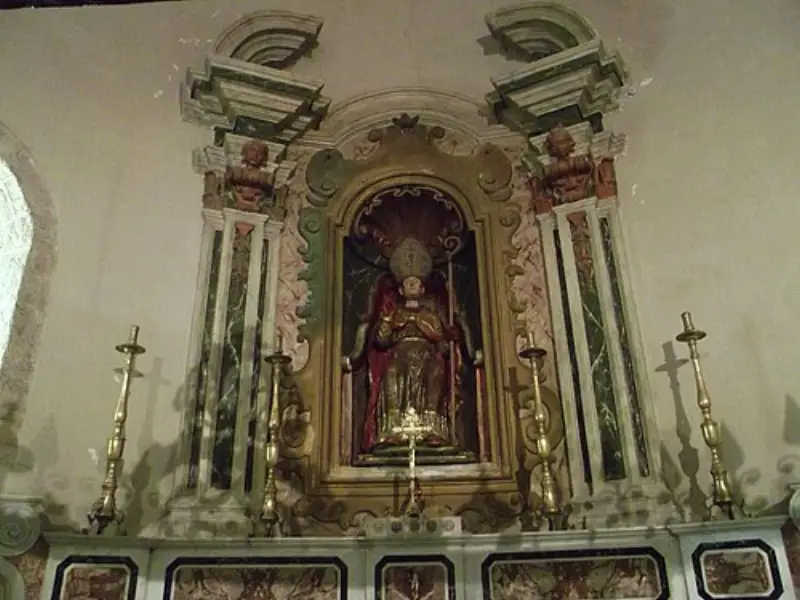
Overview
Canius, remembered in Italian as San Canio or San Canione, was a bishop of Acerenza who died a martyr during the Diocletianic Persecution. Tradition traces his origins to Iulia near Carthage, where he was born in the first half of the third century, possibly into the Roman gens Cania. The chief witness to his life is the Passio San Canionis, preserved in the cathedral of Acerenza. It relates that before the prefect Pigrasius he refused to offer worship to idols or acknowledge the divinity of the emperor, and for this defiance he was tortured and imprisoned. Even in chains he continued to proclaim the Gospel, winning converts among all who approached him. Ordered to be beheaded, he escaped when a storm and earthquake scattered the soldiers, fleeing by boat with some of the faithful to the Volturno. At Atella he preached and worked miracles, healing the sick, restoring sight to a blind woman, and freeing a boy from demonic possession. In old age he withdrew to a hermitage, where he died. Bishop Elpidius of Atella raised a shrine over his body, which was later translated to Acerenza, where his crozier is still venerated in the cathedral.
The Complete Life
From Carthage to the See of Acerenza
The origins of Canius lie on the southern shore of the Mediterranean. According to the Passio San Canionis, the principal account of his life, his birth fell at Iulia, beside Carthage, within the opening decades of the third century. Pious tradition adds that he may have descended from the ancient Roman gens Cania, a lineage that would explain the Latin form of his name. In time he crossed to Italy and was raised to the episcopate at Acerenza, a hill town in Lucania whose church he would sanctify forever by his blood. There he served as bishop when the great storm of the Diocletianic Persecution broke over the Church, the empire's final and most systematic attempt to destroy Christianity. His episcopal office placed him in the front line of that assault, for a bishop could not be forced to sacrifice without scandal to his flock. The witness he gave in that hour made him not only a martyr but the enduring patron and glory of his see, and the cathedral of Acerenza remains to this day the guardian of his memory and of the crozier that testifies to his pastoral office.
§ Life and persecution
Confession Before the Prefect
Summoned before the prefect Pigrasius, Canius declined alike to offer worship to idols and to grant that the emperor was divine, the two demands on which the persecution turned. The penalty was torture and imprisonment, his captors calculating that hunger and wounds would break his resolve. The calculation failed utterly. From his cell the bishop continued to preach the Gospel, and his words, joined to the sight of his long-suffering, brought to the Christian faith every person who came near him. When the prefect learned that his prisoner had grown only stronger, he commanded that Canius be beheaded. Before the sentence could be carried out, a fierce tempest, joined by an earthquake, dispersed the soldiers, and amid the turmoil the bishop fled by boat with some of the faithful, reaching the Volturno. In the territory of Atella, where the modern hamlet of Sant'Arpino now stands, he took up his preaching once more, and there his ministry was marked by wonders: in the amphitheatre a man in the grip of a heart attack was healed by the touch of his hand, a blind woman named Eugenia recovered her sight, and a boy possessed by a demon was set free.
§ Life and persecution
The Hermitage and the First Shrine
When age and illness overtook him, Canius did not end his days amid the crowds that had thronged his preaching. He withdrew instead to a hermitage, seeking solitude for his final years as so many confessors of the early Church had done, and there he died in peace, his martyr's confession crowned by a quiet end. Even in retreat his fame did not fade among the people he had served. The news of his death reached Bishop Elpidius of Atella not by ordinary report but, the tradition says, by a miraculous revelation. Moved by the disclosure, Elpidius went to the site and built a little shrine over the place where the saint's body lay, protecting it from neglect and desecration. That humble structure became the first keeper of the relics, and its memory endures in the Romitorio di San Canione at Sant'Arpino, an ancient structure still dedicated to the saint. Scholars believe the building was an oratory of the Atellan era and that it was precisely there, in that secluded spot, that Canius' body was preserved before its later translation to Acerenza, where his veneration would flourish for a thousand years and more.
§ Miracles
Veneration at Acerenza and Beyond
The cult of Canius took root at Acerenza, and around the year 800 Bishop Leone built a cathedral upon the ruins of an older shrine, moving the saint's body there from Atella. In 1080 the chronicler Lupo Protospata records that the relics were found anew, and the newly rebuilt cathedral and the whole diocese were solemnly placed under the martyr's protection. When Cardinal Saraceni made a pastoral visit in 1543, it was observed that the body could no longer be seen, for it rested beneath a large altar, hidden from the eyes of pilgrims but no less venerated for that. Within the ambulatory of today's cathedral, under the altar that bears his name, his crozier is kept, shown, and venerated as a relic and regarded as a testimony to the diocese's calling to the work of evangelization. His patronage embraces Calitri together with Acerenza and its archdiocese. At Sant'Arpino, in the province of Caserta, the parish of San Canione keeps his name alive beside the ancient Romitorio, while his feast is celebrated on May 25 throughout the region that claims him as its own.
§ Veneration
Timeline
- 800
Bishop Leone of Acerenza raised a new cathedral over the remains of an earlier shrine and moved the saint's body there from Atella.
§ Veneration
- 1080
The body of Canius was rediscovered, and the rebuilt cathedral and diocese of Acerenza were placed under his protection.
§ Veneration
- 1543
During a pastoral visit, Cardinal Saraceni recorded that the saint's body lay hidden beneath a large altar.
§ Veneration
The Record
- Patron of
- patron of Calitri·patron of Acerenza and its archdiocese
- Symbols
- bishop's crozier
- Canonization
- Pre-congregation martyr, venerated since antiquity in Southern Italy
Prayer
Bibliography
Show 5 sources
- Francesco Lanzoni, Le origini delle diocesi antiche d'Italia: studio critico, Volumi 35-36, Tip. Poliglotta Vaticana, 1923
- AA. VV., Raccolta Rassegna Storica dei Comuni, vol. 30, 2016
- Pina Belli D'Elia, Clara Gelao, La Cattedrale di Acerenza: mille anni di storia, Edizioni Osanna, 1999
- Santiebeati.it: life of San Canio (in Italian)
- Calitritradizioni.it: San Canio, venerated at Calitri (in Italian)
Profile text adapted from the Wikipedia article, licensed CC BY-SA 4.0.
Pray with this saint every day
Save St. Canius to your favorites, read the full profile, and get feast-day reminders in the Saints app.
Get the Saints AppFree on the App Store for iPhone and iPad