
died 6th century·Feast October 25
St. Canna
Welsh mother of saints and church foundress
Overview
Canna was a sixth-century figure of the early Welsh Church, remembered as a mother of saints who later embraced the religious life as a nun in south Wales. Two ancient Welsh churches bear her dedication. Later genealogical tradition, preserved in the writings of Iolo Morganwg, made her a daughter of King Tewdwr Mawr, whose realm was linked with Armorica, the modern Brittany, and with Cornwall, and the mother of two sons, Crallo and Elian, who were themselves honored as saints. She was reputedly both sister-in-law and cousin of the great Breton-born teacher Illtud, and her foundation at Llangan, near Llantwit, may have been chosen for its closeness to him. She married Sadwrn, described as her first cousin or uncle, and together they are said to have accompanied Saint Cadfan to Britain, founding a church in Carmarthenshire and another in Anglesey. Her memory endured long after her death: a healing well at her Carmarthenshire church drew pilgrims for centuries, an inscribed stone nearby is known as Canna's Chair, and two districts of Cardiff, Canton and Pontcanna, still carry her name in their Welsh forms. Her feast is kept on October 25.
The Complete Life
A Mother of Saints in Early Wales
Canna belongs to the generation of holy men and women who shaped the Christianity of sixth-century Wales. She is remembered first as a mother of saints: her sons Crallo and Elian were themselves venerated in the Welsh calendar. The chief source for her family connections is the body of tradition transmitted by Iolo Morganwg, a writer whose reconstructions are regarded as unreliable, so that the genealogy preserved there must be held with caution. According to that tradition, she was a daughter of King Tewdwr Mawr, whose rule was associated with Armorica, the Brittany of today, and with Cornwall, tying her to the noble houses on both sides of the Channel. Her vocation unfolded in two stages, in the pattern familiar from the lives of many Welsh saints: first her marriage and motherhood, and afterward the consecration of her life as a nun in south Wales. She counted as kinswoman too to Illtud — both sister-in-law and cousin in the old genealogies — the master of the great monastery at Llantwit Major, a kinship that placed her within the most influential spiritual circle of her age and shaped the geography of her own foundations.
§ Life
Founding Churches with Sadwrn and Cadfan
The mission of Canna was carried out in company. She married Sadwrn, described in the traditions as her first cousin or her uncle, and the two of them joined the company of Saint Cadfan, one of the founding figures of Brythonic monasticism, journeying with him to Britain. Together they are credited with the foundation of two churches, one in Carmarthenshire in the south and another in Anglesey off the northern coast, a span that testifies to the reach of their work across the Welsh land. Her own closest foundation was at Llangan, near Llantwit, a site whose name preserves hers in the classic Welsh pattern of a church dedicated to its founder. The choice of the location is traditionally explained by her kinship with Illtud, whose great school at Llantwit stood nearby, so that her community would have stood in living contact with the learning and discipline of his monastery. Through these foundations Canna's life joined the double threads of family and faith that characterized the age: churches planted by kinsfolk, sustained by monastic teachers, and remembered in the landscape ever after.
§ Life
Wells, Stones, and the Name of Cardiff
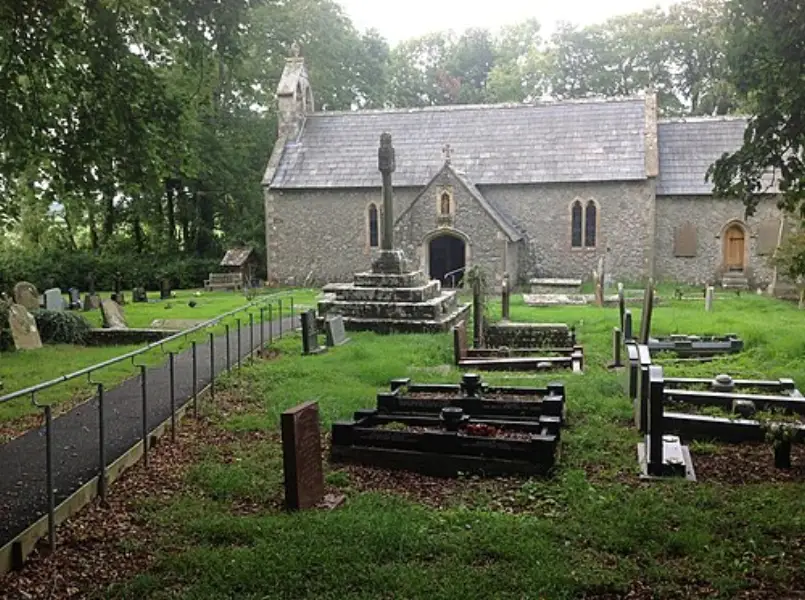
The memory of Canna remained alive in the landscape of Wales for a millennium and more. At St Canna's Church in Carmarthenshire, a holy well called Ffynnon Ganna lay below the old church, and its water was believed to possess curative power. For many centuries the sick came there on pilgrimage, seeking relief at the saint's spring; the well itself has since vanished, but the tradition of its healing bears witness to the depth of her local cult. In a field near the churchyard there stood also a stone known as Canna's Chair, bearing an undated inscription that may possibly read CANNA, a silent monument linking the ground to her name. Perhaps most remarkably, her name survives in the everyday speech of Wales's capital: the Cardiff district of Canton comes from the Welsh Treganna, Saint Canna's Town, while Pontcanna means Canna's Bridge. Two churches stand dedicated to her, at Llangan and in Carmarthenshire, and her feast day is observed on October 25, keeping alive the memory of the sixth-century nun whom the Welsh Church honors as a mother of saints.
§ Veneration
The Record
- Patron of
- patron of St Canna's Church, Llangan·patron of St Canna's Church, Carmarthenshire
- Canonization
- Pre-congregation saint of the early Welsh Church, honored by ancient church dedications
Prayer
Bibliography
Show 4 sources
- Price, Thomas (1848). Iolo Manuscripts: A Selection of Ancient Welsh Manuscripts, in Prose and Verse, from the Collection Made by the Late Edward Williams, Iolo Morganwg. W. Rees; sold by Longman and Company, London, pp. 534, 536.
- Archaeologia Cambrensis: a record of the antiquities of Wales and its Marches and the journal of the Cambrian Archaeological Association, Vol. 3 (4th ed.), Cambrian Archaeological Association, January 1872, pp. 235-239.
- "The Placenames of the Cardiff District", Reports and Transactions, Vol. 32-33, Cardiff Naturalists' Society, 1901, p. 39.
- Jones, David Daven (1910). The Cymry and their church. Carmarthen: W. Spurrell, pp. 114-115.
Profile text adapted from the Wikipedia article, licensed CC BY-SA 4.0.
Pray with this saint every day
Save St. Canna to your favorites, read the full profile, and get feast-day reminders in the Saints app.
Get the Saints AppFree on the App Store for iPhone and iPad